13-Inch, 24-Inch or 30-Inch: Which DTF Printer Width Will Actually Pay for Itself in 2026?
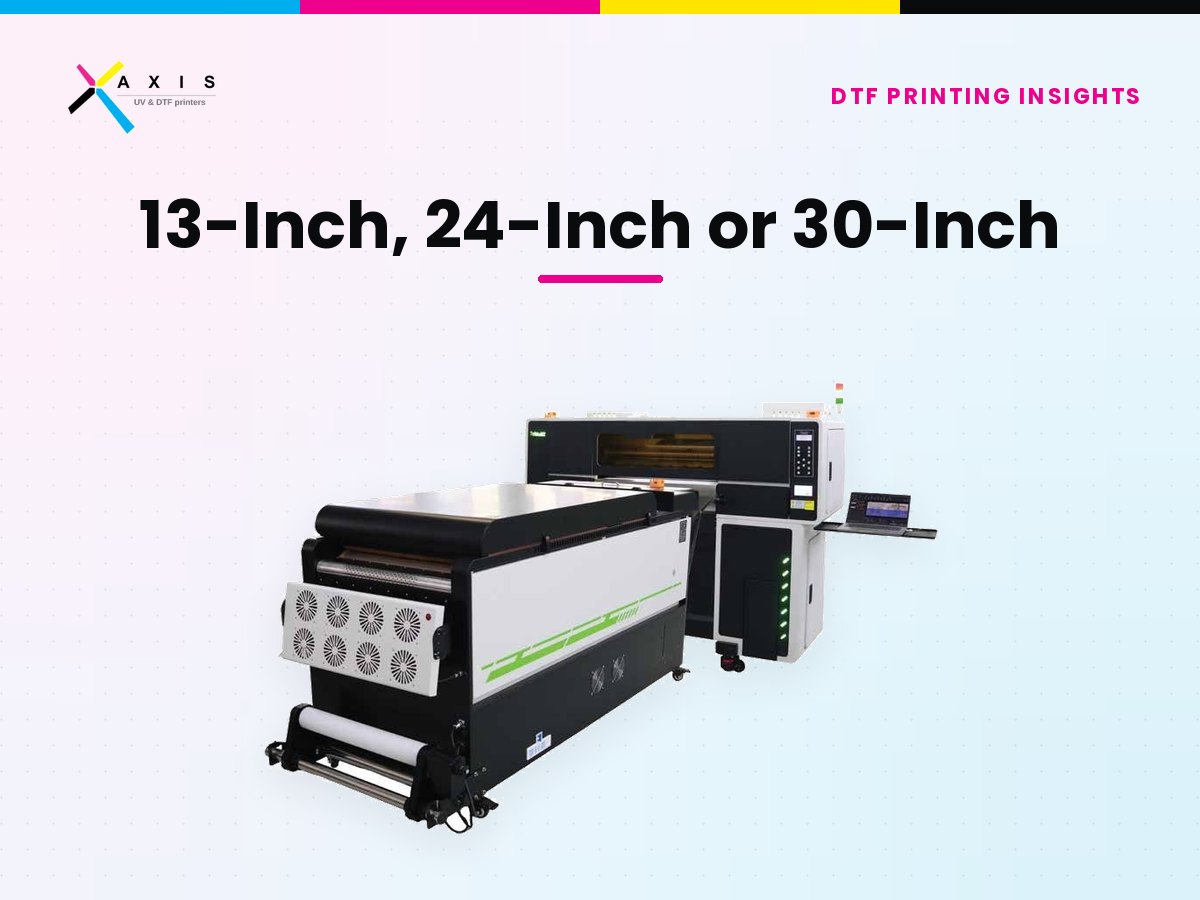
Quick answer: which DTF printer width should you buy?
Choose your DTF printer width by your realistic daily order volume, not by the widest machine on display. A 13-inch (A3) printer suits low-volume startups and testing, up to roughly 50 to 80 prints a day. A 24-inch printer fits growing shops running steady daily orders. A 30-inch printer is for high-volume production, bulk uniforms and reseller supply. Buy for the demand you can prove in the next 12 to 18 months, keep a small buffer for peak seasons, and prioritise dependable service and spare parts over headline speed. Width should follow your order book, not your ambition alone.
What is DTF printing, and why does print width matter so much?
Print width matters because it sets your ceiling on order size, batch efficiency and daily output. Direct-to-film (DTF) printing is a method where a design is printed onto a special film, coated with adhesive powder, cured, and then heat pressed onto fabric. The printer's width (commonly 13-inch, 24-inch or 30-inch) decides how many designs you can nest side by side on each film pass.
A wider machine prints more designs per pass, which lowers film waste and labour per print. A narrower machine costs less upfront but forces more passes for the same volume. The right width is the one that matches how many prints you will genuinely sell each day.
How fast is India's custom apparel market growing in 2026?
The demand curve is steep, which is exactly why sizing your machine correctly is now a strategic decision. According to Grand View Research (2025), the India print on demand market generated USD 857.9 million in 2025 and is expected to reach USD 5,419.0 million by 2033, a compound annual growth rate of 26.2%.
That is roughly a sixfold expansion in demand over eight years. A machine sized only for today's trickle of orders can become a bottleneck long before it is paid off. Sizing decisions made in 2026 will shape your capacity through the fastest growth years of this cycle.
What does choosing the wrong DTF printer width actually cost you?
The wrong width quietly taxes your margins every single day, in two opposite ways. Undersize the machine and you lose orders, work longer hours and press more film passes than needed. Oversize it and you sink capital into capacity that sits idle while the loan runs.
According to IMARC Group (2025), the India custom T-shirt printing market reached USD 176.6 million in 2025 and is projected to hit USD 407.9 million by 2034, growing at 9.75% a year. A shop that cannot absorb festival and school-season spikes hands those orders to a competitor.
The broader hardware market is steadier. According to Grand View Research (2024), the global direct to film printing market was USD 2,720.0 million in 2024 and is projected to reach USD 3,920.0 million by 2030 at a 6.0% CAGR. Hardware grows slowly while local demand grows fast, so the buyer's edge comes from matching capacity to orders, not from chasing the biggest machine.
13-inch vs 24-inch vs 30-inch DTF printers: which width fits which business?
In short: 13-inch for startups and testing, 24-inch for steady growing shops, and 30-inch for high-volume and bulk supply. The table below compares the three common widths against the factors that decide daily profit.
| :-: | :-: | :-: | :-: |
|---|---|---|---|
| Factor | 13-inch (A3) | 24-inch | 30-inch |
| Best suited for | Startups, home setups, sampling and testing demand | Growing shops with steady daily orders | High-volume production, bulk uniforms, reseller supply |
| Realistic daily output | Low (roughly 50 to 80 prints) | Medium to high | High, built for continuous runs |
| Designs nested per pass | Fewer | More | Most |
| Upfront investment | Lowest (entry-level, plus 18% GST) | Medium | Highest |
| Film waste per print | Higher | Lower | Lowest at full utilisation |
| Main risk | Becomes a bottleneck as orders grow | Needs consistent order flow to justify | Idle capacity if demand is not yet proven |
Notice that no single width wins on every row. The correct choice depends on the orders you can prove, your working capital, and how quickly you expect to scale.
Why are more Indian printers moving to wider DTF machines?
They are moving wider because DTF has become the dominant digital garment method and volumes are climbing. According to Textile Insights (2023 to 2033 forecast), India's digital textile printing market is set to grow at about 13% a year, direct-to-film already accounts for 45.6% of that market, and more than 1,000 digital fabric printing services now operate in the country.
Compared with older direct-to-garment workflows, DTF works on cotton, polyester and blends without pre-treatment, which widens the jobs a single machine can take. As a shop's job mix broadens, a wider film pays back faster.
"We expect to see continued major growth for the foreseeable future as volumes and demand continue to rise." Deepak Siddharth, CEO and Founder, RDX Digital, quoted by Keypoint Intelligence (2025).
That same report notes RDX Digital saw 200% growth in device sales, from 5 units in 2024 to 15 already in 2025. Rising equipment demand tends to follow rising order demand, which is the real signal behind the shift to wider machines.
How should a smart buyer decide on DTF printer width?
Decide with data from your own order book, then apply four criteria in order. Width is a capacity decision, so it should start from measured demand, not a showroom impression.
- Prove your realistic daily volume first. Record actual and expected daily orders, average design size and peak-season demand before comparing any machine.
- Size for verified demand plus a modest buffer. Buy for the next 12 to 18 months of provable orders, with headroom for festival and school spikes, not for a best-case fantasy.
- Judge true cost per sellable print. Include film, ink, powder, garment, labour, electricity, wastage and a maintenance reserve, not just the sticker price.
- Insist on a practical upgrade path. Extra heads, higher production modes or better shaker capacity should be possible without replacing the whole setup.
What should you look for in a DTF machine and supplier before you buy?
Look for a supplier who demonstrates real output, teaches you to run the machine, and stands behind it locally. The machine width only pays off if the equipment stays productive, so the supplier matters as much as the specification.
- Look for a supplier who runs a live demonstration on your fabrics and shows realistic sellable output, not only a maximum-speed claim.
- Look for dependable machinery with stable white-ink circulation and protected print heads built for Indian power and humidity conditions.
- Look for structured operator training so your business does not depend on a single technician.
- Look for transparent job costing guidance so you can price each order with a protected margin.
- Look for a written service-response commitment: response time, remote support, technician charges and spare-parts dispatch.
- Look for a local stock of consumables and critical spare parts so a small fault does not stop production for days.
Where does Axis Enterprises fit into this decision?
Everything above points to one practical need: a machine sized to your real orders, backed by training and responsive local support. That is exactly what Axis Enterprises is built to provide, with DTF printing machines, heat presses, inks, film and powder, plus installation, operator training and after-sales service for Indian garment businesses. Rather than pushing the widest machine, the approach is to match capacity to the orders you can prove and to keep that capacity running with dependable service and genuine spare parts.
Your low-risk next step
The fastest way to size your machine correctly is to see the real output before you commit any capital. You can book a free live DTF machine demonstration at axisdtf.com, bring your own fabrics and typical designs, and watch true sellable output on 13-inch, 24-inch and 30-inch options side by side. It costs nothing, it removes the guesswork, and it lets you plan your setup around dependable local support instead of a showroom speed claim.
Frequently asked questions
How many prints per day should I expect from a 13-inch, 24-inch or 30-inch DTF machine?
Realistic daily output depends on design size, ink coverage and your powder and curing workflow, not just the printer. A 13-inch machine typically handles a low volume suited to startups, while 24-inch and 30-inch machines handle progressively higher continuous runs. Always judge output on your own artwork during a live demonstration, because advertised maximum speeds ignore preparation, powdering, curing and finishing.
Should I choose machine capacity based on current orders or expected future growth?
Base it mostly on demand you can prove now, with a modest buffer for growth and seasonal peaks. India's print on demand market is forecast by Grand View Research to grow 26.2% a year to 2033, so some headroom is sensible. Buying far beyond proven demand, however, ties up working capital in idle capacity while your loan runs.
How can I verify a seller's advertised printing speed before purchasing?
Ask for a live demonstration using your own fabrics, designs and normal production settings, then time the full cycle. Measure sellable output including artwork setup, powdering, curing and pressing, not the printhead speed alone. A seller confident in the machine will welcome this test rather than avoid it.
Will a smaller DTF machine become a bottleneck during festival or school-order seasons?
It can, if your peak-season demand regularly exceeds its realistic daily output. Undersized machines force longer hours, more film passes and, in the worst case, refused orders that go to competitors. If seasonal spikes are a large share of your revenue, size up or plan capacity carefully before the season.
Is DTF printing better suited to Indian shops than direct-to-garment printing?
For many Indian shops, yes, because DTF prints on cotton, polyester and blends without pre-treatment, which broadens the jobs one machine can accept. Textile Insights reports direct-to-film already holds 45.6% of India's digital textile printing market. The best choice still depends on your fabric mix, volume and finish requirements.
Sources
- Grand View Research, India Print On Demand Market Size and Outlook (2025)
- IMARC Group, India Custom T-Shirt Printing Market (2025)
- Grand View Research, Direct To Film Printing Market Size Report (2024)
- Textile Insights, India's Digital Textile Printing Market to Grow 13% CAGR Between 2023 to 2033
- Keypoint Intelligence, Digital Printing Reshaping India's Apparel Market (2025)
Founder, Axis Enterprises. Selling and servicing digital printing machines across India since 2011. Author of "Increase Your Profit by 270% with UV Printing Technology". More about the author