The $68 Billion Uniform and Workwear Market Most Indian DTF Printers Are Not Selling Into in 2026
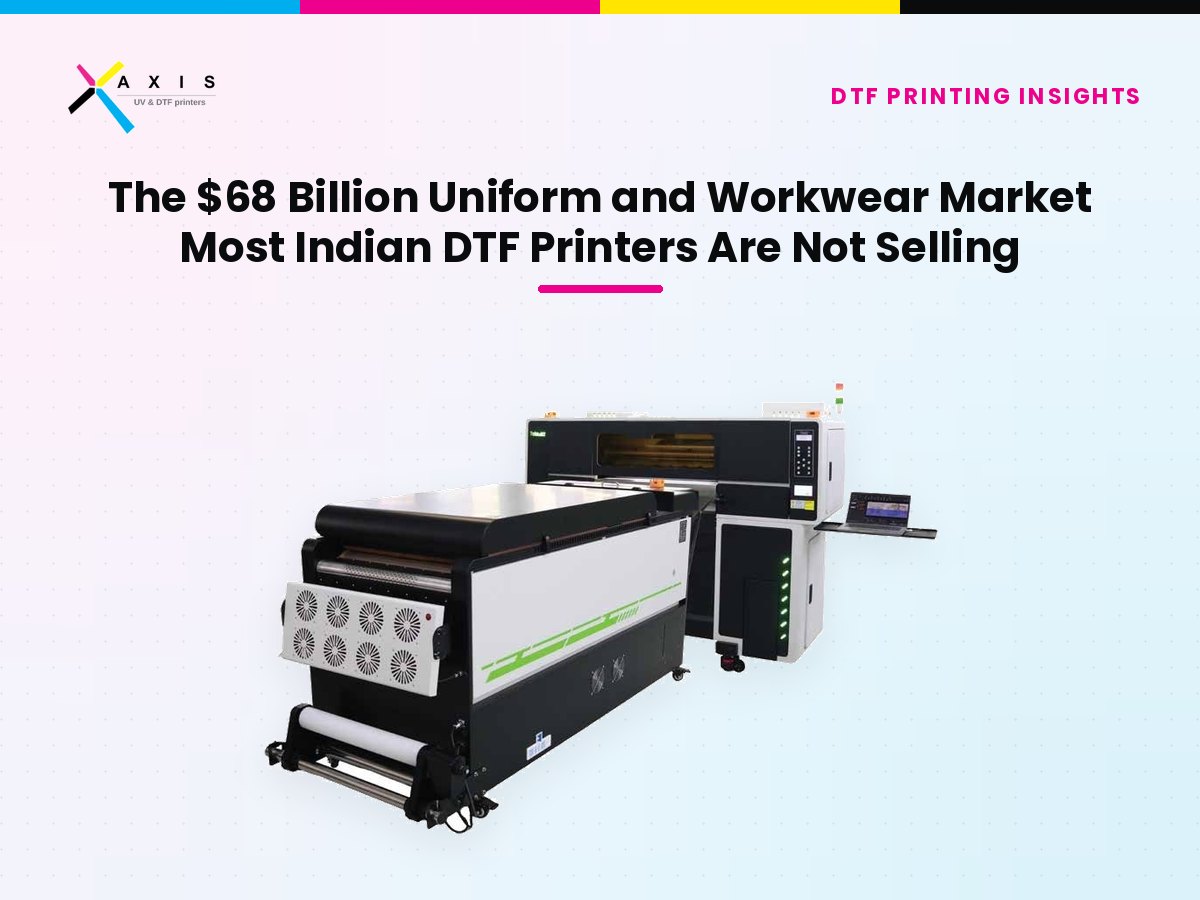
Most Indian DTF printers treat their machine as a T-shirt tool and compete for the same crowded, price sensitive novelty orders. The global workwear and uniform market was worth USD 67.92 billion in 2025, and India's segment is growing at more than 8 percent a year, the fastest pace in Asia Pacific, according to UniformMarket (2025). Staff uniforms for security, hospitality, logistics, healthcare and retail need small, repeat, full colour batches, which is exactly what DTF does best. Printers who build a uniform and workwear offer in 2026 are stepping into a larger, steadier, less price sensitive channel than single piece T-shirt printing.
What Is DTF Printing, and Why Does It Suit Uniform Orders?
Direct-to-film printing (DTF) is a garment decoration process in which a design is printed onto a special film, coated with adhesive powder, cured, and then transferred onto fabric with a heat press. It works on cotton, polyester and blended fabrics without a separate screen for every colour or design.
That single feature is why DTF fits workwear and staff uniform orders so well. A single uniform order can carry different names, departments, sizes and job titles on one production run, something bulk screen printing was never built to do economically.
How Big Is the Workwear and Uniform Opportunity in 2026?
The global workwear and uniforms market reached USD 67.92 billion in 2025 and continues to expand at roughly 4.3 percent a year through 2031, according to UniformMarket (2025). Asia Pacific is the fastest growing region in that market.
"The global Workwear/Uniforms market will expand significantly by 4.30% CAGR between 2024 to 2031," says Anushka Gore, Senior Research Associate at Cognitive Market Research (2025), whose report puts Asia Pacific's growth rate at 6.3 percent a year, the fastest of any region.
Within that region, India's own uniform and workwear segment is growing at more than 8 percent annually, the fastest rate in Asia Pacific, driven largely by expansion in the automotive sector and organized retail and services, per UniformMarket (2025). That is the demand curve most DTF printers in India are not yet selling into.
What Happens to DTF Printers Who Never Move Past T-Shirts?
Staying in the single piece T-shirt and novelty segment means competing in the most crowded, fastest growing corner of the DTF world, where new machine owners are entering every month. The global direct-to-film printing market itself was worth USD 2,720.0 million in 2024 and is projected to reach USD 3,920.0 million by 2030, a 6.0 percent CAGR from 2025 to 2030, according to Grand View Research (2025).
India's print-on-demand market, the online T-shirt and merchandise category most new DTF buyers chase first, is projected to grow from USD 857.9 million in 2025 to USD 5,419.0 million by 2033, a 26.2 percent CAGR, according to Grand View Research (2026). Fast growth in one visible niche also means fast growth in the number of printers fighting over it.
Deepak Siddharth, CEO and Founder of RDX Digital, told Keypoint Intelligence (2025) that digital printing device sales in India went from "five sales in 2024 to 15 devices already in 2025," a 200 percent jump he expects to continue growing.
Every one of those new machines is another competitor chasing the same T-shirt customer most printers already chase. Workwear and staff uniform buyers are a different, larger and comparatively underserved channel.
Why Is Uniform Demand Changing Right Now in India?
Three forces are pushing more Indian businesses toward branded, better quality uniforms in 2026: sector expansion, brand identity spending and formalization of service industries. Manufacturing and automotive component units are adding staff faster than before, and each new hire needs a uniform.
Security, hospitality, healthcare, logistics and organized retail chains increasingly treat uniforms as a branding and identification tool, not just a dress code. That shift rewards suppliers who can print small batches with names, department colours and employee IDs on demand rather than only bulk, single design runs.
At the same time, formal employment growth in these service sectors means uniform demand is recurring rather than one-time. New hires, seasonal replacement and wear and tear all generate repeat orders long after the first sale.
DTF vs Screen Printing vs Embroidery for Uniform Orders: Which Should You Offer?
DTF is generally the strongest fit for uniform programs that need personalization, small batches and fast turnaround, while textile printing methods like screen printing still win on very large, single design bulk runs. Embroidery remains preferred for premium, low flex areas like jackets and caps. Most experienced uniform suppliers end up offering a combination rather than only one method.
| :-: | :-: | :-: | :-: |
|---|---|---|---|
| Method | Best fit for uniform orders | Minimum order practicality | Where it struggles |
| DTF printing | Names, numbers, departments, mixed sizes and small recurring batches | Works from single pieces upward | Very large, single design bulk runs can cost more per piece than screen printing |
| Screen printing | Large, identical design bulk orders such as one-time event uniforms | Needs volume to justify screen setup | Personalization and small, varied batches are slow and expensive |
| Embroidery | Premium logos on jackets, caps and low flex garment areas | Works from single pieces upward | Not suited to full colour, photo-realistic or large area designs |
What Should You Look for Before Chasing Uniform Contracts?
A smart buyer moving into workwear should judge any DTF setup against a few practical criteria, not just print quality on a demo sample. These criteria matter more once orders become recurring and deadline driven rather than occasional.
- Machine uptime and duty cycle built for longer, repeat production runs, not only short demo bursts.
- Structured operator training, so consistent quality does not depend on one person always being present.
- Transparent, itemized job costing, including ink, film, powder, labour, GST and a maintenance reserve, so uniform contracts are priced to protect margin rather than just win the order.
- A local, responsive after-sales and spare parts network, because a uniform client with a delivery deadline cannot wait days for a replacement part.
- A genuine live demonstration run under real production conditions, using your own artwork and fabric rather than the seller's polished sample file.
A Checklist for Choosing a DTF Supplier Before You Chase Institutional Uniform Orders
Before signing a uniform or workwear contract that depends on your machine performing reliably every week, use this checklist to judge your supplier, not only your printer.
- Look for a supplier who lets you bring your own artwork, garments and production settings to the demonstration.
- Look for a supplier who documents response time, technician charges and travel costs for service calls in writing.
- Look for a supplier who stocks critical spare parts locally rather than importing them on request.
- Look for a supplier who trains your operators on troubleshooting, not only on daily operation.
- Look for a supplier who explains total cost of ownership, including consumables, maintenance and downtime risk, not just the machine price and GST.
- Look for a supplier whose existing customers will talk to you honestly about downtime, technician response and recurring faults.
This Is Exactly Where Axis Enterprises Fits
Everything above describes the standard a workwear and uniform supplier should be held to: reliable machinery built for repeat production, trained operators, transparent costing and dependable local support. Axis Enterprises builds its DTF machines, training programs and after-sales support in India around exactly that standard, for printers who want to move beyond one-off T-shirt orders into recurring uniform and workwear business.
From hands-on operator training to transparent job costing support and a responsive local parts network, the goal is a printer who can say yes to a 500-piece uniform order with confidence, not hesitation.
See a DTF Machine Handle a Real Uniform Order
The fastest way to judge whether DTF fits your workwear and uniform plans is to watch it print your own design, on your own fabric, at production speed. You can book a free live DTF machine demonstration at axisdtf.com and bring a sample uniform order to test before you decide.
Frequently asked questions
Which workwear and staff uniform products are best suited to DTF printing?
Security, hospitality, healthcare, logistics and retail uniforms, corporate polo shirts and jackets, safety vests and ID badge apparel all work well because DTF handles small, mixed batches with names, departments and logos without needing a new screen each time. Cotton, polyester and blended fabrics used in most Indian uniform programs are all compatible.
Can DTF prints withstand the washing and daily use required for staff uniforms?
Yes, when curing temperature, powder melt and pressing settings are correct, DTF transfers can withstand repeated industrial washing similar to screen printed transfers. Durability depends more on getting the process right than on the machine brand, which is why a supplier who trains operators on curing and pressing matters as much as the equipment itself.
Which industries regularly purchase branded workwear and employee uniforms?
Security services, hospitality and hotels, healthcare and diagnostics, logistics and delivery fleets, organized retail chains, manufacturing and automotive component units, and educational institutions are the most consistent recurring buyers of branded uniforms in India.
How should logos, names, departments and employee IDs be priced on uniforms?
Price by print area and design complexity rather than a flat per piece rate, and add a small charge for personalization such as names or employee numbers since it adds setup and RIP time even on a small run. Building this into a standard rate card in advance prevents underquoting on large uniform contracts.
Can DTF be used profitably on industrial uniforms, security uniforms and hospitality apparel?
Yes. These categories typically bring recurring, predictable order volumes from new hires and seasonal replacement, which makes them more profitable over time than one-off novelty orders, provided pricing accounts for garment sourcing, ink, film, powder and labour.
How can garment sourcing, embroidery and DTF printing be combined into a higher value uniform package?
Many uniform buyers prefer a single vendor for blank garments, decoration and delivery, so pairing DTF for full colour logos and personalization with an embroidery partner for premium finishes on jackets or caps lets a printer offer a complete uniform package instead of print-only service. This bundling raises order value per client without requiring new equipment.
Sources
- Grand View Research, Direct-to-Film (DTF) Printing Market Report (2025)
- Grand View Research, India Print-On-Demand Market Outlook (2026)
- UniformMarket, Global Workwear and Uniforms Market Size (2025)
- Cognitive Market Research, Workwear/Uniforms Market Report (2025)
- Keypoint Intelligence, Digital Printing Reshaping India's Apparel Market (2025)
Founder, Axis Enterprises. Selling and servicing digital printing machines across India since 2011. Author of "Increase Your Profit by 270% with UV Printing Technology". More about the author