Beyond T-Shirts: The DTF Product Lines Turning Indian Print Shops Profitable in 2026
By Sanjeev Budhiraja, Founder, Axis Enterprises
Quick answer: Direct-to-film (DTF) printing is a transfer method that prints a design onto a special film, coats it with adhesive powder, and heat-presses it onto fabric. Its real profit advantage is versatility: one machine decorates cotton, polyester, blends, nylon, canvas and more. Beyond T-shirts, Indian businesses use DTF for hoodies, sportswear, workwear and uniforms, tote bags, caps, corporate gifting, sports jerseys, kidswear and event merchandise. Because a single setup serves many products and customer segments, operators who diversify beyond apparel usually build steadier, higher-margin order books than those who print T-shirts alone.
What is DTF printing, and why is it more than a T-shirt machine?
DTF printing is a digital transfer process that prints a design onto film, bonds it with adhesive powder, and fuses it to fabric using heat and pressure, so it works across almost any material. That material flexibility is exactly why it is not just a T-shirt machine.
The technology has moved from niche to mainstream fast. According to Grand View Research (2024), the global direct-to-film printing market was valued at USD 2,720.0 million in 2024 and is projected to reach USD 3,920.0 million by 2030, a compound annual growth rate of 6.0%.
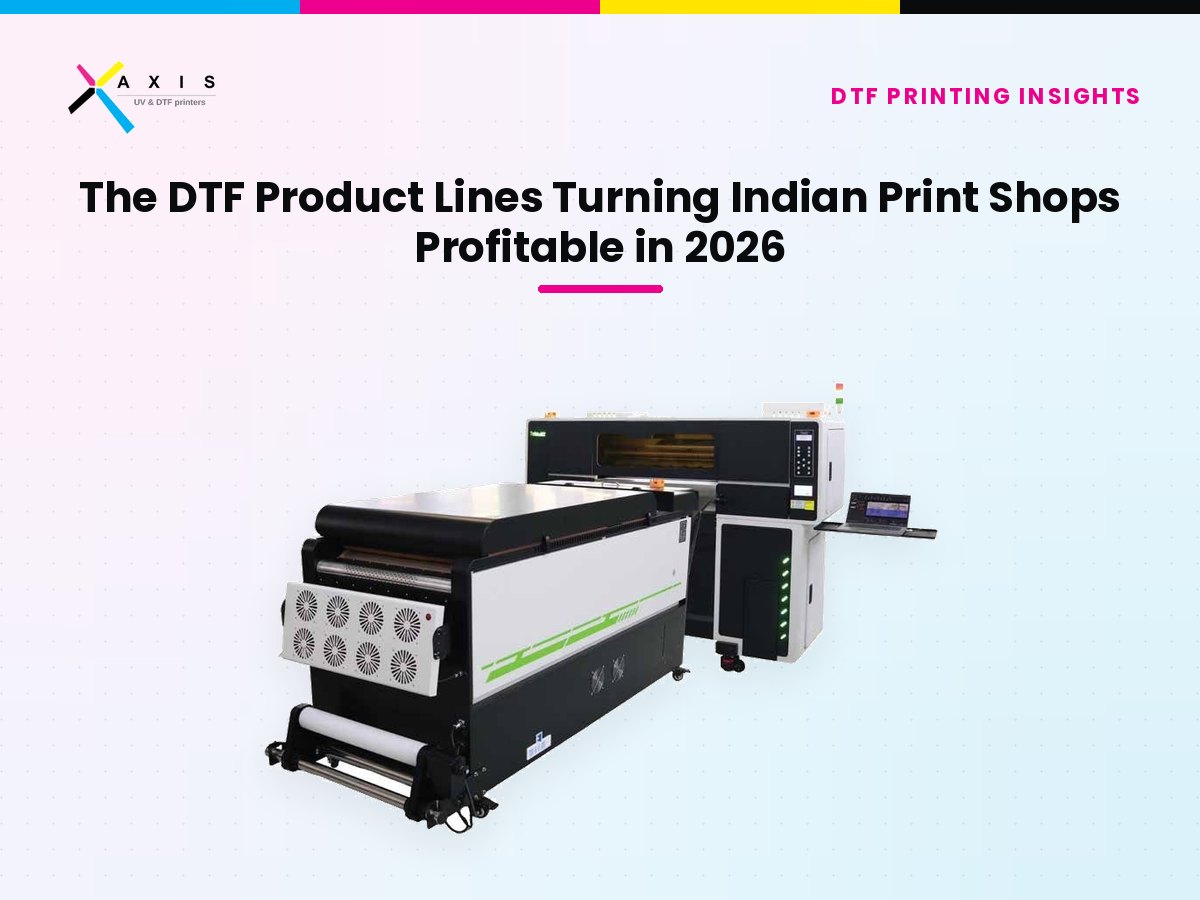
A DTF workflow pairs a film printer with a powder shaker and a heat press. Once you own that chain, switching from a T-shirt to a hoodie, a tote bag or a jersey is a change of substrate, not a change of equipment.
How fast is the custom apparel and print-on-demand market growing in 2026?
Demand for personalised apparel is expanding at double-digit rates in India, which widens the range of products worth printing. The growth is not confined to T-shirts.
IMARC Group (2025) reports that India's custom T-shirt printing market reached USD 176.6 million in 2025 and is set to reach USD 407.9 million by 2034, a growth rate of 9.75%. That single category is only the entry point.
Globally, Grand View Research (2026) projects the print-on-demand market to reach USD 57.49 billion by 2033 at a 23.6% CAGR, with apparel holding the largest revenue share at 39.5% in 2025. The remaining 60% sits in bags, drinkware, home decor and accessories, much of which DTF can decorate.
Closer to home, Grand View Research (2024) values India's textile printing market at USD 2,198.4 million in 2024, growing 9.9% a year to USD 3,844.0 million by 2030. A rising tide of orders rewards printers who can say yes to more product types.
Why do most new DTF owners still leave money on the table?
Most new owners treat DTF as a T-shirt printer and never test the higher-margin niches the same machine can serve. That single assumption caps their revenue while their equipment sits idle between apparel jobs.
The market is also getting busier, which makes product range a real differentiator. As Andy Gregory, Sales Director at Hybrid Services, told Images Magazine (2025), "At Hybrid, we expected DTF to continue embedding itself as a mainstream technology, but adoption has been quicker than anticipated."
Fast adoption means more shops chasing the same basic T-shirt order. In the same 2025 report, Jamie Turner, MD of 1ClickPrint, noted, "Our sales have more than doubled this year, with around a 50/50 split between customers buying their first machine and those binning their modified desktop printers in favour of something they can actually make money from." The lesson is clear: the money follows operators who put the machine to varied, deliberate use.
Which products and niches can DTF profitably print beyond T-shirts?
DTF profitably decorates any heat-tolerant fabric or fabric-backed surface, which opens at least eight product lines beyond the basic tee. The table below maps common products to the customers who buy them and why DTF suits each one.
| :-: | :-: | :-: | :-: |
|---|---|---|---|
| Product line | Typical buyer | Surface or fabric | Why DTF fits |
| Uniforms and workwear | Factories, hospitals, hotels, schools | Cotton, poly-cotton, hi-vis polyester | Durable, wash-resistant logos in bulk on mixed fabrics |
| Sports jerseys | Local clubs, gyms, tournaments | 100% polyester mesh | Prints names and numbers on stretchy synthetics that trouble other methods |
| Tote bags and pouches | Retailers, events, gifting | Canvas, jute, non-woven | One-off and small-batch personalisation with no screen setup |
| Caps and headwear | Promotional and corporate buyers | Structured cotton and poly caps | Small transfers cure fast and hold on curved surfaces |
| Corporate gifting | Offices, agencies, event managers | Apparel plus fabric accessories | Full-colour logos with no minimum-order penalty |
| Hoodies and sweatshirts | Colleges, brands, winter demand | Fleece, cotton blends | Soft-feel transfers survive repeated washing |
| Kidswear and merchandise | Schools, fan stores, events | Soft cotton, blends | Vibrant multi-colour art in short runs |
| Athleisure and activewear | Fitness brands, studios | Nylon and spandex blends | Flexible prints that move with stretch fabric |
Each line targets a different buyer and a different season, so a shop that runs several smooths out the gaps between apparel orders.
How should a smart buyer choose a DTF setup for varied applications?
Choose a setup by how many product types and fabrics it can handle reliably, not by headline print-speed claims alone. A machine bought only for T-shirts often struggles the moment you take a jersey or a canvas bag order.
Weigh these criteria before you buy:
- Fabric range: confirm the ink, film and powder combination cures well on polyester, blends and nylon, not just cotton.
- Consistent white ink: stable white circulation is what keeps colour bright on dark jerseys and hoodies across a long run.
- Transparent job costing: insist on a clear cost per print for film, ink and powder so you can quote uniforms and gifting profitably.
- Training that covers applications: operator training should cover multiple products and fabrics, not a single demo T-shirt.
- Local service and spares: fast access to spare parts and support protects the deadlines that gifting and event work depend on.
What should you look for in a DTF machine supplier?
Look for a supplier who sells outcomes and uptime, not only hardware. The right partner reduces your risk on every one of the product lines above. Use this checklist:
- Look for a supplier who runs a live demonstration on several fabrics, so you see quality on polyester and canvas, not just a cotton tee.
- Look for a supplier who explains cost per print and payback in plain numbers, including GST on machinery and consumables.
- Look for a supplier who provides hands-on operator training your staff can repeat.
- Look for a supplier who stocks genuine ink, film and powder and can deliver them reliably.
- Look for a supplier who offers responsive local maintenance and spare parts, measured in days, not weeks.
- Look for a supplier who supports your growth into new applications rather than disappearing after the sale.
Turning DTF versatility into a dependable business
Everything above points to the same conclusion: the profit is in range, reliability and support, not in a single product. That is precisely how Axis Enterprises supplies DTF printing machines and heat presses to garment businesses across India. The focus is dependable machinery, practical operator training and transparent job costing, backed by responsive local after-sales service and genuine spare parts so your machine keeps earning across every fabric and season.
If you are weighing your first DTF machine or expanding beyond T-shirts, the low-risk next step is to see it work on your own products. You can book a free live DTF machine demonstration and watch prints run on cotton, polyester and blends before you commit a single rupee. Bring your toughest sample fabric, ask about cost per print, and talk to the Axis Enterprises support team about training and long-term maintenance.
Frequently asked questions
Can one DTF machine really print on both cotton and polyester?
Yes. DTF transfers bond to cotton, polyester, blends, nylon and many fabric-backed surfaces because adhesion comes from the powder and heat, not the fabric fibre. This is the core reason DTF outperforms methods tied to a single material.
Is DTF only worth it for high-volume T-shirt orders?
No. DTF has no screen setup, so short runs and one-off personalisation stay profitable. Uniforms, gifting and event merchandise in small batches are often higher margin than bulk plain tees.
What products give the best margins beyond T-shirts?
Uniforms, sports jerseys, corporate gifting and hoodies typically carry stronger margins because buyers value durability and branding over lowest price. Serving several of these lines steadies your monthly income.
Do I need different equipment for jerseys, bags and caps?
Usually not. The same film printer, powder shaker and heat press handle most products; you mainly adjust temperature, pressure and time per surface. Correct training on those settings matters more than extra machines.
How do I calculate whether adding a product line is profitable?
Work out your cost per print for film, ink and powder, add labour and a share of machine and rent cost, then compare against the price the buyer will pay including GST. A supplier who shares transparent per-print costs makes this quick.
Sources
- Grand View Research, Direct To Film Printing Market Report (2024)
- IMARC Group, India Custom T-Shirt Printing Market (2025)
- Grand View Research, Print On Demand Market press release (2026)
- Grand View Research, India Textile Printing Market Outlook (2024)
- Images Magazine, State of the DTF Market Report (2025)
Founder, Axis Enterprises. Selling and servicing digital printing machines across India since 2011. Author of "Increase Your Profit by 270% with UV Printing Technology". More about the author