How to Build Repeat DTF Orders from Schools and Uniform Dealers in India (2026 Playbook)
India runs one of the largest uniform economies on earth. According to the Economic Survey 2024-25 (Government of India, citing UDISE+ 2023-24), the school system alone serves 24.8 crore students across 14.72 lakh schools. Every one of those students wears a garment that carries a name, a crest or a class marking, and most replace it more than once a year.
That is not a one-time market. It is a reorder that arrives on a calendar. For a custom-apparel printer, the buyers who own that calendar, schools and uniform dealers, are the closest thing the trade has to predictable income.
Quick answer: how do you build repeat DTF orders from schools and uniform dealers?
Build a fixed, reusable print offer (crests, house names, section badges and roll numbers) that the same buyer reorders every term or season. Direct-to-film printing suits this because one approved artwork file can be reproduced on cotton, polyester and blended uniforms without new screens each time. Agree a simple per-garment rate card, keep the artwork on file, and tie delivery windows to the school or corporate calendar. The result is an order that returns on a schedule instead of a single sale. Dependable machinery, transparent per-print costing and fast local service decide whether those repeat orders stay profitable across every reorder.
What is a repeat-order DTF offer, and why do uniforms suit it?
A repeat-order DTF offer is a standardised, reusable print package that one institutional buyer orders again and again on a predictable cycle. The artwork is fixed, the price is agreed once, and only the quantities change.
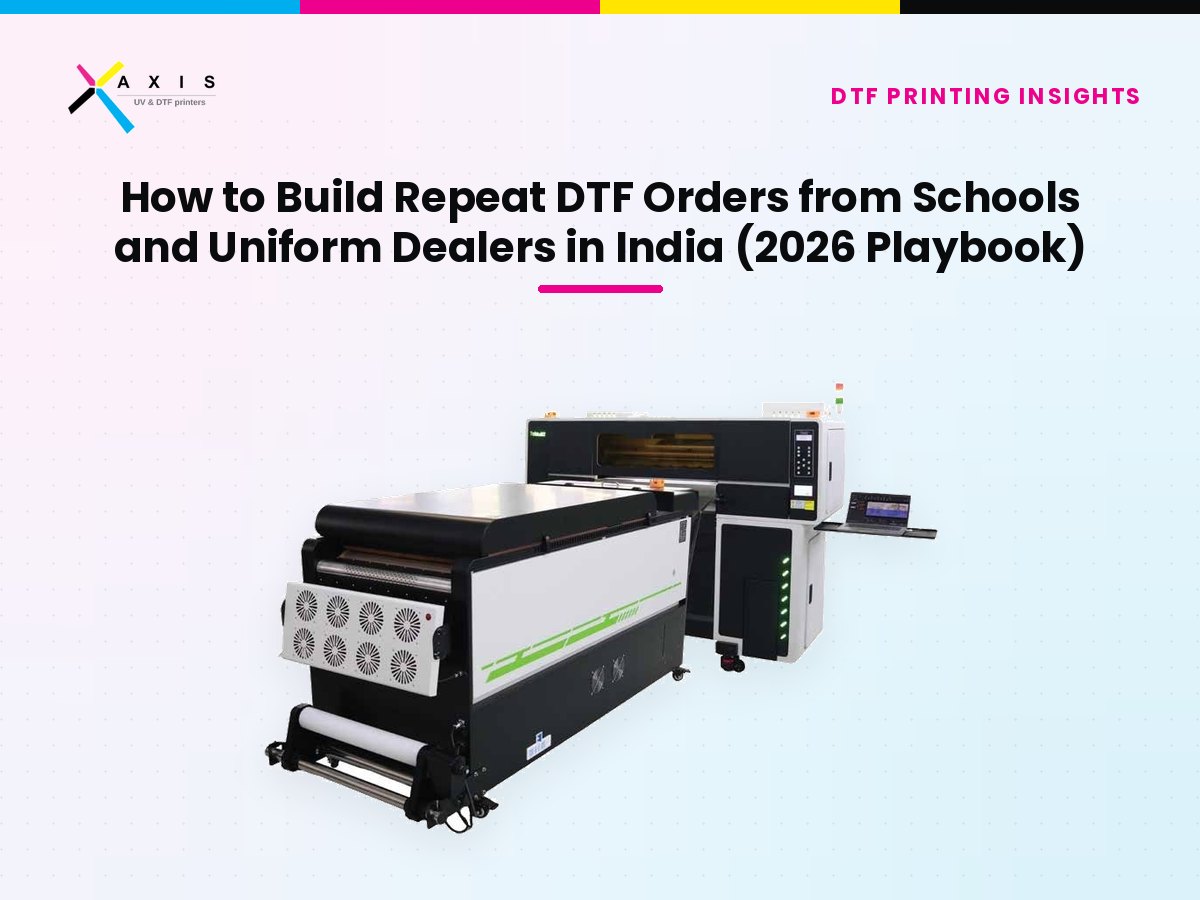
Direct-to-film printing (DTF) is a process where a design is printed onto a coated film, bonded with adhesive powder, then transferred onto fabric with a heat press. Unlike screen printing, it needs no separate screen or stencil per design, so a school crest stored as one file can be reprinted on demand.
Uniforms fit this model almost perfectly. The design rarely changes between terms, the fabric mix is known, and the same dealer or school returns for more. That combination, stable artwork plus recurring demand, is what turns a print shop from order-chasing into order-fulfilling.
Why do most DTF print shops struggle with unpredictable income?
Most small print shops struggle because they sell one-off jobs to strangers instead of repeat jobs to institutions. Each new order restarts the cycle of quoting, designing and chasing, and the pipeline empties the moment a promotion ends.
The wider market is growing, which masks the problem. The India custom T-shirt printing market reached USD 176.6 million in 2025 and is projected to grow at a 9.75% CAGR to USD 407.9 million by 2034, according to IMARC Group. Rising demand pulls in more printers, and price competition on random retail jobs gets harder every season.
Institutional buyers behave differently. They do not haggle over a single T-shirt; they place a bulk order, then place it again. The printers who capture those buyers stop competing on price and start compounding on repeat volume.
What is changing in India's uniform and apparel market in 2026?
The uniform sector is large, recurring and modernising, which is exactly why it rewards printers who can serve it reliably. Industry analysis published by Apparel Resources estimates India's uniform market at roughly Rs. 44,000 crore per year, with about 11 crore Indians wearing a uniform across schools, corporates, healthcare, security and government.
Demand for personalisation is rising alongside it. The global direct-to-film printing market was valued at USD 2.72 billion in 2024 and is forecast to reach USD 3.92 billion by 2030, with Grand View Research (2025) noting India's textile and apparel market is projected to grow near 10% annually toward USD 350 billion by 2030. More branded, named and sectioned garments mean more recurring print work.
Industry voices see the same shift. Phil McMullin, Head of Sales Commercial and Industrial at Epson UK, told Texintel:
"Print is not dead; it's alive and evolving in various directions. The personalization wave that started during COVID is still going strong, and it offers a massive profit opportunity."
For a DTF printer, schools and uniform dealers are where that personalisation demand is most regular and least seasonal.
Why do schools and uniform dealers generate repeat orders?
They generate repeat orders because their demand is tied to a fixed calendar and a stable design, not to a passing trend. A school reorders house shirts every intake and every replacement cycle; a dealer supplying several institutions reorders continuously.
Compare the two kinds of work a print shop can take on:
| :-: | :-: | :-: |
|---|---|---|
| Factor | One-off retail order | Institutional repeat order (schools and uniform dealers) |
| Reorder pattern | Rare and unpredictable | Recurring on a known calendar |
| Artwork | New design every time | One approved file reused for years |
| Order size | Small, single pieces | Bulk batches per section or class |
| Cash flow | Lumpy, promotion-driven | Steadier, planned around terms |
| Price pressure | High, buyer compares every shop | Lower once you are the trusted supplier |
This is the structural advantage. Once your artwork and rate card are on file with a dealer, the switching cost of moving to another printer is real, and your orders repeat with far less selling effort.
How should you evaluate the equipment behind a repeat-order offer?
Judge the equipment on whether it can produce the same result, at the same cost, on every reorder for years. A repeat contract is only profitable if quality and cost stay constant across hundreds of runs.
A smart buyer of a textile printing setup for institutional work should weigh these criteria:
- Consistency across batches: the crest printed in April must match the crest printed in November, or the dealer complains.
- Fabric versatility: uniforms mix cotton, polyester and blends, so the machine must hold colour and adhesion across all of them.
- Predictable cost per print: if you cannot cost one garment accurately, you cannot quote a rate card that survives a year of reorders.
- Uptime and fast service: a machine down during an intake week can cost you the contract, so local support and spare parts matter more than headline speed.
- Trained operators: repeat quality depends on people who run the same job the same way every time.
What should you look for in a DTF machine supplier before chasing uniform contracts?
Look for a supplier who sells you reliability and support, not just a machine, because a uniform contract is a multi-year commitment. The purchase decision should be judged on the reorder years, not the first invoice.
Before you sign a contract that depends on your equipment, look for a supplier who:
- Runs a live demonstration on your own uniform fabrics, so you see real output before buying.
- Provides hands-on operator training so your team can hold quality without the seller present.
- Quotes transparent consumable costs (ink, film and powder) so your per-print costing is honest.
- Keeps genuine spare parts in India and responds quickly when a machine stops.
- Offers installation and after-sales maintenance, not just delivery to your door.
- Understands GST invoicing and can support you as a formal supplier to schools and dealers.
Where does this leave you as a printer ready to grow?
Everything above points to one requirement: dependable production backed by real local support. That is exactly what Axis Enterprises is built to provide, supplying DTF printing machines, heat presses and consumables together with installation, operator training and after-sales service for garment businesses across India.
If your plan is to win schools and uniform dealers and keep them reordering, the machine behind that plan has to stay consistent and stay running. Axis Enterprises pairs production-ready DTF machinery with the training and spare-parts support that make repeat contracts profitable rather than risky.
The lowest-friction way to judge any of this is to watch it work on your own fabric. You can book a free live DTF machine demonstration and bring a sample uniform, a crest and a house name, then see the exact print your future customers would receive. There is no better test of a repeat-order plan than seeing the reorder-quality print in front of you, so arrange your demonstration with Axis Enterprises before you commit to a supplier.
Frequently asked questions
Is DTF printing suitable for school and uniform fabrics?
Yes. DTF transfers bond to cotton, polyester and blended fabrics, which covers most school and institutional uniforms. Because one printed film can be applied across different fabric types, a single crest design works across an entire uniform range without changing the process.
How is a repeat-order uniform offer different from normal T-shirt printing?
A repeat-order offer fixes the artwork and price once, then the same buyer reorders on a calendar. Normal retail T-shirt work restarts with new designs and new customers each time, so it takes far more selling effort for less predictable income.
What makes institutional orders more profitable over time?
The artwork is reused for years, the buyer returns without fresh marketing, and price pressure drops once you are the trusted supplier. Costs per print fall as your operators repeat the same job, so margins improve across reorders even at steady prices.
Do I need trained operators to hold quality across reorders?
Yes. Repeat contracts depend on the November crest matching the April crest. Trained operators who run the same settings the same way are the main reason quality stays constant, which is why operator training should be part of your equipment purchase.
How do GST and formal invoicing affect selling to schools?
Schools and dealers usually require proper GST invoices from a registered supplier. Setting up correct GST registration and invoicing early makes you eligible for institutional contracts and removes a common reason buyers reject small printers.
Sources
- Press Information Bureau, Government of India, Economic Survey 2024-25 (UDISE+ 2023-24 school education data)
- Apparel Resources, "The Uniform Code: A Sector Poised For Growth"
- IMARC Group, India Custom T-Shirt Printing Market Report
- Grand View Research, Direct To Film Printing Market Size Report (2025)
- Texintel, "The Impact of Direct to Film Printing for Sportswear and Product Personalisation" (Phil McMullin, Epson UK)
Founder, Axis Enterprises. Selling and servicing digital printing machines across India since 2011. Author of "Increase Your Profit by 270% with UV Printing Technology". More about the author