The Business Systems to Set Up Before Your First DTF Printing Order in 2026
By Sanjeev Budhiraja, Founder, Axis Enterprises
Quick answer: Before your first order, a new DTF printing business needs six working systems: a job-costing method that includes ink, film, powder, labour, electricity, wastage and 18% GST; a simple order and artwork intake process; a daily and weekly machine maintenance routine; a consumables reorder trigger; a cash-flow and working-capital plan separate from the machine purchase; and a supplier relationship for fast service and spare parts. Demand for custom apparel in India is strong, so most new printers do not fail for lack of orders. They fail because these back-office systems were never built, and the business runs out of cash or reliable output within the first year.
Is a growing market enough to make a new DTF printing business succeed?
No. A growing market removes the demand excuse, but it does not build the business for you. The numbers show the opportunity is real and expanding.
According to Grand View Research, India's print-on-demand market generated USD 857.9 million in revenue in 2025 and is expected to reach USD 5,419.0 million by 2033, a compound annual growth rate of 26.2% from 2026 to 2033. In the custom apparel segment, IMARC Group (2025) valued India's custom T-shirt printing market at USD 176.6 million in 2025, projecting USD 407.9 million by 2034 at a 9.75% CAGR.
Demand is clearly rising. The risk sits somewhere else, in how the business is run day to day.
What is a business system, and what is DTF printing?
A business system is a documented, repeatable way of handling one recurring task so the result does not depend on memory or mood. Pricing, order intake, maintenance and reordering are each a system.
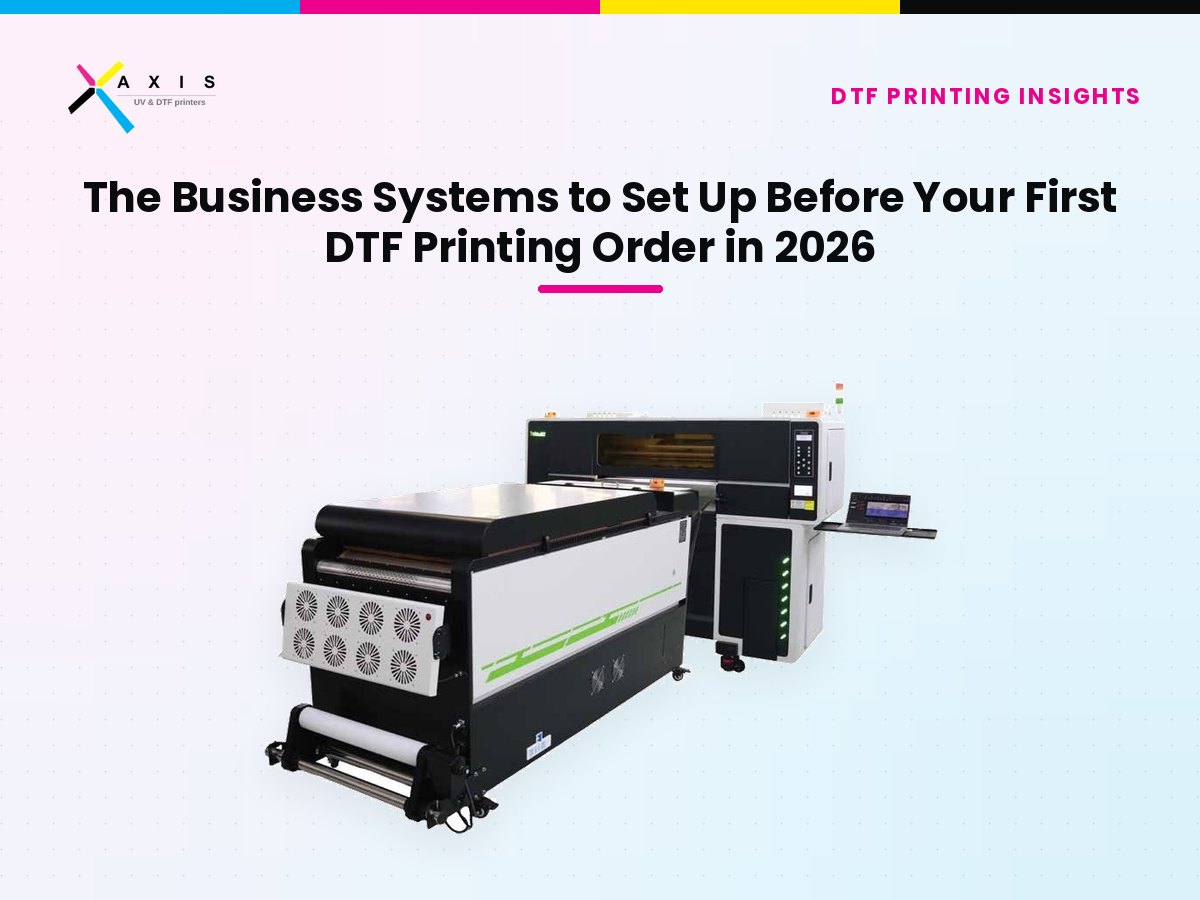
Direct-to-film printing (DTF) is a process of printing a design onto a special film, coating it with adhesive powder, curing it, and transferring it onto fabric with a heat press. It is one of the fastest-growing forms of print on demand because it prints on cotton, polyester and blends without a minimum order quantity.
The machine produces the print. The systems around it decide whether the print is profitable, on time and repeatable.
What actually causes new printing businesses to fail?
Cash and operations, not weak demand. Most closures trace back to money running out and processes that were never systemised.
Nearly half of all new businesses fail within their first five years, according to the U.S. Bureau of Labor Statistics. Looking at why, CB Insights, in a 2026 analysis of 431 startups that shut down from 2023 onward, found that 70% ran out of capital and 43% failed on poor product-market fit.
Running out of capital is usually the final event, not the root cause. The root cause is spending the whole budget on the machine and leaving nothing to run the business.
"Never take your eyes off the cash flow because it's the lifeblood of business." Sir Richard Branson, founder of the Virgin Group (source).
What is changing for DTF printing businesses in 2026?
The technology is maturing and competition is shifting from who owns a machine to who runs it well. Equipment access is no longer the moat.
Grand View Research (2024) estimated the global direct-to-film printing market at USD 2,720.0 million in 2024, projected to reach USD 3,920.0 million by 2030 at a 6.0% CAGR. As machines become common, price competition rises, and the printers who keep healthy margins are the ones with tight costing, low wastage and steady uptime.
That is why the smart question in 2026 is not only "which machine" but "which systems", supported by dependable machinery and local service.
How should a new printer decide what to set up first?
Think in systems, not equipment. A machine is a one-time purchase; the systems around it run every single day and decide your profit.
"Systems run the business and people run the systems." Michael E. Gerber, author of The E-Myth Revisited (source).
A useful buying framework rests on four criteria that protect a new printer through the first year:
- Dependable output: the machinery must run reliably every day, because downtime during your first orders destroys trust and cash flow.
- Operator capability: you or your staff must be trained to run and maintain the machine, not dependent on one absent technician.
- Transparent costing: you must know the true cost of every print, including consumables, labour, electricity, wastage and GST, before you quote.
- Local support: fast service response and access to genuine spare parts keep a small business alive when something goes wrong.
What business systems should you set up before your first DTF order?
Set up six systems before you accept a single order. Each one prevents a specific, common cause of early failure, and none of them requires more money than the machine already costs.
The table below maps each system to the pain it removes and what skipping it typically costs a new printer.
| :-: | :-: | :-: |
|---|---|---|
| Business system to set up first | What it prevents | Cost of skipping it |
| Job-costing sheet (ink, film, powder, garment, labour, electricity, wastage, 18% GST) | Underquoting and invisible losses | Quoting Rs. 90 for a print that truly costs Rs. 110, losing money on every order |
| Order and artwork intake process | Wrong sizes, colours and reprints | Reprints, wasted film and powder, missed deadlines |
| Daily and weekly maintenance routine | Clogged heads and white-ink settling | Downtime and print-head damage that can cost tens of thousands of rupees |
| Consumables reorder trigger | Running out of film, ink or powder mid-order | Stopped production and unhappy first customers |
| Working-capital plan (separate from machine cost) | Cash running out before orders repeat | A profitable-on-paper business that still cannot pay its bills |
| Supplier and spare-parts relationship | Being stranded after a breakdown | Days or weeks of lost revenue waiting for service or parts |
Notice how much of this points back to working capital and reliable support, not to the machine's top speed. When you shop, look for a supplier who does more than sell hardware: one who installs the machine, trains your operators, shares real job-costing numbers, and commits to service response times and spare-part availability in writing.
Where does this leave a first-time DTF printer?
You do not need a bigger machine; you need a supplier who helps you build the business around it. That is exactly how Axis Enterprises works with new printers in India.
Axis Enterprises supplies DTF printing machines, heat presses and consumables, and pairs them with installation, practical operator training and setup guidance, transparent job costing, and responsive local service and genuine spare parts. The goal is not just to sell you a printer, but to help you launch a business that survives its first year and repeats orders.
If you are planning your setup, the most useful next step costs you nothing. You can book a free live DTF machine demonstration to see real print quality, ask about true running costs, and get honest answers about the systems you will need before your first order. Bring your toughest questions about pricing, maintenance and after-sales support, and use the visit to plan your launch properly.
Frequently asked questions
Should I set up business systems before or after buying the DTF machine?
Set up the core systems before, or at least alongside, the purchase. Your job-costing sheet, working-capital plan and supplier service terms should be decided before you commit, because they influence which machine and supplier you choose. Fixing these after your first orders is far more expensive.
How much money do I need to start a DTF printing business in India in 2026?
Budget for the machine plus roughly three months of working capital for garments, ink, film, powder, salaries, marketing and repairs. A common mistake is spending the entire budget on equipment and leaving nothing to actually run production. Keep a separate contingency fund for print-head replacement and unexpected downtime.
What is the most common reason new DTF printing businesses fail?
Running out of cash, not running out of customers. As CB Insights found, the majority of failed businesses simply ran out of capital, usually because costs were higher and repeat orders slower than planned. Strong demand for custom apparel does not protect a business with weak costing and no cash buffer.
How do I price a DTF print so I actually make a profit?
Price from a costing sheet, not from a competitor's rate. Add up film, ink, powder, the garment, labour, electricity, an allowance for wastage and 18% GST, then apply your margin on top. Charge more for large designs and heavy white-ink coverage, since they consume more consumables.
Do I need trained operators before my first order?
Yes. An untrained operator causes clogged nozzles, colour problems and film wastage that quickly erase your margin. Ensure you or your staff receive hands-on training and a written maintenance routine as part of your machine purchase, so the business does not depend on a single person.
How many orders do I need before the business is stable?
Focus on repeat buyers rather than a fixed number. A few reliable intermediaries, such as uniform suppliers, event agencies and local apparel resellers, create more predictable volume than many one-time buyers. Track your break-even in orders per month using your costing sheet, and aim to cover fixed costs before counting profit.
Sources
- Grand View Research: India Print On Demand Market Size and Outlook, 2025 to 2033
- IMARC Group: India Custom T-Shirt Printing Market Size and Report, 2025 to 2034
- Grand View Research: Direct To Film Printing Market Size, Industry Report to 2030
- U.S. Chamber of Commerce, citing the U.S. Bureau of Labor Statistics: Why Small Businesses Fail
- CB Insights: Why Startups Fail, Top Reasons (2026 analysis)
- Sir Richard Branson, founder of the Virgin Group, on cash flow
- Michael E. Gerber, author of The E-Myth Revisited, on business systems
Founder, Axis Enterprises. Selling and servicing digital printing machines across India since 2011. Author of "Increase Your Profit by 270% with UV Printing Technology". More about the author