How to Buy a DTF Machine That Grows With Your Business (Not One You Outgrow in a Year)
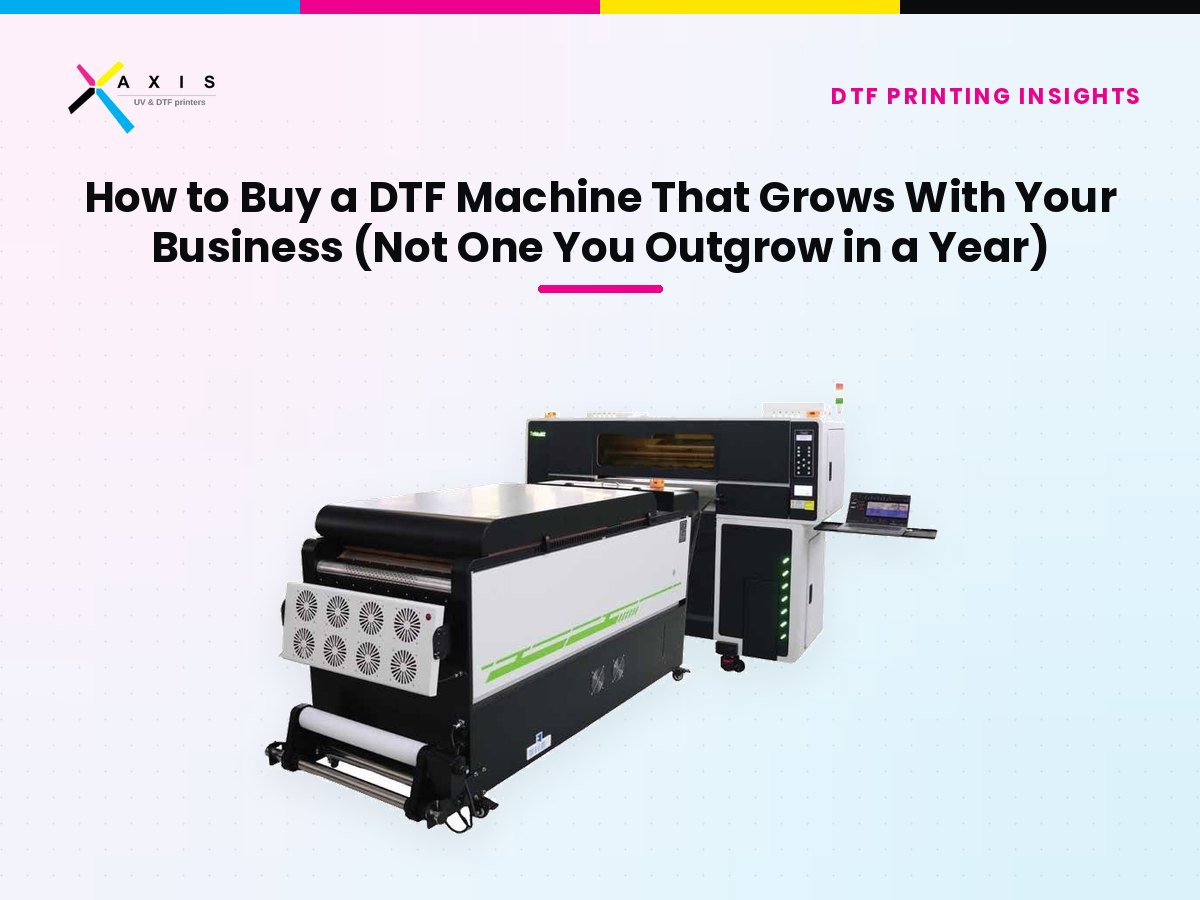
Quick answer: To buy a DTF machine that grows with your business, judge it on capacity at realistic daily use, cost per sellable print, and a clear upgrade path (extra print heads, a larger powder shaker, or higher production modes), not on the lowest sticker price or the fastest demo speed. India's custom-apparel demand is rising, so the machine that fits today can bottleneck you within a year. Choose a supplier who backs the hardware with hands-on operator training, transparent running costs, and fast local service with spare parts, so scaling means adding orders rather than replacing your whole setup.
Direct-to-film (DTF) printing is a process that prints a design onto a coated film, coats it with adhesive powder, cures it, and then transfers it onto fabric with a heat press. It works across cotton, blends, polyester and more, which is why it has spread so fast through Indian garment-printing shops. The trap is not the technology. The trap is buying the wrong size of it.
Why do so many DTF printers outgrow their first machine within a year?
Most first-time buyers pick a machine for the orders they have today, not the orders they will win next year, and demand is climbing faster than they expect. The result is a capable machine that becomes a bottleneck the moment business grows.
The growth is real and measurable. According to Grand View Research, the global direct-to-film printing market was worth USD 2,720.0 million in 2024 and is projected to reach USD 3,920.0 million by 2030, a compound annual growth rate of 6.0% from 2025 to 2030.
The demand feeding those machines is rising even faster. Grand View Research expects the global print-on-demand market to reach USD 57.49 billion by 2033, expanding at 23.6% per year from 2026 to 2033.
When your order book can more than double in a few seasons, a machine sized only for month one runs out of headroom quickly. Reprinting that decision is expensive: you pay again for freight, installation, training and downtime while you switch.
What is actually changing in India's garment-printing market right now?
The short answer: printing is shifting from bulk, fixed-run methods toward flexible, made-to-order digital output, and India is one of the fastest-moving regions in that shift. That changes what a machine needs to do over its life.
Textile printing as a whole is moving digital at pace. Coherent Market Insights values the global digital textile printing market at USD 10.3 billion in 2026, growing to USD 24.2 billion by 2033 at a 13.0% CAGR, and names Asia Pacific the fastest-growing regional market across that 2026 to 2033 period.
The Indian custom-apparel opportunity is concrete, not abstract. IMARC Group reports the India custom T-shirt printing market reached USD 176.6 million in 2025 and is forecast to hit USD 407.9 million by 2034, a CAGR of 9.75% from 2026 to 2034.
Two forces sit behind those numbers. Buyers now expect small runs, fast turnaround and personalisation, which rewards on-demand production over large minimums. And competition is pushing shops to add fabric types and finishes, which rewards machines that can be upgraded rather than replaced.
One industry voice frames the mindset shift well.
"It should be treated as a business model, not a printing method." Cassie Green, Content Director, Apparelist, speaking on decoration trends at PRINTING United Expo 2025.
Read that way, the machine is not a one-time purchase. It is the production engine of a business you intend to grow, so it has to be judged on how well it scales.
How should a smart buyer judge a DTF machine in 2026?
Judge a DTF machine on lifetime economics and headroom, not on the day-one price or the peak speed shown in a demonstration. Five criteria separate a machine you grow with from one you grow out of.
- Realistic capacity: plan around normal daily demand at roughly 60 to 70% utilisation, because peak-speed demos usually ignore artwork prep, powdering, curing, loading and finishing.
- Cost per sellable print: compare total cost per good print, including ink, film, powder, wastage, cleaning and downtime, not just the machine price. A cheaper machine can carry a higher lifetime cost.
- Upgrade path: look for added print heads, larger shaker or powder capacity, and higher production modes, so growth does not force a full replacement.
- Uptime and serviceability: local service response and spare-parts availability decide how many production days you lose each year.
- Operator readiness: a machine only performs as well as the person running it, so training is part of the purchase, not an extra.
The table below shows how the same budget plays out when it is spent on price alone versus spent on growth.
| :-: | :-: | :-: |
|---|---|---|
| Buying criterion | Machine chosen on lowest price | Machine chosen for growth |
| Sizing basis | Today's order volume only | Realistic demand at 60 to 70% utilisation with headroom |
| Upgrade path | Fixed configuration, replace to grow | Add heads, shaker capacity or faster modes |
| True cost measure | Sticker price | Cost per sellable print over the machine's life |
| Downtime risk | Uncertain parts and service | Local spares and fast service response |
| Operator support | Self-taught, trial and error | Structured hands-on training included |
What should you look for in a DTF machine and its supplier?
Look for a supplier who sells you a scaling plan, not just a box. Use this checklist before you sign anything.
- Look for a supplier who quotes capacity at realistic utilisation and shows a full production run, not only a top-speed burst.
- Look for a machine with a documented upgrade path so you can raise output without buying a second setup.
- Look for transparent running-cost figures for ink, film and powder, so you can calculate cost per print and payback honestly, with GST accounted for.
- Look for structured operator training, because untrained operators cause most nozzle blockages, wastage and reprints.
- Look for guaranteed local after-sales service and genuine spare parts held in the country, so a fault costs hours, not weeks.
- Look for a seller who stays involved after installation and treats your growth as their business, not only the sale.
Notice that none of these are about the flashiest specification. They are about whether the machine, and the people behind it, can carry a business that keeps getting bigger.
Where does Axis Enterprises fit into this?
Axis Enterprises builds its offer around exactly these criteria: dependable DTF machines, heat presses and consumables, matched to your real production plan and backed by installation, operator training and responsive local support. The aim is a setup you scale, not one you replace. You can see the full range and current machine options at Axis Enterprises, and compare configurations with a real production plan in mind rather than a demo-day speed.
Because the market is moving quickly, the smartest first step is to see the machine run your kind of jobs before you commit. The most useful thing you can do this month is book a free live DTF machine demonstration and bring a few of your own designs and fabrics. Watch a full run, from artwork to finished transfer, ask about the upgrade path, and get transparent running costs in writing so you can plan payback with GST included. If you would rather talk first, the team can walk you through DTF machines built to grow with your business and help you size the right configuration for where you want to be in three years, not just where you are today.
Frequently asked questions
How much production headroom should a first DTF machine have?
Size the machine so your expected daily orders sit near 60 to 70% of its realistic output, not 100%. That buffer absorbs busy seasons and order growth without forcing overtime or a second machine. It also leaves room for artwork prep, curing and finishing, which peak-speed figures usually ignore.
Is it cheaper to upgrade a DTF machine or replace it?
Upgrading is almost always cheaper when the machine was designed for it. Adding print heads, shaker capacity or a faster production mode costs far less than repurchasing freight, installation, training and lost production days. This is why an upgrade path matters more than a low starting price.
What running costs should I ask about before buying?
Ask for the cost of ink, film and powder per print, plus expected wastage, cleaning consumption and maintenance. Combine these into a cost per sellable print and add GST. That single number, not the machine price, tells you whether a job is profitable.
Why is after-sales service so important for DTF machines?
A DTF machine only earns money when it is running, so downtime is a direct loss. Local service response and in-country spare parts decide whether a fault costs you hours or weeks. Treat service coverage as part of the machine's price, not an afterthought.
Is DTF only useful for T-shirts?
No. DTF transfers work across cotton, blends, polyester, bags, caps and many other items, which is why shops use it for uniforms, events, corporate gifting and small brand runs. That range is part of what makes the technology worth scaling rather than limiting to one product.
Sources
- Grand View Research, Direct-to-Film Printing Market Size and Industry Report
- Grand View Research, Print-on-Demand Market to Reach USD 57.49 Billion by 2033
- Coherent Market Insights, Digital Textile Printing Market Size and Forecast, 2026 to 2033
- IMARC Group, India Custom T-Shirt Printing Market Size and Report
- ASI Central, PRINTING United Expo 2025: Decoration Trends and Equipment Upgrades
Founder, Axis Enterprises. Selling and servicing digital printing machines across India since 2011. Author of "Increase Your Profit by 270% with UV Printing Technology". More about the author