Why the Cheapest DTF Film, Ink and Powder Cost Indian Printers the Most in 2026
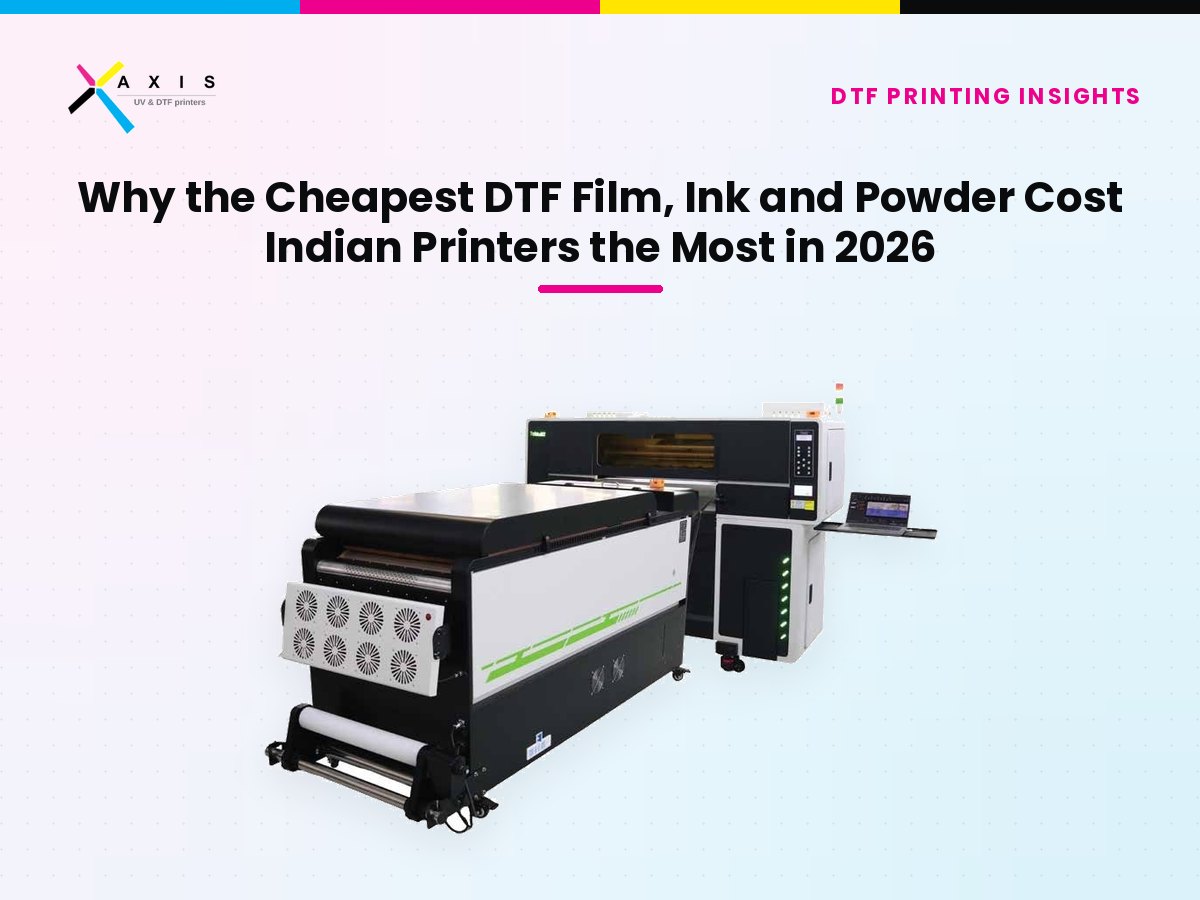
Here is a fact most new printers never hear on the day they buy a machine: the film, ink and powder you load into it decide more of your profit than the printer itself. A well built machine running the wrong consumables will still produce prints that peel, feel oily and fade after a few washes.
Quick answer: To choose DTF film, ink and powder well, treat them as one matched system rather than three separate purchases. Pick a film, pigment ink set and hot melt powder that a supplier has already tested together, then judge them on cost per sellable print and wash durability, not on price per roll or per kilogram. Confirm the print survives repeated washing, stores safely in Indian heat and humidity, and can be traced to a batch if a fault appears. Cheap, mismatched materials look profitable until peeling, colour drift and clogged print heads quietly erase the saving.
What exactly are DTF film, ink and powder?
DTF consumables are the three matched materials that together carry a design from printer to garment: the printable PET film, the pigment inks including white, and the adhesive hot melt powder. Direct to garment methods print straight onto fabric, but direct to film prints onto a film first, coats it with powder, cures it, and then transfers it with a heat press.
Because the design is built on film and then bonded to cloth, all three materials have to behave as one chemistry. The ink has to sit correctly on that specific film, and the powder has to melt into that specific ink layer. This is why DTF has spread so fast across custom apparel and print on demand work in India.
The category is large and still growing. According to Grand View Research (2024), the global direct to film printing market was estimated at USD 2,720 million in 2024, projected at about USD 2,930 million in 2025, and set to reach USD 3,920 million by 2030, growing at a compound annual rate of 6.0 percent from 2025 to 2030.
How much does a mismatched consumable set really cost you?
A cheap, mismatched set almost always costs more per sellable print than a slightly dearer matched one. The saving on the invoice is real, but it is smaller than the waste it creates in reprints, downtime and returned garments.
Consider where the money leaks when materials do not match:
- Poor adhesion and weak whites force reprints, so film, ink and powder are spent twice on one order.
- Oily or under cured prints get rejected by the customer after the first wash, turning a paid job into a refund.
- Low grade or wrong viscosity ink settles and clogs dampers and nozzles, which means lost production hours and, at worst, a damaged head.
Ink alone is a meaningful running cost, not a rounding error. IntelMarketResearch (2025) valued the global DTF printer ink market at USD 1,159 million in 2025, rising to USD 1,463 million by 2034 at a 3.5 percent compound annual rate, which shows how much printers everywhere are spending on consumables every year. For a small shop in India, a single reprinted batch can burn several hundred rupees in materials plus the labour to run it again.
Why do individually good materials still fail together?
Good ink, good film and good powder can still fail as a set because DTF quality comes from compatibility, not from any single component. A premium ink formulated for one film can bead or spread on another, and a powder tuned for one ink can stay tacky or turn brittle on a different one.
Two forces make this harder in India right now. The first is speed of adoption. As Andy Gregory, Sales Director at Hybrid Services, observed in Images magazine's State of the DTF Market Report 2025, "At Hybrid, we expected DTF to continue embedding itself as a mainstream technology, but adoption has been quicker than anticipated." Fast adoption has flooded the market with unbranded consumables of uneven quality.
The second force is demand pulling more first time owners in. IMARC Group (2025) reports the India custom T-shirt printing market reached USD 176.6 million in 2025 and is projected to grow at 9.75 percent through 2034.
Broader textile printing demand is rising too. The global Grand View Research (2025) print on demand market was valued at USD 10.8 billion in 2025 and is forecast to reach USD 57.5 billion by 2033 at a 23.6 percent compound annual rate. More new entrants means more people buying consumables on price before they understand chemistry.
India's climate adds a third problem. Heat and humidity make white ink settle faster and can leave powder clumpy, so storage discipline matters as much as the purchase decision.
How should a smart buyer judge DTF consumables in 2026?
Judge consumables the way you would judge a supplier you plan to depend on for years, not a one time bargain. The buyers who stay profitable use a small set of criteria that have little to do with sticker price.
- Matched as a system: the film, ink and powder are sold and tested together, so compatibility is proven before the material reaches your shop.
- Cost per sellable print: the true cost is the price divided by prints that pass wash and peel, not the price per roll or per kilogram.
- Wash and peel durability: the transfer survives repeated washing and abrasion, because a print that fails after one wash was never cheap.
- Storage stability in Indian conditions: the ink and powder tolerate local heat and humidity with a simple, documented handling routine.
- Traceability and support: every batch can be traced, and a knowledgeable local team can tell you whether a fault came from the film, the ink or the powder.
What should you look for in a consumables supplier?
Look for a supplier who sells a proven system and stands behind it locally, not one who only sells you the lowest priced roll. Use this checklist when you compare options:
- Look for a supplier who provides film, ink and powder validated to work together, with settings you can follow.
- Look for a supplier who will show you wash tested samples on cotton, polyester and blends before you commit.
- Look for a supplier who talks in cost per finished print and helps you calculate it for your own jobs.
- Look for a supplier who keeps stock in India so a delayed batch never stops your production.
- Look for a supplier who offers operator training and a clear point of contact for technical problems.
- Look for a supplier who can trace a faulty batch and support the machine, not just sell the material.
The difference between the two approaches shows up clearly once you compare them side by side:
| :-: | :-: | :-: |
|---|---|---|
| What you are buying | Cheapest mixed consumables | Matched, tested consumable system |
| Compatibility | Unproven, sourced from three separate sellers | Validated together before sale |
| Wash and peel durability | Inconsistent, frequent reprints | Consistent, tested on multiple fabrics |
| Print head risk | Higher, from wrong viscosity or low grade ink | Lower, ink matched to the head |
| True cost basis | Low price per roll, high cost per sellable print | Fair price, low cost per sellable print |
| Support if a fault appears | Little, no batch traceability | Local support with batch traceability |
Where does Axis Enterprises fit in?
Everything above points to the same conclusion: you are not buying film, ink and powder separately, you are buying a tested system with support behind it. This is exactly how Axis Enterprises works with printers across India, supplying DTF machines together with film, ink and powder that are matched to the machine and backed by installation, operator training and local after sales service. The aim is a setup where the consumables, the screen printing alternative you may be replacing, and the machine all make commercial sense together.
Because the same team supplies the machine, the consumables and the service, a fault can be traced to its source instead of turning into guesswork between three vendors. That is what keeps a small shop running on time.
What is the easiest next step?
The lowest risk way to judge any of this is to see the prints for yourself before you spend on a machine or a year of consumables. You can book a free live DTF machine demonstration with Axis Enterprises, watch real film, ink and powder run on real fabric, and check the wash and peel result with your own hands. Bring a garment you actually sell and see how the matched system performs on it before you decide.
Frequently asked questions
Can I safely use ink, film and powder from three different suppliers?
You can, but you take on the compatibility risk yourself. Materials that each perform well alone may bead, peel or stay tacky when combined, so you must wash test every new combination before using it on paid orders. A system tested together removes most of that risk.
Should I approve consumables on purchase price or cost per sellable print?
Judge them on cost per sellable print. Divide the material cost by the number of prints that actually pass wash and peel, not by prints attempted. A cheaper roll that causes reprints usually costs more per finished, sellable garment.
How should ink, film and powder be stored in India's heat and humidity?
Store them cool, sealed and away from direct sun, and keep white ink circulating so it does not settle. Humidity makes powder clump, so keep it closed and dry. A simple written handling routine prevents most storage related failures.
How many wash cycles should a test print survive before I approve consumables?
Test to the standard your customers expect, which for everyday apparel usually means the print holds colour and adhesion through repeated home washing. Run several wash cycles on cotton, polyester and a blend before approving a set. If it fails early, the saving on price is not real.
How do I trace whether a quality failure came from the ink, film or powder batch?
Record the batch of each material against the job so a fault can be isolated later. Change one variable at a time when you troubleshoot. A supplier who provides batch traceability and technical support makes this far faster than three separate sellers can.
Why can individually good ink, film and powder still produce poor results together?
Because DTF quality depends on how the three react as one chemistry, not on each part alone. Ink tuned for one film can spread wrongly on another, and powder tuned for one ink can fail to bond with a different one. Matching them as a validated set is what delivers a durable print.
Sources
- Grand View Research, Direct To Film Printing Market Size, Industry Report, 2025 to 2030
- IntelMarketResearch, DTF Printer Ink Market, 2026 to 2034
- IMARC Group, India Custom T-Shirt Printing Market, 2026 to 2034
- Grand View Research, Print On Demand Market Size And Share Report, 2026 to 2033
- Images magazine, State of the DTF Market Report 2025
Founder, Axis Enterprises. Selling and servicing digital printing machines across India since 2011. Author of "Increase Your Profit by 270% with UV Printing Technology". More about the author