Why the Cheapest DTF Printer Often Costs the Most Over the Next Three Years
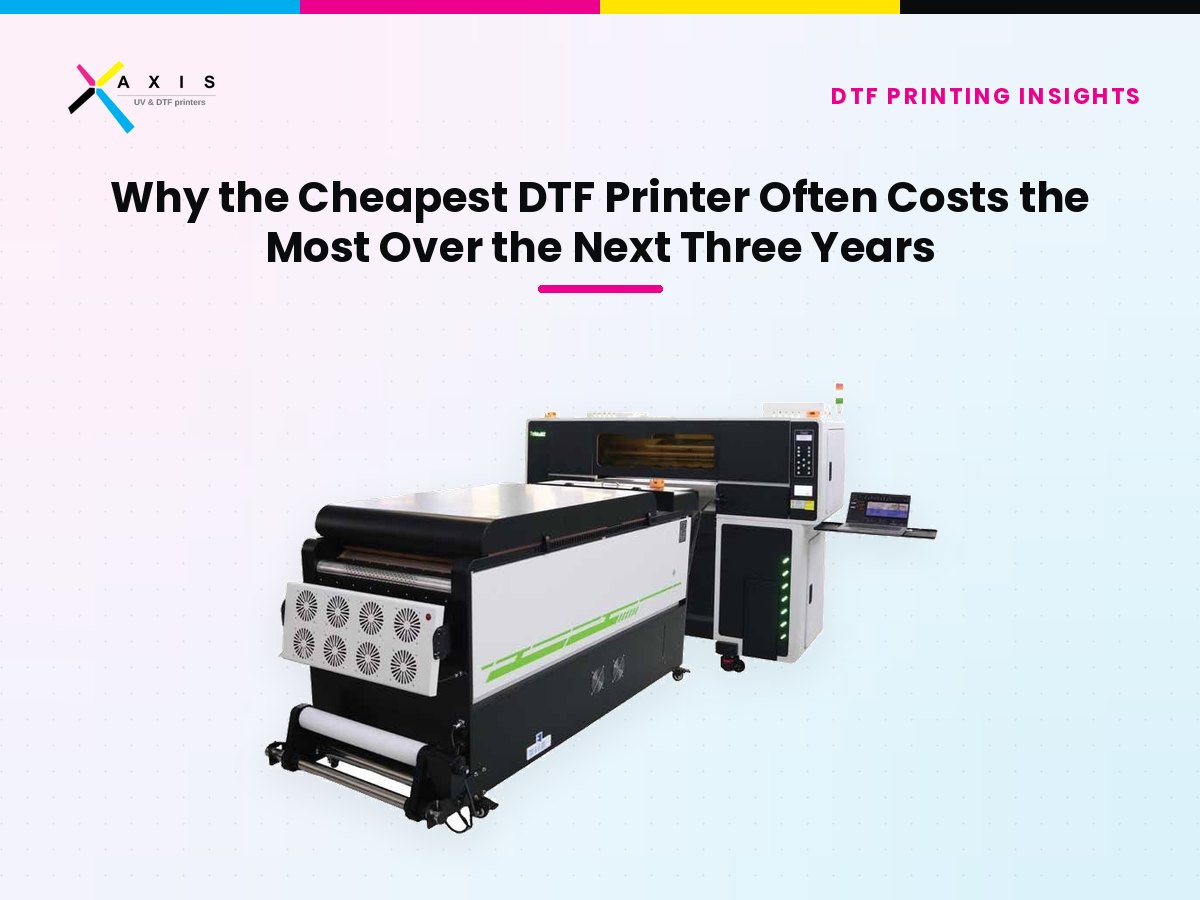
Quick answer: The cheapest DTF machine often costs the most because the purchase price is only a small part of what you actually pay. The number that decides your profit is the total cost of ownership, spread across every good print you sell over three years. Total cost of ownership is the sum of the machine price plus film, ink, powder, wastage, cleaning, maintenance, spare parts and lost production hours. A low sticker price paired with high wastage, frequent downtime and weak service usually produces a higher cost per sellable print than a well built machine bought from a supplier who trains you and stocks spares locally.
What is total cost of ownership for a DTF machine?
Total cost of ownership is every rupee a machine costs you across its working life, not just the day-one price. For a printer, that means the setup cost plus consumables, electricity, maintenance, spare parts, operator time and the value of orders lost to downtime.
Direct-to-film printing (DTF) is a process that prints a design onto a special film, coats it with adhesive powder, cures it and then transfers it onto fabric with a heat press. Each of those steps consumes materials and time, so the real measure of value is total cost of ownership per sellable print, not the quotation you sign on purchase day.
Why does the cheapest DTF machine often cost the most in 2026?
The cheapest machine often costs the most because a low price is usually funded by cutting the parts you cannot see: build quality, consumable compatibility, training and after-sales support. Those cuts show up later as wasted film, blocked nozzles and idle hours that quietly raise your cost per print.
Demand for DTF is real and growing, which is exactly why buying badly hurts. According to Grand View Research (2024), the global direct-to-film printing market was valued at USD 2,720.0 million in 2024 and is projected to reach USD 3,920.0 million by 2030, a compound annual growth rate of 6.0 percent from 2025 to 2030.
The finished-product market is expanding even faster. According to Grand View Research (2024), the global custom t-shirt printing market was worth USD 5.16 billion in 2024 and is forecast to reach USD 9.82 billion by 2030, with digital printing the fastest growing technique at a 12.5 percent CAGR. Rising demand pulls in more printers, competition tightens margins, and a high cost per print becomes the fastest way to lose money in a busy market.
What hidden costs turn a cheap DTF printer into an expensive one?
The hidden costs are wasted film and powder, extra cleaning ink, white-ink downtime, early print-head replacement and unbillable idle hours. Added over three years, these usually exceed whatever was saved on the purchase price.
In India the pressure is sharpest because the local market is growing quickly. According to IMARC Group (2025), the India custom t-shirt printing market reached USD 176.6 million in 2025 and is expected to touch USD 407.9 million by 2034, a CAGR of 9.75 percent from 2026 to 2034. In that kind of market, the printers who win are not the ones who paid the least, but the ones whose machines run every day at a predictable cost.
- Consumable waste: Poorly built shakers and unstable printing waste film and powder on every rejected sheet.
- Downtime: Every hour spent unclogging nozzles is an hour of orders you cannot fill or bill.
- Repairs and spares: A cheap print head that fails early can cost more to replace than the savings on the original machine.
Why is cost per sellable print a better number than machine price?
Cost per sellable print is a better number because it captures everything the machine actually consumes to produce one print a customer pays for. It divides all your costs, from ink to downtime, by the good prints you sell, so a cheap machine with heavy wastage is exposed for what it truly costs.
The equipment side of this market is broad and still maturing. According to 360iResearch (2026), the DTF printer market was valued at USD 2.68 billion in 2025 and is projected to reach USD 4.25 billion by 2032, a CAGR of 6.77 percent. That range means buyers face very different machines at similar prices, and only cost per print separates a bargain from a liability.
Consumable quality is a large and often ignored part of that number. Mike Davis, Application Specialist at Roland DGA, notes in Screen Printing magazine:
"DTF printing requires a higher level of white ink output versus CMYK ink."
White ink is one of the costliest consumables in the workflow, and a machine that manages it poorly burns through ink and cleaning cycles. That is why buyers moving into textile printing or print on demand should judge a machine by how cheaply it produces a good print, not by its opening price.
How should a smart buyer compare DTF machines in 2026?
A smart buyer compares machines on total three-year cost and reliability, not the sticker price alone. The right questions are how much a machine wastes, how often it stops, how fast it can be fixed, and whether the operator will be trained to run it well.
Use criteria that reward dependable output over a cheap quotation:
- Dependable build: stable printing and curing that produce a consistent, sellable print instead of frequent rejects.
- Transparent job costing: a clear, honest figure for ink, film, powder and electricity per print, before you buy.
- Practical training: hands-on operator training so your team runs the machine at low waste from day one.
- Local after-sales service and spares: quick support and in-stock parts so a fault means hours of downtime, not weeks.
The table below shows how the two approaches compare over a realistic three-year horizon.
| :-: | :-: | :-: |
|---|---|---|
| Cost factor | Cheapest machine, weak support | Value-focused machine, full support |
| Purchase price (before GST) | Lowest on day one | Moderate, justified by build quality |
| Film, ink and powder waste | High, from rejects and instability | Low, from stable output and training |
| White-ink downtime | Frequent clogs and cleaning cycles | Managed with correct circulation |
| Spare parts and service | Slow, uncertain, sometimes unavailable | Local, stocked, fast response |
| Three-year cost per sellable print | Higher than expected | Lower and predictable |
What should you look for in a DTF machine supplier?
Look for a supplier who sells you a costed, working process, not just a box. The right partner proves the numbers before you pay and stands behind the machine long after installation.
- Look for a supplier who gives a live, timed demonstration from artwork to finished transfer, so you see real output, not a maximum-speed claim.
- Look for a supplier who states the true cost per print, including film, ink, powder and wastage, before you commit.
- Look for a supplier who trains your operators so waste stays low and quality stays consistent.
- Look for a supplier who stocks spare parts locally and answers service calls quickly, because downtime is lost revenue.
- Look for a supplier who supports you as a long-term printing partner, not only on the day of sale.
Where can Indian printers get a DTF machine built around true cost per print?
This is exactly the gap Axis Enterprises was built to close for Indian garment printers. Axis Enterprises supplies DTF printing machines, heat presses and consumables together with installation, hands-on operator training, maintenance and responsive local after-sales support, so the number that matters, your cost per sellable print, stays low and predictable. You can see the machines run in a live DTF demonstration and compare real output before you invest, and you can review the full range of DTF printers and consumables at axisdtf.com.
What is the easiest next step?
The lowest-risk way to test everything above is to watch a machine work with your own artwork before you spend a rupee. Book a free live DTF machine demonstration and let the timed output and honest per-print costing speak for themselves. You can book a free live DTF machine demonstration with Axis Enterprises and bring a design you actually sell, so you leave with a real cost per print rather than a promise.
Frequently asked questions
How much does a DTF printing setup cost in India in 2026?
Entry-level DTF setups start at a few lakh rupees, while wider production machines cost more, all before GST. The more useful figure is total cost of ownership, because two machines at a similar price can produce very different cost per print once wastage, downtime and service are included.
Is the cheapest DTF machine ever the right choice?
Only when its full three-year running cost is genuinely lower, which is rare. A low price often hides high consumable waste, frequent downtime and slow support that push the real cost per print above that of a better built machine.
What raises the running cost of a DTF machine the most?
White-ink handling, film and powder wastage, cleaning cycles and print-head wear are the biggest running costs. A stable machine and a trained operator keep all four low, which is where most of the long-term savings come from.
Why does after-sales service affect total cost?
Because every hour a machine is stopped is an hour of orders you cannot bill. A supplier with local spares and fast service turns a fault into a short pause instead of days of lost revenue, which directly lowers your effective cost per print.
How do I calculate cost per sellable print?
Add all monthly costs, including consumables, electricity, maintenance, a share of the machine price and any wasted material, then divide by the number of good prints you actually sold that month. Tracking this figure over time shows whether a machine is truly cheap or only cheap on paper.
Sources
- Grand View Research, Direct-To-Film Printing Market Size & Report (2024)
- Grand View Research, Custom T-Shirt Printing Market Size & Report (2024)
- IMARC Group, India Custom T-Shirt Printing Market Size and Report (2025)
- 360iResearch, DTF Printer Market, Global Forecast 2026-2032
- Screen Printing magazine, What Every Screen Printer Needs to Know About DTF Production
Founder, Axis Enterprises. Selling and servicing digital printing machines across India since 2011. Author of "Increase Your Profit by 270% with UV Printing Technology". More about the author