How to Choose a DTF Printing Machine Supplier in India in 2026: What Separates a Safe Investment From an Expensive Mistake
Here is a fact most first-time buyers learn too late: the machine is rarely the reason a printing business fails. The supplier behind it usually is.
The global market for direct-to-film (DTF) printing was valued at USD 2.72 billion in 2024 and is projected to reach USD 3.92 billion by 2030, growing at a 6.0% CAGR, according to Grand View Research (2024). Demand is real and rising. Yet two buyers can purchase the same printer in the same month and end up in completely different places, and the difference is almost always who sold it and what happened after.
What makes a DTF printing machine supplier reliable in India?
A reliable DTF printing machine supplier in India is one that proves the machine in front of you, trains your operators, quotes the full running cost in writing, and guarantees fast local service with genuine spare parts. Before buying, insist on a live demonstration on your own fabrics, ask for the real cost per print including ink, film and powder, and confirm the service turnaround and parts availability in your city. Judge the supplier on the three years after the sale, not the discount on day one. The right partner protects both your print quality and your cash flow, because a printer that sits idle earns nothing while your rent and EMI keep running.
What is DTF printing, and what does a supplier actually sell you?
DTF printing is a process that prints a design onto a special film, coats it with adhesive powder, cures it, and then transfers it onto fabric using a heat press. It works on cotton, polyester, blends and dark garments without the setup cost of screen printing, which makes it a natural fit for short runs and print on demand.
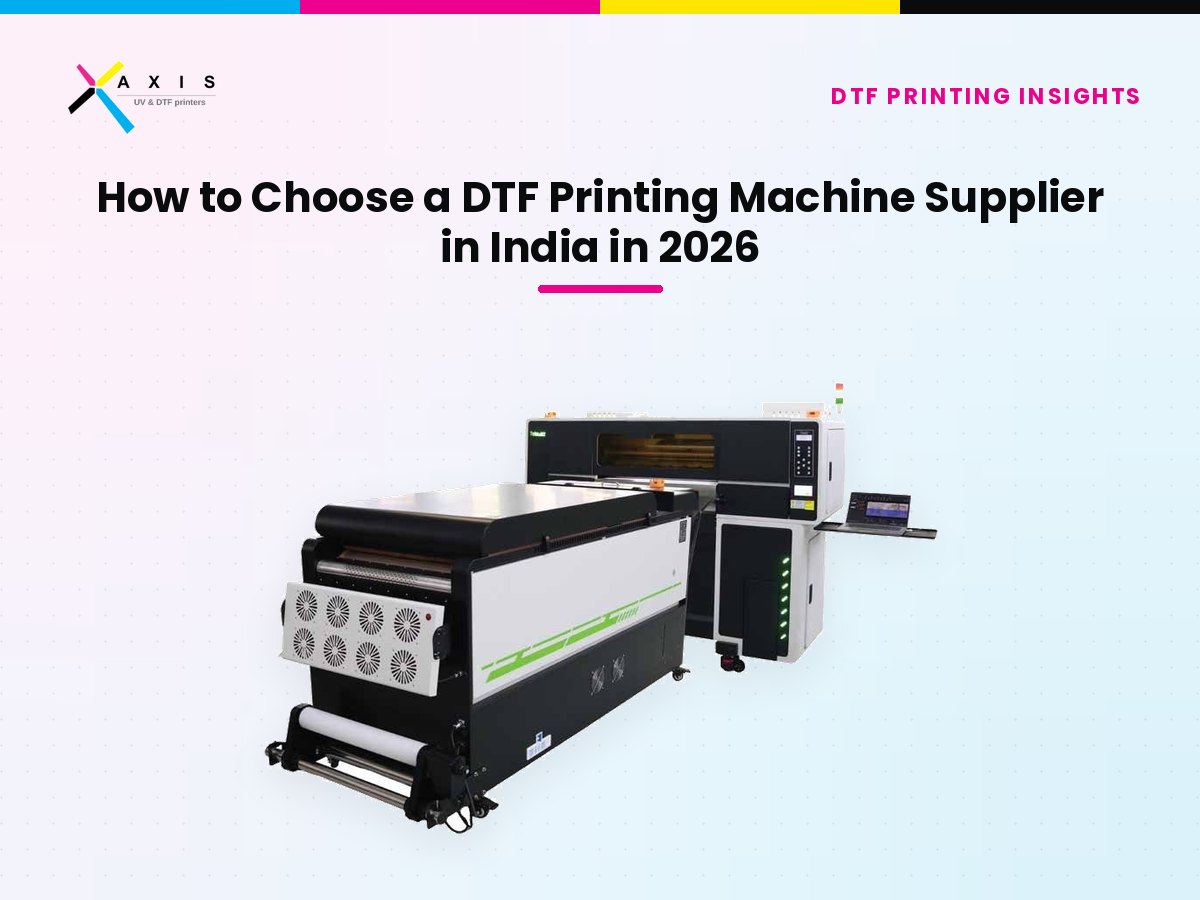
A DTF supplier is not selling you a single box. They are selling a system: the printer, the heat press, the inks, film and powder you will reorder every month, the installation, the operator training, and the service that keeps it all running. When people say a machine "stopped working," the real failure is usually one of these missing pieces, not the hardware itself.
Why is 2026 a good time to enter DTF printing in India?
The tailwinds are strong and measurable. India's textile printing market alone was valued at USD 2,198.4 million in 2024 and is forecast to reach USD 3,844.0 million by 2030 at a 9.9% CAGR, per Grand View Research (2024). Custom, on-demand apparel is where much of that growth is heading.
Globally, the print on demand market is projected to reach USD 57.49 billion by 2033, expanding at a 23.6% CAGR from 2026, according to Grand View Research (2026). For an Indian shop, that means steady demand for small-batch printing: sports jerseys, staff uniforms, event merchandise and personalised gifting.
Operators already inside the market are feeling it. Deepak Siddharth, CEO and Founder of RDX Digital, described the shift plainly:
"We have seen 200% growth in digital sales, going from five sales in 2024 to 15 devices already in 2025."
That quote, reported by Keypoint Intelligence (2025), captures the opportunity. But growth in the category does not guarantee growth for you. That depends on the choice you make before any of it starts.
What goes wrong when you choose the wrong supplier?
The cost of a poor supplier choice is not a bad review; it is a business that quietly stops. More than 75,000 MSMEs shut down in India over the past five years, and closures in 2024 to 2025 alone nearly doubled to roughly 35,000 units, as reported by Deccan Herald (2025) citing government data. Small printing units are not immune to this.
The pattern behind these failures is familiar to anyone in the trade. It usually starts with one of these:
- Misleading speed claims. A machine sold as "600 shirts an hour" that delivers a fraction of that once real powdering, curing and finishing are counted.
- Low-quality imported machinery. Grey-market units with no Indian service network, where a single failed print head can idle the business for weeks.
- Hidden running costs. Cheap sticker price, expensive ink consumption, and consumables that are hard to source or wildly variable in quality.
- Weak service commitments. No trained engineer within reach, no spare parts in the country, and no accountability once payment clears.
Each of these is a supplier problem wearing a machine costume. The hardware may be fine on day one. The relationship is what fails.
How should a smart buyer judge a DTF supplier?
Reframe the decision: you are not buying a printer, you are buying uptime and predictable cost per print. A smart buyer in 2026 evaluates a supplier against criteria that most sellers hope you never ask about. Use these five.
- Proof before payment. Will they run a live demonstration on your fabrics, with your artwork, in front of you? A confident supplier says yes without hesitation.
- Transparent job costing. Can they show you the true cost per print, including ink, film, powder and wastage, so you can price jobs and protect your margin?
- Operator capability. Do they train your team properly, or hand over a machine and disappear? Most "faults" are untrained-operator errors.
- Local service and spare parts. How fast can an engineer reach you, and are genuine parts stocked in India? Downtime is the real cost, not the repair bill.
- Long-term accountability. Are they a business you can still call in year three, or a one-time seller? Ask to speak to a customer who has needed a real repair.
What should you look for in a DTF supplier before you buy?
Use this checklist as an objective filter before you commit a single rupee. A supplier worth buying from will pass most of these without flinching. Score any seller against the list below.
| :-: | :-: | :-: |
|---|---|---|
| What to check | A reliable supplier | A risky seller |
| Live demonstration | Prints on your fabric, your design, before payment | Shows a video or a sample printed elsewhere |
| Cost per print | Gives ink, film and powder costs in writing | Only quotes the machine price |
| Installation and training | On-site setup plus hands-on operator training | Delivers the box and leaves |
| Service turnaround | Defined response time, engineer reachable locally | Vague promises, no named contact |
| Spare parts | Genuine parts stocked in India | Parts imported on request, long waits |
| Consumables supply | Reliable, consistent ink, film and powder | Whatever is cheapest that month |
If a seller resists the first two rows, treat that as your answer. Everything else follows from whether they are willing to be measured before they are paid.
Where does Axis Enterprises fit in?
Everything above describes how Axis Enterprises was built to work. Axis Enterprises (axisdtf.com) supplies DTF printing machines, heat presses and consumables to Indian garment businesses, and pairs the hardware with the parts most sellers leave out: on-site installation, hands-on operator training, transparent job costing, and responsive local after-sales service with genuine spare parts.
The philosophy is simple. A machine that a first-time owner can run confidently, price accurately, and get repaired quickly is worth far more than a cheaper box that sits idle. If you want to see the difference for yourself, the best test is to watch a DTF machine printing on your own fabric and ask every question on the checklist above.
What is the easiest next step?
The lowest-risk way to evaluate any DTF investment is to see it working before you decide. You can book a free live DTF machine demonstration with Axis Enterprises, bring your own garments and artwork, and get a written cost-per-print estimate for the jobs you actually plan to run. There is no obligation to buy.
Use the visit to pressure-test the machine, the training, and the after-sales promise, then compare what you learn against every other quote on your desk. If you would rather talk through your setup first, reach out through the Axis Enterprises team and start with the numbers.
Frequently asked questions
How much does a DTF printing setup cost in India in 2026?
A DTF setup in India generally spans a wide range depending on print width, speed and build quality, and the machine price is only part of the picture. Always add installation, operator training, and monthly consumables such as ink, film and powder, and apply GST where relevant. Ask any supplier for the full cost per print in writing so you can compare setups fairly rather than on sticker price alone.
How do I verify a DTF supplier is genuine before buying?
Ask for a live demonstration on your own fabric, a written cost-per-print breakdown, and the name and location of the service engineer who would handle your repairs. Request to speak with an existing customer who has needed a real repair, not just a freshly installed reference. A genuine supplier answers all three without hesitation.
Why do DTF machines stop working, and is it the machine or the supplier?
Most reported machine failures trace back to untrained operators, poor-quality consumables, or a supplier with no local service, rather than the hardware itself. Print-head clogging and white-ink problems, for example, are usually maintenance and training issues. This is why the supplier and its service network matter more than the brand name on the box.
Is DTF printing still a good business to start in India in 2026?
The demand signals are positive, with India's textile printing market forecast to reach USD 3,844.0 million by 2030 at a 9.9% CAGR per Grand View Research (2024), and strong growth in on-demand apparel. Whether it works for you depends far more on operating cost control and uptime than on market size. Choose a supplier who helps you master both.
What running costs should I plan for beyond the machine?
Plan for ink, film and adhesive powder as your recurring monthly costs, plus electricity, routine maintenance, and occasional spare parts. Wastage during learning also adds up, which is why proper operator training pays back quickly. A supplier who quotes these honestly before the sale is protecting your margin, not padding a quote.
Sources
- Grand View Research, Direct-to-Film Printing Market Report (2024)
- Grand View Research, India Textile Printing Market Outlook (2024)
- Grand View Research, Global Print On Demand Market (2026)
- Deccan Herald, More than 75,000 MSMEs shut shop in past five years: Govt (2025)
- Keypoint Intelligence, Digital Printing: Reshaping India's Apparel Market (2025)
Founder, Axis Enterprises. Selling and servicing digital printing machines across India since 2011. Author of "Increase Your Profit by 270% with UV Printing Technology". More about the author