How to Choose the Right DTF Printing Machine in India in 2026: A Buyer's Guide to Capacity, Cost and Growth
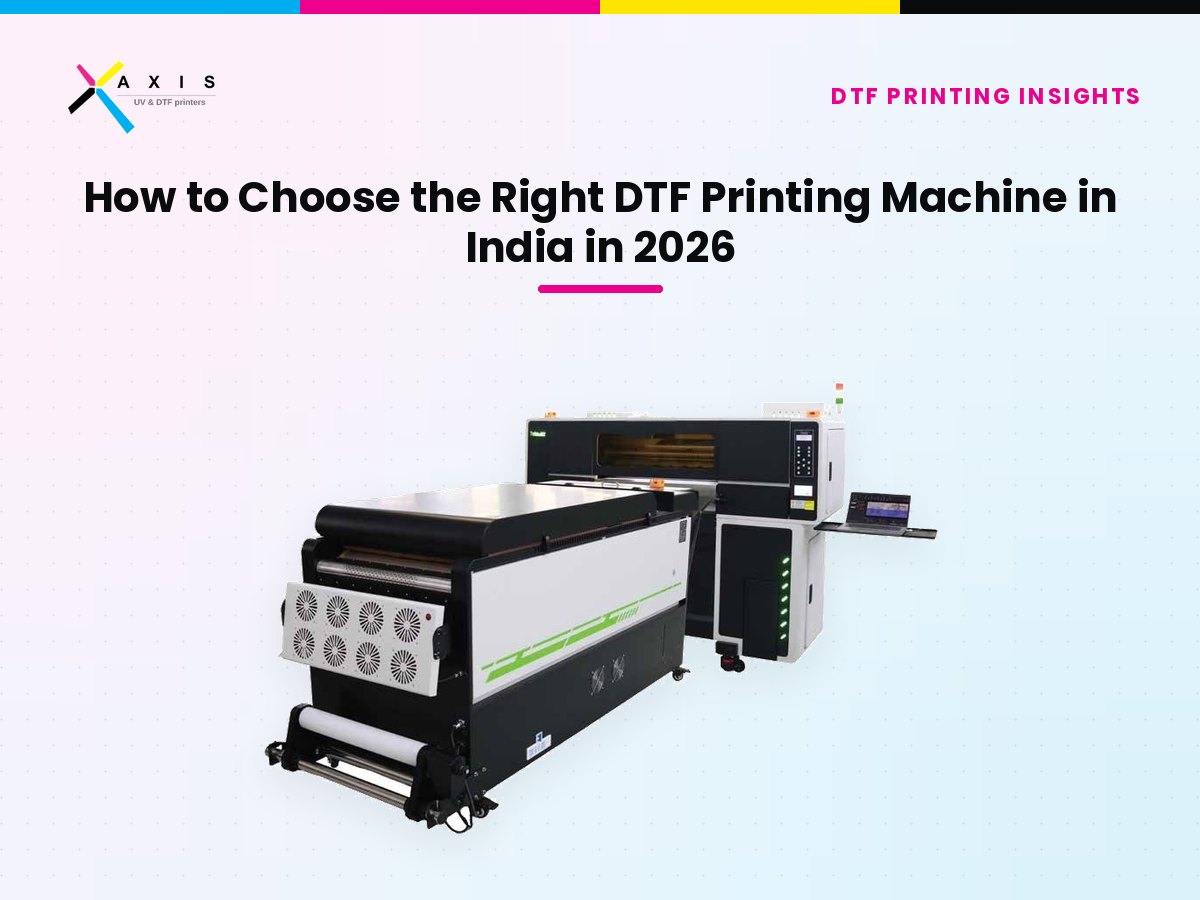
Direct-to-film printing (DTF) is a process of printing a design onto a coated PET film, applying adhesive powder, curing it, and then heat-pressing the transfer onto fabric. A DTF machine is the printer at the centre of that workflow, and choosing the right one decides your daily output, your running cost, and how much your business can grow before you outgrow the equipment.
The problem is that most first-time buyers compare machines on advertised print speed and sticker price alone. Capacity, print-head configuration, and real-world throughput matter far more, and getting them wrong is expensive to undo.
The quick answer: how do you choose the right DTF machine?
Choose a DTF machine by matching its realistic daily capacity to your current orders plus expected growth over the next 12 to 18 months, not to the seller's advertised top speed. Decide the print width you need (13-inch for testing and low volume, 24-inch for steady small-business production, 30-inch and wider for high volume). Confirm the print-head type and how easily heads and spare parts are serviced locally. Insist on a live demonstration on your own artwork and fabric, and buy from a supplier who provides operator training, transparent running-cost figures, and responsive after-sales support.
Why is a printing method barely five years old already a multi-billion-dollar market?
DTF moved from a niche technique to a global industry in under a decade, which is why the machine choice matters so much right now. According to Grand View Research, the global direct-to-film printing market was valued at USD 2,720.0 million in 2024 and is projected to reach USD 3,920.0 million by 2030, growing at a CAGR of 6.0% from 2025 to 2030.
The pull comes from custom apparel demand. The global print-on-demand market is projected to reach USD 57.49 billion by 2033 at a CAGR of 23.6% from 2026 to 2033, and apparel already held the largest revenue share at 39.5% in 2025, per Grand View Research.
That growth is why the machine sitting at the centre of the workflow deserves careful thought. Buy for the market you are entering over the next two years, not only for the orders on your desk today.
What does choosing the wrong DTF machine actually cost you?
The real cost of the wrong machine is not the purchase price, it is the orders you cannot fulfil and the downtime you cannot afford in a fast-growing market. A machine that is too small becomes a bottleneck during festival, wedding, and school-order seasons, while a machine that is too large sits idle and drains capital.
The opportunity is measurable. India's custom t-shirt printing market was valued at USD 176.6 million in 2025 and is projected to reach USD 407.9 million by 2034 at a CAGR of 9.75% from 2026 to 2034, according to the IMARC Group.
That demand sits inside a much larger base. India's textile and apparel market is projected to reach US$ 350 billion by 2030 at a 10% CAGR, and the sector is expected to roughly double its contribution to national GDP by the end of the decade, per the India Brand Equity Foundation (IBEF). In a market growing this fast, an underpowered or unreliable machine costs you the exact orders your competitors are winning.
Why do so many first-time buyers pick the wrong machine?
Buyers pick the wrong machine because they compare advertised speed and price instead of realistic capacity, print-head configuration, and serviceability. Advertised speed is measured under ideal conditions, but your true output is limited by powdering, curing, and heat-pressing, not just by how fast the printer moves.
The buyer pool is also changing, which raises the stakes. Established decorators are adopting DTF as a second technology, and they bring higher volume expectations. As Rob Super, CEO and Founder of American Print Supply, told ASI Central at the 2025 PRINTING United Expo: "We're seeing more and more screen printers, hardcore rotary shops all throughout the country, taking note of DTF because it is a powerful tool."
DTF sits alongside screen printing and other textile printing methods rather than replacing them, so the right machine is the one that fits your specific product mix and order pattern. The DTF printer segment itself was valued at USD 2.68 billion in 2025 and is forecast to reach USD 4.25 billion by 2032 at a CAGR of 6.77% from 2026 to 2032, according to 360iResearch, so machine options will keep expanding and the comparison will only get harder.
How should a smart buyer actually evaluate a DTF machine in 2026?
A smart buyer evaluates a DTF machine on realistic throughput, print-head reliability, running cost, and local support, not on headline speed. These four criteria decide whether the machine earns money or sits under repair.
- Realistic daily capacity: judge output across the full workflow (print, powder, cure, press), and match it to current orders plus 12 to 18 months of expected growth.
- Print-head configuration and life: understand single-head versus multi-head setups and how head replacement is priced and sourced, since heads are the costliest wear part.
- Transparent running cost: ask for cost per print built from ink, film, powder, electricity, and maintenance, so your quotes and margins are based on real numbers, not guesses.
- Local after-sales service and spare parts: confirm that spares, consumables, and a trained engineer are reachable quickly, because a day of downtime in peak season can cost more than the part itself.
What should you look for in a DTF machine supplier?
Look for a supplier who proves output on your own artwork, trains your operator, and stands behind the machine after the sale. The equipment is only as good as the support and the consumables behind it. Use this checklist before you commit:
- Look for a supplier who runs a live demonstration on your fabric and your designs, not a showroom sample.
- Look for a supplier who states realistic daily capacity and cost per print in writing, including heat press and curing time.
- Look for a supplier who provides structured operator training so white-ink handling and maintenance do not depend on trial and error.
- Look for a supplier who keeps genuine ink, film, powder, and spare parts in stock locally, with clear GST-inclusive pricing.
- Look for a supplier who offers installation and a defined after-sales response time for service calls.
- Look for a supplier who helps you choose machine width and head configuration based on your orders, rather than upselling capacity you will not use.
13-inch vs 24-inch vs 30-inch DTF machines: which size fits your business?
The right width depends on your order volume and growth stage: smaller widths suit testing and low volume, wider machines suit steady and high-volume production. The table below compares the common configurations so you can match the machine to your business rather than to a spec sheet.
| :-: | :-: | :-: | :-: | :-: |
|---|---|---|---|---|
| Machine width | Best-fit business stage | Relative daily output | Typical head setup | Space and power needs |
| 13-inch (A3) | First-time buyers, home studios, sampling and low-volume niche orders | Low | Single head | Compact, single-phase power |
| 24-inch | Growing small businesses with steady custom apparel orders | Medium to high | Single or dual head | Dedicated room, stable power supply |
| 30-inch and wider | Established shops, bulk and seasonal contract production | High | Dual or multi head | Production floor, higher power and ventilation |
Use this as a starting frame, then confirm the numbers with a live demonstration on your own jobs. Output claims mean little until you see them on your fabric with your artwork.
Where does Axis Enterprises fit into this decision?
Everything above points to the same conclusion: the right DTF machine is a matter of matched capacity, honest costing, and dependable local support, not the lowest price on a brochure. That is exactly how Axis Enterprises works with garment printers across India, pairing DTF machines and heat presses with practical operator training, transparent running-cost guidance, and responsive after-sales service. You can compare machine sizes and head configurations against your real orders and see a live DTF machine demonstration on your own designs before you invest a rupee.
If you are weighing your first machine or planning an upgrade before the next festival season, the lowest-risk next step is simply to watch the machine run your jobs. Axis Enterprises offers hands-on operator training and local after-sales support as standard, so you can start production with confidence rather than guesswork. Book a free live DTF machine demonstration and bring your own artwork and fabric, so the capacity and cost figures you plan around are your numbers, not someone else's.
Frequently asked questions
How many prints per day should I expect from a 13-inch, 24-inch or 30-inch DTF machine?
Expect low output from a 13-inch machine, medium to high from a 24-inch, and high volume from a 30-inch and wider setup, but treat any single number with caution. Real daily output is limited by powdering, curing, and pressing, not only by print speed. The only reliable figure is one you see produced on your own artwork and fabric during a live demonstration.
Should I choose machine capacity based on current orders or expected future growth?
Choose capacity for your current orders plus your realistic growth over the next 12 to 18 months. Buying only for today risks a bottleneck during peak seasons, while buying far beyond your pipeline ties up capital in idle capacity. A supplier who reviews your order pattern with you helps you size the machine correctly.
How can I verify a seller's advertised printing speed before purchasing?
Verify speed by asking for a timed demonstration of the complete workflow on your own designs, from printing through powder, cure, and press. Advertised speeds are measured under ideal lab conditions and rarely reflect finished, sellable output. If a seller will not demonstrate real throughput on your jobs, treat the speed claim as unproven.
When should I buy a two-head machine instead of a single-head setup?
Move to a dual or multi-head machine when your steady order volume regularly exceeds what a single head can produce within your working hours. Multi-head setups raise output but also raise maintenance and head-replacement cost, so the volume must justify it. Base the decision on documented orders, not on seasonal spikes alone.
Will a smaller machine become a bottleneck during festival or school-order seasons?
Yes, a machine sized only for average demand often becomes a bottleneck during festival, wedding, and school-order peaks. The safest approach is to size for peak-season demand plus a margin for urgent jobs and reprints. Keeping some spare capacity protects your delivery times and your reputation when orders surge.
Sources
- Grand View Research, Direct-to-Film Printing Market Size, Industry Report, 2030
- 360iResearch, DTF Printer Market Size and Share, 2026-2032
- IMARC Group, India Custom T-Shirt Printing Market Size and Report, 2034
- Grand View Research, Print-On-Demand Market to Reach USD 57.49 Billion by 2033
- India Brand Equity Foundation (IBEF), Textile Industry and Market Growth in India
- ASI Central, PRINTING United Expo 2025: The Present and Future of Direct-to-Film Printing
Founder, Axis Enterprises. Selling and servicing digital printing machines across India since 2011. Author of "Increase Your Profit by 270% with UV Printing Technology". More about the author