Why Customers Reject Perfectly Printed DTF Transfers Over Colour, and How to Fix It in 2026
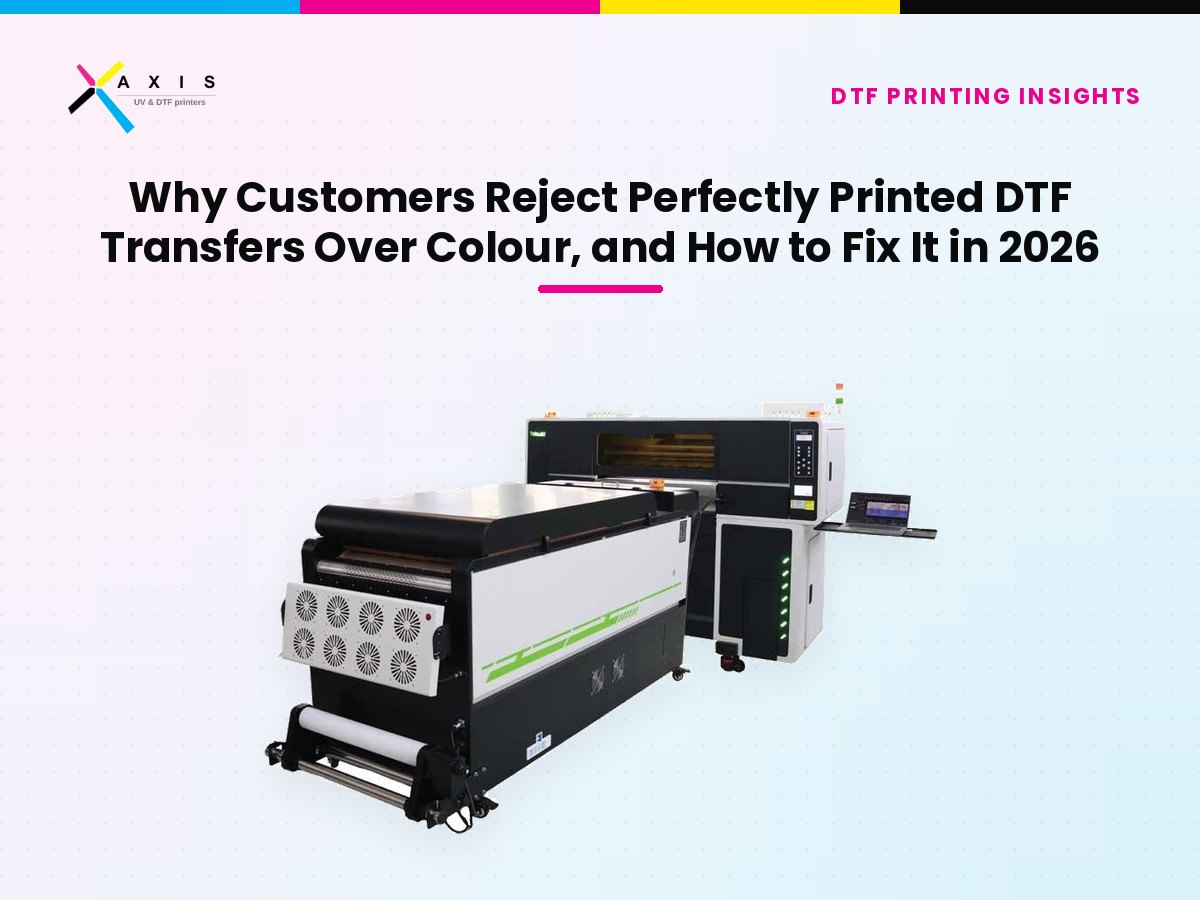
Quick answer: Most DTF (direct-to-film) print rejections are not caused by bad artwork or a faulty machine. They happen because the colour a customer approved on screen does not match the colour that comes off the press after curing. Fixing this means calibrating your workflow with proper ICC colour profiles, testing on the actual fabric and machine that will run the job, and using a physical swatch reference instead of a monitor for final sign-off. Printers who standardise this process cut reprint rounds, protect margins on every order, and build the kind of reputation that brings repeat business from schools, corporate buyers, and event clients in 2026.
What Is DTF Printing, and Why Does Colour Go Wrong So Easily?
Direct-to-film (DTF) printing is a method where a design is printed onto a special PET film using CMYK and white inks, coated with adhesive powder, then transferred onto fabric using a heat press. Colour goes wrong because DTF involves more variables than a simple digital print: white underbase density, film type, powder melt, curing temperature, and monitor calibration all shift the final shade independently of the artwork file.
Unlike screen printing, where a colour is mixed once and locked into a screen, DTF colour is generated fresh by the RIP software and printer for every job. That flexibility is what makes DTF attractive for short runs and personalised orders, but it also means colour discipline has to be built into the workflow rather than assumed.
How Small a Colour Difference Can a Customer Actually Notice?
Smaller than most printers assume. Colour scientists measure differences using a metric called Delta E, and the threshold for visible difference is much lower than it feels on a busy production day.
"A human eye that is trained to evaluate color can see a visual difference between two swatches of color that have a Delta E of 2 or 3," writes Shelby Sapusek, CMO of ColorCasters LLC, in a 2025 PRINTING United Alliance technical brief.
An untrained eye, such as a customer looking at their own logo, typically needs a Delta E of only 5 to 6 before noticing something is off. That is a narrow window, and it explains why a print that looks "close enough" to an operator can still get rejected by the client who ordered it.
Why Is Getting Colour Right Becoming a Bigger Deal for DTF Printers in 2026?
Because the market is growing fast, and growth brings more competitors chasing the same repeat customers. According to Grand View Research (2026), India's DTF printing market was valued at USD 218.8 million in 2024 and is projected to reach USD 380.3 million by 2030, growing at a compound annual rate of 9.3 percent.
Globally, the picture is similar. Grand View Research (2026) values the worldwide direct-to-film printing market at USD 2.72 billion in 2024, projected to reach USD 3.9 billion by 2030 at a 6.0 percent CAGR.
Demand for customised apparel is climbing even faster. According to Grand View Research (2026), India's print-on-demand market stood at USD 857.9 million in 2025 and is projected to reach USD 5,419.0 million by 2033, a 26.2 percent CAGR fuelled by demand from schools, event organisers, and small fashion brands ordering short, customised runs.
More orders and more competitors mean more first impressions riding on a single print. A buyer who gets a colour-accurate sample the first time has little reason to shop around for their next order.
What Actually Causes Colour Mismatches in DTF Production?
Most colour mismatches trace back to one of four points in the workflow, not to the printer hardware itself. Knowing where to look saves hours of guesswork on the shop floor.
- Monitor calibration: An uncalibrated screen can show a design several shades brighter or cooler than what any printer can physically produce.
- White underbase density: Too little white ink lets the fabric colour bleed through; too much makes colours look flat and chalky.
- Curing temperature and time: Under-cured powder leaves prints dull and prone to peeling; over-curing can scorch and darken lighter shades.
- Missing ICC profiles: Without a profile matched to the specific ink, film, and fabric combination, the RIP software is effectively guessing at colour conversion.
Nearly half the industry has not automated even the basics of this workflow yet. FESPA's 2025 Print Census, reported by WhatTheyThink (2026), surveyed 774 print businesses across 89 countries and found that nearly 50 percent report no automation tools in place at all. Colour management is one of the easiest and cheapest places to close that gap.
How Should a Smart Buyer Think About Solving This Problem?
Chasing a cheaper machine will not fix a colour problem rooted in process. A smarter approach is to judge any DTF setup, and any supplier, against criteria that actually predict consistent output over years of daily use.
- Repeatable output, not just peak specifications. A machine that holds the same colour on order 500 as it did on order 1 matters more than a headline speed number.
- Structured operator training. Colour consistency depends on people following a process, not on the machine alone, so real hands-on training is not optional.
- Transparent job costing. Suppliers who help you cost ink, film, powder, and rework accurately make it easier to justify the extra minute spent on a proper colour check.
- Responsive local after-sales support. When a colour problem appears mid-batch, the speed of getting a technician or a straight answer determines how much of the order you save.
- Consistent consumables and profiles. Ink, film, and powder that behave the same batch after batch are what make a colour profile worth building in the first place.
What Should You Look for in a DTF Supplier Before You Buy?
Look past the brochure and test the things that actually protect colour accuracy once the machine is running your daily orders.
- Look for a supplier who will run a live demonstration printing your own artwork on your intended fabric, not just a pre-loaded sample file.
- Look for a supplier who provides or supports ICC colour profiles for the specific ink, film, and powder combination you will actually use.
- Look for a supplier who includes structured operator training on colour calibration, not just machine start-up steps.
- Look for a supplier who can explain job costing clearly enough that you can price rework without guessing.
- Look for a supplier with local technicians and spare parts, so a colour or print-head issue does not stall a client deadline for days.
- Look for a supplier willing to put maintenance and colour-consistency commitments in writing, not just in a sales conversation.
| :-: | :-: | :-: |
|---|---|---|
| Colour Problem | Likely Cause | What Usually Fixes It |
| Print looks dull or chalky after curing | Too much or unevenly applied white underbase powder | Recalibrate powder density and shaker settings for the specific film in use |
| Colours look correct on screen but wrong after pressing | Uncalibrated monitor or missing ICC profile | Build a profile matched to the ink, film, and fabric combination, then verify against a physical swatch |
| Same design prints differently on two separate orders | Inconsistent curing temperature or time between batches | Log and standardise heat press settings per fabric type |
| Colour fades or shifts after a few washes | Under-curing the powder to save time | Run a wash-durability test before approving final production settings |
How Does This Fit Into a Modern DTF Printing Business?
Fixing colour approval is not a one-time task. It sits alongside the broader shift toward digital textile printing, where every job is produced on demand rather than pre-planned in bulk, which is exactly why colour discipline has to be built into the daily routine rather than handled case by case.
This is where Axis Enterprises fits in. Axis Enterprises builds its DTF machines, training, and after-sales support around exactly the criteria described above: dependable print output, hands-on operator training that covers colour calibration, transparent job costing, and responsive local service and spare parts so a colour issue never turns into a lost order. You can see this approach in action by visiting axisdtf.com.
Printers who have gone through Axis Enterprises' operator training programs often say the biggest change is not the machine itself but having a repeatable process for checking colour before a job goes to press. That is a direct result of treating colour management as a core part of machine setup, not an afterthought.
If you are weighing whether your current process is costing you reprints and repeat orders, the fastest way to find out is to see a machine and its colour workflow running in person. You can book a free live DTF machine demonstration at axisdtf.com and bring your own artwork and fabric to test exactly the scenario giving you trouble.
Frequently asked questions
What is Delta E, and why does it matter for DTF printing?
Delta E is a numerical scale that measures the difference between two colours. In DTF printing it matters because a trained eye can spot a difference at a Delta E of just 2 to 3, and an untrained customer typically notices one around 5 to 6, so even small process drift can trigger a rejected order.
Why does a DTF print look different after curing than it did on screen?
Screens display colour using light, while printed ink and powder reflect light after being cured onto fabric, so the two will never match perfectly without a proper ICC colour profile. Uncalibrated monitors make this gap even larger, which is why a physical swatch should always be the final reference, not the screen.
Can two DTF machines from the same brand still print different colours?
Yes, if their white underbase settings, curing profiles, or consumable batches differ even slightly. This is why standardised settings and documented profiles matter more than simply owning the same model of machine.
How can a small DTF business reduce back-and-forth on customer colour approvals?
Build a physical swatch book from your actual production settings and use it, rather than a screen, for every customer sign-off. Pairing this with a documented ICC profile for each fabric and ink combination removes most of the guesswork that causes repeated approval rounds.
Does operator training really affect colour consistency?
Yes, because most colour drift comes from small process variations, such as inconsistent powder application or curing time, rather than the machine itself. Structured training, like the programs built into Axis Enterprises' installation and support process, is what keeps those variations from creeping back in over time.
Sources
- Grand View Research, India Direct-to-Film Printing Market Outlook (2026)
- Grand View Research, Direct To Film Printing Market Size and Share Report (2026)
- Grand View Research, India Print On Demand Market Outlook (2026)
- PRINTING United Alliance, "Dissecting Delta E and the Mathematical Difference Between Colors" by Shelby Sapusek, CMO, ColorCasters LLC (2025)
- WhatTheyThink, "FESPA Launches its 2026 Print Census as it Releases Key Findings from its 2025 Survey" (2026)
Founder, Axis Enterprises. Selling and servicing digital printing machines across India since 2011. Author of "Increase Your Profit by 270% with UV Printing Technology". More about the author