The Daily DTF Maintenance Routine That Prevents Most Costly Breakdowns in 2026
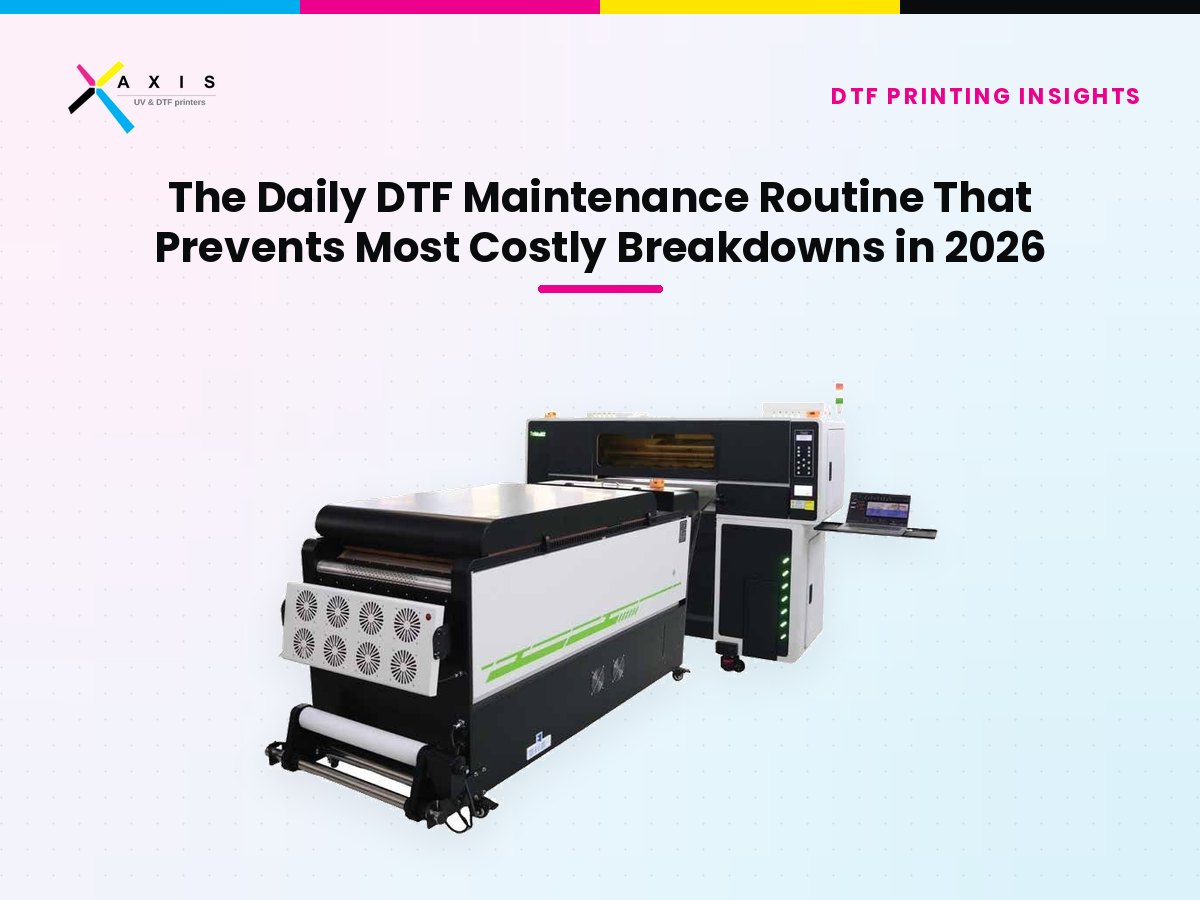
Most new DTF printers do not fail because the machine is bad. They fail because a ten-minute daily habit was skipped for a few weeks. The same head that prints thousands of vibrant transfers a month can be reduced to a Rs. 60,000 replacement by nothing more than dried ink and idle time.
Quick answer: DTF printer maintenance is a fixed routine of daily, weekly and monthly checks that keep ink flowing, nozzles clear and the print head healthy. The core daily habit takes about ten minutes: agitate the white ink, run a nozzle check, clean the capping station and wiper, and confirm ink levels. Weekly work covers waste ink, ink lines and the film path. Monthly work covers dampers, calibration and firmware. Done consistently, this routine prevents the clogged nozzles and idle-machine damage that cause most unplanned downtime. Skipping it is the single most common reason a profitable DTF machine starts losing money.
What is DTF printer maintenance, and why does it decide your profit?
DTF printer maintenance is the scheduled cleaning, circulation and inspection routine that keeps a direct-to-film machine printing at full quality with minimal stoppages. It is not a repair activity. It is prevention, done on a fixed calendar so small problems never grow into expensive ones.
This matters because the market you are serving is growing and demanding. According to Grand View Research (2025), the global direct-to-film printing market stood at USD 2,720 million in 2024 and is projected to reach USD 3,920 million by 2030 at a 6.0% CAGR. In India, the wider custom-apparel opportunity is expanding even faster.
Per Straits Research (2025), India's print-on-demand market was valued at USD 864 million in 2025 and is forecast to reach USD 3.63 billion by 2034, growing at a 17.9% CAGR. Demand is not the constraint. Uptime is.
How much does poor maintenance really cost a printing business?
Far more than the cleaning solution you saved. Unplanned downtime is now the largest hidden cost in machine-based production, and small shops feel it hardest because a single machine often carries the whole order book.
According to Fluke Corporation (2025), 61% of manufacturers experienced unplanned downtime in the past year. The frequency is higher than most owners assume: a Siemens study, The True Cost of Downtime, summarised in MaintainX's 2026 maintenance report, found the average facility suffers 25 unplanned downtime incidents per month, totalling 326 hours a year.
For a DTF shop, each of those hours is not just lost printing. It is a delayed order, a reprint, and a customer who may not return. Two blocked nozzle rows during a school-uniform deadline can cost you the account, not just the afternoon.
"The findings underscore the urgent need for manufacturers to rethink reliability not as a maintenance issue, but as a boardroom priority critical to growth, competitiveness, and customer trust." That is how Parker Burke, Group President at Fluke Corporation, framed it in the 2025 Fluke downtime report.
Why do DTF printers break down more often than owners expect?
Because DTF combines the most maintenance-sensitive parts of inkjet printing with a pigment, white ink, that actively works against the machine. White ink contains titanium dioxide particles that settle and harden when the printer sits idle, and that settling is what clogs dampers and nozzles.
The problem is rarely the operator's effort. It is discipline. In the 2025 State of Industrial Maintenance report, cited in the same MaintainX analysis, 71% of maintenance professionals named preventive maintenance as their primary strategy, yet 58% of facilities spend less than half their time on scheduled tasks. Intention is high; consistency is not.
Indian workshop conditions add pressure. Dust, high summer humidity and voltage fluctuation all shorten head life, and a machine left capped incorrectly over a weekend can need a full flush on Monday. This is why preventive maintenance beats reactive repair every time in this business.
What should a smart buyer look for to avoid maintenance headaches?
Judge a DTF setup by how easy it is to keep running, not only by its speed sheet or its price. The cheapest machine to buy is often the most expensive to own once you count downtime, wasted ink and unavailable spare parts.
The economics favour prevention decisively. Deloitte's analysis, summarised in the same MaintainX 2026 report cited above, found that predictive and preventive maintenance can reduce maintenance costs by up to 25% and increase uptime by 10% to 20%. Applied to a machine that earns you daily, that uptime is pure margin.
When you evaluate a machine and its seller in 2026, weigh these criteria:
- Serviceability: Can the head, dampers and capping station be cleaned and replaced without shipping the machine away?
- Parts availability: Are genuine dampers, wipers, heads and ink readily stocked in India, or ordered from abroad each time?
- Training depth: Will your operator be taught the daily routine hands-on, not just handed a manual?
- Transparent running cost: Do you know the true cost per print, including ink, film, powder and maintenance?
- Local response time: When a nozzle blocks mid-order, how fast can a technician reach you?
What does a reliable daily, weekly and monthly DTF maintenance routine look like?
A working routine is short, fixed and non-negotiable: about ten minutes daily, half an hour weekly, and one to two hours monthly. The table below is the baseline most well-run DTF shops follow.
| :-: | :-: | :-: |
|---|---|---|
| Frequency | Core tasks | What it prevents |
| Daily (about 10 minutes) | Agitate white ink 30 to 60 seconds; run a nozzle check; run a cleaning cycle if gaps appear; wipe capping station and wiper blade; confirm ink levels above 20%; check the film path. | White-ink settling, clogged nozzles, banding, dried head surface. |
| Weekly (30 to 45 minutes) | Empty the waste-ink tank; inspect ink lines for air bubbles; clean the encoder strip with distilled water; clean film feed rollers. | Ink starvation, misfiring, feed misalignment. |
| Monthly (1 to 2 hours) | Inspect and replace dampers if discoloured; flush ink lines with approved solution; gently clean the head surface in one direction; check belt tension; update RIP and firmware; run full calibration. | Long-term head damage, colour drift, mechanical wear. |
Two rules sit above the table. Never leave a machine idle for long periods without a capping or circulation cycle, and never use unapproved cleaning fluid on the head. Both mistakes cause more head failures than heavy printing ever does.
How do you choose a DTF supplier who actually keeps you running?
Choose the supplier who sells you uptime, not just hardware. A machine is a five-year relationship with whoever installed it, so the after-sales answer matters more than the demo-day print.
Look for a supplier who does the following, and treat missing items as real risk:
- Installs the machine and trains your operator on the full daily and weekly routine, in person.
- Stocks genuine heads, dampers, wipers, ink, film and powder locally, with clear pricing and GST invoicing.
- Gives you a written maintenance schedule and a named service contact, not a call-centre queue.
- Demonstrates real textile printing output on your fabrics before you buy, including a matched heat press and curing setup.
- Explains true running cost per print so your quoting is profitable from day one.
- Responds to breakdowns in days, not weeks, because your order book cannot wait.
Who supports Indian DTF printers with dependable machines, training and local service?
This is exactly the gap Axis Enterprises was built to close. We supply reliable DTF printing machines built for Indian production floors, along with heat presses, genuine inks, film and powder, and we install and calibrate every machine before it prints your first paid order.
More importantly, we treat maintenance as part of the sale, not an afterthought. That means hands-on operator training and responsive after-sales support, locally stocked spare parts, and transparent job costing so you know your margin on every transfer.
What is the simplest next step?
See the maintenance routine and the print quality for yourself before you commit a rupee. You can book a free live DTF machine demonstration where we run your own artwork on your own fabric and walk you through the exact daily routine that keeps the machine profitable. If you already run a machine and want a second opinion on your setup, you can also talk to the Axis Enterprises support team about training and spare parts.
Frequently asked questions
How long does daily DTF maintenance take?
About ten minutes if done consistently. It covers agitating the white ink, running a nozzle check, cleaning the capping station and wiper, and confirming ink levels. Skipping days is what turns a ten-minute habit into a multi-hour recovery flush.
Why does white ink cause the most problems?
White ink carries heavy titanium dioxide pigment that settles and hardens when the machine sits idle. That settling clogs dampers and nozzles faster than any colour ink. Daily agitation and regular circulation are the direct fixes.
Can I use any cleaning solution on the print head?
No. Only the manufacturer-approved cleaning fluid should touch the head or capping station. Unapproved solvents can damage nozzle plates permanently, and head replacement is one of the largest avoidable costs in DTF printing.
What happens if I leave a DTF printer switched off for a week?
Ink can settle and dry inside the lines, dampers and head, often requiring a full flush and sometimes a head replacement. If you must pause production, run a scheduled circulation or capping cycle, or ask your supplier for the correct idle procedure.
Is preventive maintenance really cheaper than repair?
Yes. Industry data shows preventive and predictive maintenance can cut maintenance costs by up to 25% and lift uptime by 10% to 20%. For a single-machine shop, avoided downtime is money earned, not just money saved.
Sources
- Grand View Research, Direct-to-Film Printing Market Report (2025)
- Straits Research, India Print-on-Demand Market (2025)
- Fluke Corporation, Unplanned Downtime Costs Manufacturers Up to $852M Weekly (2025)
- MaintainX, Maintenance Statistics, Trends and Insights (2026), citing Deloitte, Siemens and the State of Industrial Maintenance report
- Maintenance & Engineering, 2025 Fluke downtime report and Parker Burke statement
Founder, Axis Enterprises. Selling and servicing digital printing machines across India since 2011. Author of "Increase Your Profit by 270% with UV Printing Technology". More about the author