Deep-Cleaning Mistakes That Are Quietly Damaging DTF Print Heads and Wasting Ink in 2026
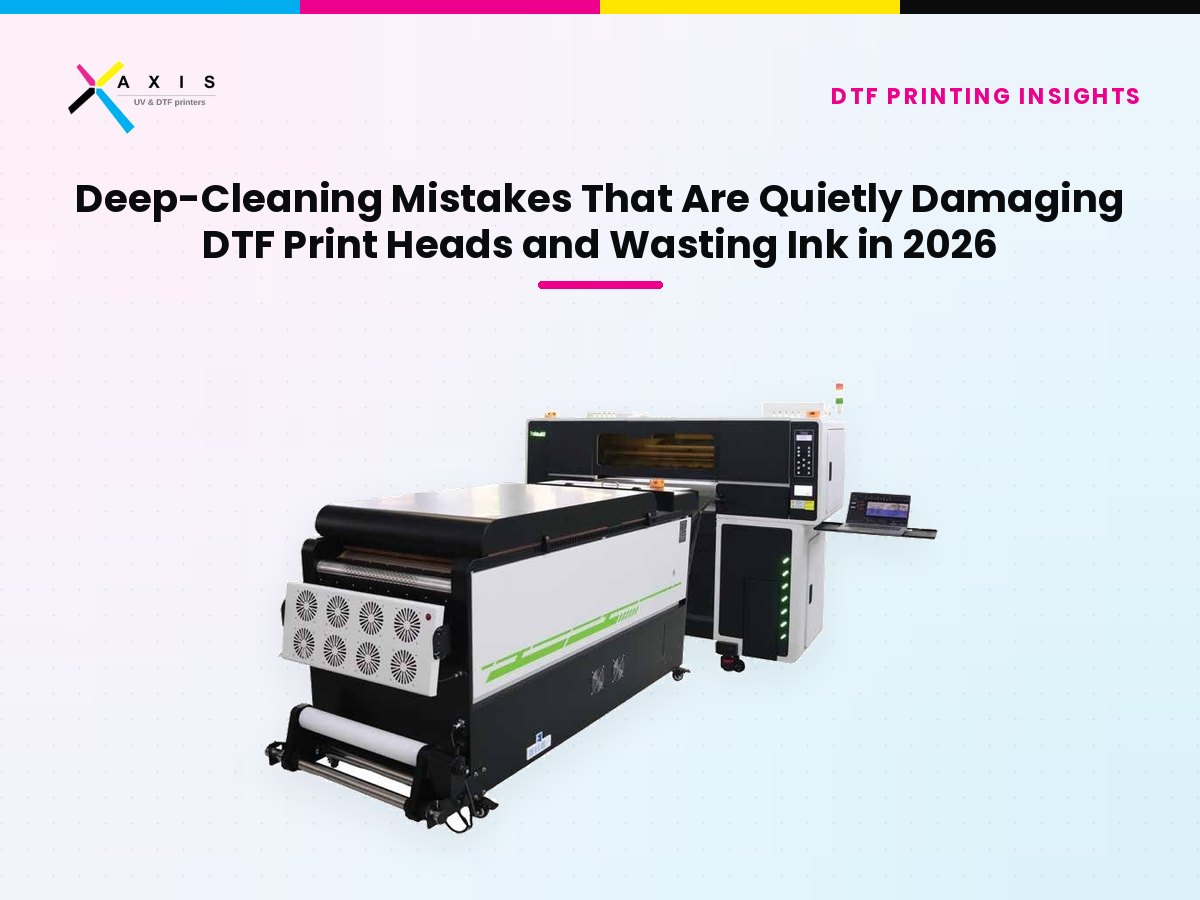
Most DTF print head damage in 2026 is not caused by high print volume. It is caused by well-meaning deep-cleaning routines: excessive auto-cleans, aggressive manual flushing, incompatible cleaning solutions, and neglected capping stations, dampers, and wiper blades.
A replacement print head typically costs upward of Rs 75,000, while the small parts that actually cause most of that damage cost only Rs 7,000 to Rs 13,000 a year to keep in good condition. The fix is not less cleaning. It is correct cleaning: the right frequency, the right solution, and disciplined replacement of the parts that protect the head.
What is a DTF deep clean, and why can it hurt more than it helps?
A DTF deep clean is an intensive maintenance cycle that force-flushes ink through a print head's nozzles, dampers, and ink lines to clear buildup that routine daily wiping cannot reach. It differs from the short automatic cleaning cycle a direct-to-film (DTF) printing machine runs before each job, and it puts far more strain on the underlying inkjet printing mechanism each time it runs.
According to DigiPrint USA (2026), a replacement print head typically costs upward of $900, roughly Rs 75,000 to Rs 80,000 at current exchange rates, while the three small parts most responsible for that damage, dampers, capping stations, and wiper blades, cost only $80 to $150 a year, roughly Rs 7,000 to Rs 13,000, to keep in working order. Most operators only learn this ratio after paying for a new head.
How much does printhead damage actually cost a growing DTF business in 2026?
Printhead damage costs money twice: once for the replacement part, and again in the order volume lost while the machine sits idle. Both costs are climbing as the DTF market itself expands.
India's direct-to-film printing market was valued at $243.9 million in 2025 and is projected to reach $380.3 million by 2030, growing at a 9.3% compound annual rate, according to Grand View Research (2025). As more small and medium printers enter this market, machines that are already running close to full capacity have far less room to absorb an unplanned week of downtime from a damaged head.
- A single head replacement (roughly Rs 75,000 to Rs 80,000) can wipe out a month or more of net profit for a small print shop.
- Every day the machine is down waiting on a part is a day of orders pushed to a competitor.
- Reprints caused by a partially clogged head, rather than total failure, often surface only after the film has already been through the heat press stage, wasting garments as well as ink.
Why do well-intentioned cleaning routines end up damaging the print head?
Most damage comes from cleaning too often, too aggressively, or with the wrong materials, not from normal printing. Operators trying to protect an expensive head often do the opposite by running deep cleans on a fixed schedule instead of in response to an actual problem.
"Every time you do an auto-clean, you're literally throwing money down the drain because the ink is going down your tubes," says Deana Iribe, training and marketing content manager at Printer Biz and owner of The Print Bakery, speaking at the PRINTING United Expo direct-to-film panel in October 2025.
Every auto-clean cycle purges ink through the lines to force a suspected clog clear, and it consumes ink whether or not a clog actually exists. Operators who trigger cleaning on a timer, rather than after a nozzle-check print shows a real problem, are the ones most likely to shorten head life while believing they are protecting it.
Environment plays a role too. The same panel recommended keeping DTF workspaces at a minimum of 45% humidity, since dry air accelerates ink drying inside the nozzles between cleaning cycles, a problem a basic humidifier (roughly Rs 9,000 to Rs 44,000) usually solves. Combined with an incompatible cleaning solution or a stiff wiper blade dragging debris across the nozzle plate, these small oversights add up to the majority of preventable head damage.
What is changing in India's DTF market that makes this mistake costlier in 2026?
Competitive pressure is rising, so a business with a damaged head does not just fall behind on volume, it falls behind on the print quality customers now expect as standard.
The global digital textile printing market, the broader category that includes DTF, was valued at $9.3 billion in 2025 and is projected to reach $10.3 billion in 2026, growing at a 13.0% compound annual rate through 2033, according to Grand View Research (2026). That growth is drawing entrepreneurs away from traditional screen printing, which suits large bulk runs, toward digital methods that can profitably handle the small, fast, personalized orders customers increasingly ask for.
"If I'm a sole entrepreneur, if I'm spending time running the printer, doing maintenance on the printer, I'm losing sight of my sales," says Rob Super, CEO and founder of American Print Supply, at the same PRINTING United Expo panel.
This is why print head damage is a business problem, not only a technical one. Every hour spent nursing a struggling head after an over-aggressive cleaning session is an hour not spent quoting jobs, sourcing customers, or fulfilling the orders this growing market is generating.
What new buying criteria should protect you from this mistake?
A smart buyer in 2026 should judge a DTF setup on more than print speed and price. The criteria below matter more over the life of the machine than they do on day one.
- Documented maintenance protocol. A written, machine-specific cleaning schedule matters more than a generic user manual, since correct frequency is what prevents most head damage.
- Hands-on operator training. Training that covers when to clean, not just how, reduces the habit of cleaning on a fixed timer regardless of need.
- Transparent job costing. A supplier who accounts for wear-part replacement in your running costs helps you budget for Rs 7,000 to Rs 13,000 a year in parts instead of an unplanned Rs 75,000 head.
- Local spare-parts stock. Dampers, capping stations, and wiper blades sitting in a warehouse overseas do nothing for a machine that is down today.
- Responsive after-sales service. A fast diagnostic response can catch a damaged wiper or capping station before it takes the head down with it.
What does a safe DTF cleaning and parts-replacement schedule actually look like?
A safe schedule replaces small, cheap parts on a fixed calendar and reserves deep cleaning for when a nozzle-check print actually shows a problem, not before.
| Part or task | Recommended interval | Approx. cost (India) |
|---|---|---|
| Daily nozzle-check print | Before every shift | Negligible (a few rupees of ink) |
| Wiper blade | Every 2 to 3 months; monthly at 300+ transfers a day | Roughly Rs 1,300 to Rs 5,200 |
| Capping station | Inspect every 3 months; replace at least annually | Roughly Rs 1,300 to Rs 5,200 |
| Damper | Every 6 to 12 months under normal production | Roughly Rs 1,300 to Rs 5,200 |
| Deep clean / auto-clean cycle | Only after a failed nozzle-check, not on a fixed timer | Ink cost of one flush cycle |
Cost and interval data: DigiPrint USA (2026), converted to approximate rupee values.
What should you look for in a DTF machine supplier before your print head becomes a Rs 75,000 problem?
Look for a supplier who can demonstrate this discipline before you sign, not describe it after you have already bought the machine.
- Look for a supplier who trains your operators hands-on on correct cleaning cadence, not just where the buttons are.
- Look for a supplier who hands you a written daily, weekly, and monthly maintenance checklist matched to your machine and local humidity conditions.
- Look for a supplier who stocks dampers, capping stations, wiper blades, and other wear parts locally, not overseas.
- Look for a supplier who quotes job and running costs transparently, including consumable wear, not just the machine's sticker price.
- Look for a supplier who responds quickly the moment a nozzle-check print starts showing a problem, before it becomes a full head replacement.
- Look for a supplier willing to show you the actual cleaning procedure live, on a running machine, before you buy.
Where can Indian DTF printers get equipment and support built around this reality?
Axis Enterprises builds its DTF machines, training, and after-sales program around exactly this reality: print heads fail from bad habits more often than bad luck. Every machine comes with hands-on operator training programs that cover correct cleaning frequency, not just button locations, along with locally stocked genuine spare parts so a Rs 10,000 damper gets replaced before it turns into a Rs 75,000 head. Backing every machine is a responsive after-sales support team based in India, the kind of service this article just described as a buying criterion.
The fastest way to judge whether a machine and its maintenance discipline actually hold up is to watch it running. You can book a free live DTF machine demonstration at axisdtf.com and see the exact nozzle-check process, cleaning cadence, and consumable-replacement routine that protects the print head before you commit to a purchase.
Frequently asked questions
How often should a DTF print head be deep-cleaned?
Only after a daily nozzle-check print shows a real problem, not on a fixed calendar schedule. Running auto-clean cycles on a timer wastes ink and adds mechanical stress even when no clog exists, which is why industry trainers now advise checking first and cleaning only when the check fails.
What is the real cost of DTF print head damage in India?
A full print head replacement typically costs upward of Rs 75,000. The wear parts that actually cause most of that damage when neglected, dampers, capping stations, and wiper blades, cost a fraction of that, roughly Rs 7,000 to Rs 13,000 a year to replace on schedule.
Can using auto-clean too often damage a DTF print head?
Yes. Every auto-clean cycle force-flushes ink through the nozzles and lines, and running it on a fixed timer rather than in response to a genuine nozzle-check failure wastes ink and adds unnecessary stress to the head over time.
What humidity level protects a DTF print head from cleaning-related damage?
Industry trainers recommend keeping the workspace at a minimum of 45% humidity for white-ink DTF printing, since dry air accelerates ink drying inside the nozzles between cleaning cycles. A basic humidifier, typically Rs 9,000 to Rs 44,000, is usually enough to fix this.
How do I know if a cleaning mistake is starting to damage my print head?
Watch for banding, weak whites, or a nozzle-check print with missing lines that does not clear after one normal cleaning attempt. If results do not recover, the fault is more often a worn capping station, wiper, or damper than the head itself, so replacing the small part first can save the head.
Should I clean a DTF machine myself or send it for professional service?
Daily nozzle checks and routine wiping are normal operator tasks that belong in standard training. A deep clean triggered by a failed nozzle-check, or any procedure involving disassembly, is safer handled by a trained technician or under direct supplier guidance, such as the support available through Axis Enterprises' after-sales support, to avoid causing the exact damage the cleaning was meant to prevent.
Sources
- Grand View Research, India Direct-to-Film Printing Market Size and Outlook (2025)
- Grand View Research, Digital Textile Printing Market Size and Share Report (2026)
- DigiPrint USA, Dampers, Capping Stations, and Wiper Blades: the Parts That Protect Your Printhead, by Gaurav Gadh (2026)
- ASICentral, PRINTING United Expo 2025: The Present and Future of Direct-to-Film Printing (October 2025)
Founder, Axis Enterprises. Selling and servicing digital printing machines across India since 2011. Author of "Increase Your Profit by 270% with UV Printing Technology". More about the author