How to Diagnose and Fix Common DTF Printing Problems Before They Cost You a Day of Production
Most machine stoppages in a DTF workshop do not begin as breakdowns. They begin as a faint band across a print, a slightly weak white, or a transfer that peels after one wash, small signals an operator can catch in minutes but often misses for hours. That gap between the first warning and the actual fix is where a printing business quietly loses its most profitable time.
Quick answer: Common DTF problems fall into four groups: nozzle and print-head issues (banding, missing colours), ink issues (weak white, oily prints, clogging), film and powder issues (poor adhesion, uneven powder), and curing issues (peeling, cracking or rubbery feel). Diagnose them in order: check a nozzle test print first, then ink circulation and levels, then film and powder handling, then heat-press temperature, pressure and time. Most faults trace to one changed variable. Isolating that variable early is what keeps a minor issue from becoming a full day of downtime.
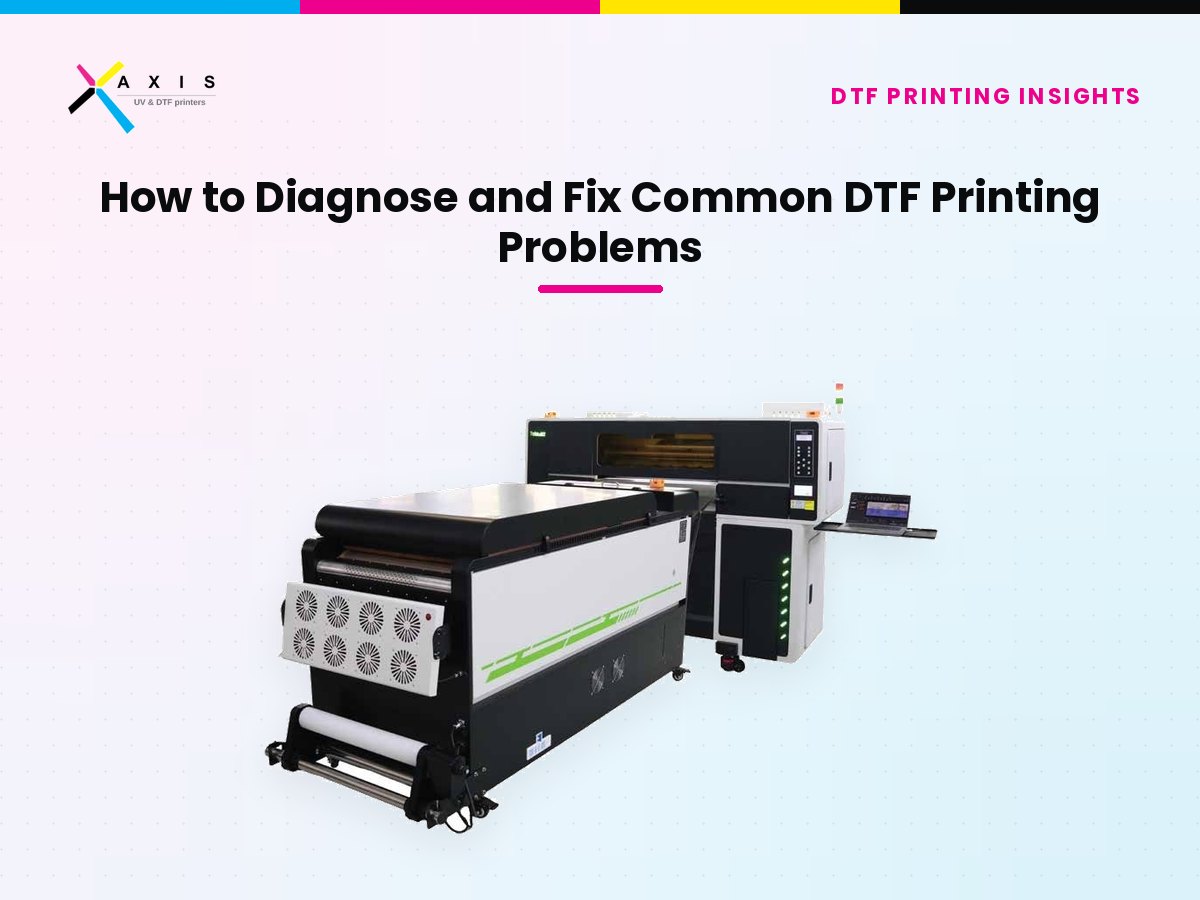
Direct-to-film printing is a process in which a design is printed onto a coated film, dusted with adhesive powder, cured, and then heat-pressed onto fabric. Because it chains together an inkjet printing stage, a powder stage and a heat press stage, a fault in any one stage shows up as a defect in the finished garment, which is exactly why fast, structured diagnosis matters.
What counts as a DTF problem, and why does it matter so much?
A DTF problem is any deviation in nozzle output, ink behaviour, film and powder handling, or curing that produces a defective transfer or stops the machine. It matters because each defect consumes film, ink, powder, a garment and operator time all at once.
The financial weight of stopped production is not a small-business myth, and the wider manufacturing data makes the point plainly.
"The data shows us that downtime can't be viewed just as operational problem anymore. It's a real risk to competitiveness and enterprise value." Parker Burke, Group President, Fluke Corporation, whose company's 2025 downtime survey found that 61% of manufacturers experienced unplanned downtime in the past year, at an average cost of USD 1.7 million per hour in large plants.
The absolute figures are enterprise-scale, but the lesson scales down cleanly. For a small Indian printer the cost is felt in missed delivery promises and wasted consumables rather than millions, yet the mechanism is identical: a machine that is diagnosing itself into the afternoon is not billing customers.
What are the most common DTF printing problems in 2026?
The most common DTF problems in 2026 are banding and missing colours (nozzle or print-head), weak or patchy white and oily prints (ink), poor powder adhesion (film and powder), and peeling or cracking after wash (curing). Nearly every complaint a workshop receives maps to one of these four groups.
The table below pairs each frequent symptom with its most likely root cause and the first check an operator should run before touching anything else.
| :-: | :-: | :-: |
|---|---|---|
| Symptom | Most likely root cause | First diagnostic check |
| Horizontal banding or lines in the print | Clogged or deflected nozzles | Run a nozzle-check test print and compare against a known-good pattern |
| Weak, grey or patchy white base | White ink settling or poor circulation | Agitate and check white-ink circulation, then reprint a white swatch |
| Oily or greasy-looking transfer | Excess or unmelted adhesive powder | Check powder quantity and curing temperature and time |
| Powder not sticking to the ink | Ink drying too fast or wrong film | Confirm film type and that powder is applied while ink is still wet |
| Print peels or cracks after washing | Under-curing or wrong press settings | Verify press temperature, pressure and dwell time against your test grid |
| Dull or shifted colours | Wrong colour profile or low-quality ink | Reprint with the correct RIP profile and a verified ink batch |
One principle runs through the whole table: change only one variable at a time. When an operator adjusts powder, temperature and film together, the real cause stays hidden and the next failure is inevitable.
Why do minor DTF issues turn into major downtime?
Minor issues become major downtime because operators cannot diagnose the specific stage at fault, so they guess, and guessing on a chained process multiplies waste. The problem is rarely the machine itself. It is the absence of a fixed diagnostic order.
This matters more every year because the field is getting more crowded and less forgiving. The global direct-to-film printing market stood at USD 2,720 million in 2024 and is projected to reach USD 3,920 million by 2030, according to Grand View Research, a 6.0% compound annual growth rate that is pulling new entrants and price competition into the category.
On the equipment side, 360iResearch (2026) estimates the DTF printer market at roughly USD 2.85 billion in 2026, growing to USD 4.25 billion by 2032 at a 6.77% CAGR. More machines in the market means more operators learning on the job, and more businesses discovering that buying a printer is easy while running it reliably is not.
India sits right in the middle of this shift. The IMARC Group (2025) values the India custom T-shirt printing market at USD 176.6 million in 2025, projected to reach USD 407.9 million by 2034 at a 9.75% CAGR, growth that rewards printers who can deliver consistent quality on time and punishes those who cannot.
The takeaway for a garment printer is direct: in a growing, competitive market, the business that diagnoses fast keeps its customers, and the one that stays down loses them to a shop that did not.
How should a smart buyer think about DTF reliability?
A smart buyer should judge a DTF setup by how quickly it can be diagnosed and restored, not only by its top print speed. Uptime, not headline specifications, decides monthly output. This is a reframe most first-time buyers miss.
The maintenance evidence supports the reframe. Deloitte reports that structured, predictive maintenance can raise equipment uptime by 10 to 20% and cut maintenance costs by 5 to 10%, gains that come from catching faults early rather than reacting to breakdowns.
Applied to DTF, that means the strongest setups are the ones designed to be understood. When you evaluate a machine and its supplier, weigh these criteria:
- Diagnosability: can an average operator run a nozzle check, read the result, and isolate the failing stage without a technician on the phone?
- Trained operators: is there real, hands-on training so your team can fix routine faults instead of waiting for help?
- Consumable discipline: are ink, film and powder specified and compatible, so you are not introducing new variables with every purchase?
- Local service depth: when a part fails, is it available and installed quickly, or does the machine sit idle for weeks?
- Transparent job costing: do you know your true cost per print, so downtime and waste are visible rather than hidden?
What should you look for in a DTF supplier to minimise downtime?
Look for a supplier whose offer is built around keeping you running, not just closing a sale. The right partner shortens the distance between a problem appearing and a problem being fixed. Use this checklist when you compare options:
- Look for a supplier who demonstrates the machine live and lets you watch a full print, powder and cure cycle before you buy.
- Look for a supplier who provides structured operator training so your staff can diagnose nozzle, ink, film and curing faults themselves.
- Look for a supplier who documents recommended ink, film and powder combinations, so your consumables stay consistent.
- Look for a supplier who stocks critical spare parts locally and commits to a clear response time for service.
- Look for a supplier who helps you calculate cost per print and break-even, so you can price jobs and measure waste honestly.
- Look for a supplier who stays reachable after installation, because after-sales responsiveness is what actually protects your uptime.
Screen, sublimation and vinyl shops adding DTF face the same test. Whatever the base technology, from textile printing methods to modern digital transfer, the supplier relationship decides how a bad day ends.
Where does Axis Enterprises fit in?
Everything above describes how Axis Enterprises is built to work with Indian garment printers. Axis supplies DTF printing machines, heat presses and matched inks, film and powder, then backs them with installation, hands-on operator training, and responsive local after-sales service and spare parts so that routine faults get diagnosed and fixed fast instead of turning into lost days.
The aim is simple: a machine your team understands, consumables that stay consistent, and a support line that answers when a print starts banding at 4 pm. You can explore the full range of machines and support at the Axis Enterprises DTF printing website.
If you are weighing your first DTF machine or trying to stop an existing one from eating your production hours, the most useful next step is to see a full cycle in person. You can book a free live DTF machine demonstration and watch a complete print, powder and cure run, ask about training and spare-parts support, and get an honest cost-per-print estimate for your own jobs. Bring a design you actually sell and arrange your demonstration with the Axis Enterprises team to see how quickly a well-set-up line recovers from the everyday problems covered here.
Frequently asked questions
Why is my DTF printer showing banding or missing lines?
Banding almost always points to clogged or deflected nozzles rather than a broken machine. Run a nozzle-check test print and compare it to a known-good pattern, then run a controlled head cleaning if nozzles are missing. If banding persists after cleaning, check ink levels and circulation before assuming a hardware fault.
Why is the white ink weak or patchy on my prints?
Weak white is usually caused by white ink settling or poor circulation, since white pigment separates faster than colour ink. Agitate the white ink, confirm the circulation system is working, and reprint a solid white swatch to check coverage. Keeping white ink moving daily prevents most of these interruptions.
Why do my DTF transfers peel or crack after washing?
Peeling and cracking are curing faults, not printing faults, in most cases. Verify your heat-press temperature, pressure and dwell time against a tested settings grid, and confirm the powder has fully melted during curing. Wash-test a sample before approving any new setting for production.
How can a small printing business reduce DTF downtime?
The fastest way to cut downtime is to fix a diagnostic order and train every operator to follow it: nozzle check first, then ink, then film and powder, then curing. Pair that with a daily maintenance routine and a local supplier who stocks spare parts. Catching one changed variable early is cheaper than any reprint.
Is DTF still a good business to enter in India in 2026?
The demand signals are positive. The print on demand and custom apparel space in India continues to grow at a strong double-digit rate, which rewards printers who can hold quality and delivery. The deciding factor is operational reliability, not the machine brand alone.
Sources
- Fluke Corporation, Unplanned Downtime Survey (2025)
- Grand View Research, Direct-to-Film Printing Market Report
- 360iResearch, DTF Printer Market (2026)
- IMARC Group, India Custom T-Shirt Printing Market (2025)
- Deloitte, Using Predictive Technologies for Asset Maintenance
Founder, Axis Enterprises. Selling and servicing digital printing machines across India since 2011. Author of "Increase Your Profit by 270% with UV Printing Technology". More about the author