The DTF Machine Demonstration Checklist: What Every Indian Buyer Should Test Before Paying in 2026
Most buyers judge a printing machine by a polished showroom clip. That single habit is the most expensive mistake a new garment-printing business can make, because the machine that shines in a two-minute demo is not always the machine that survives a full production day.
What should you test in a DTF machine demonstration before you buy?
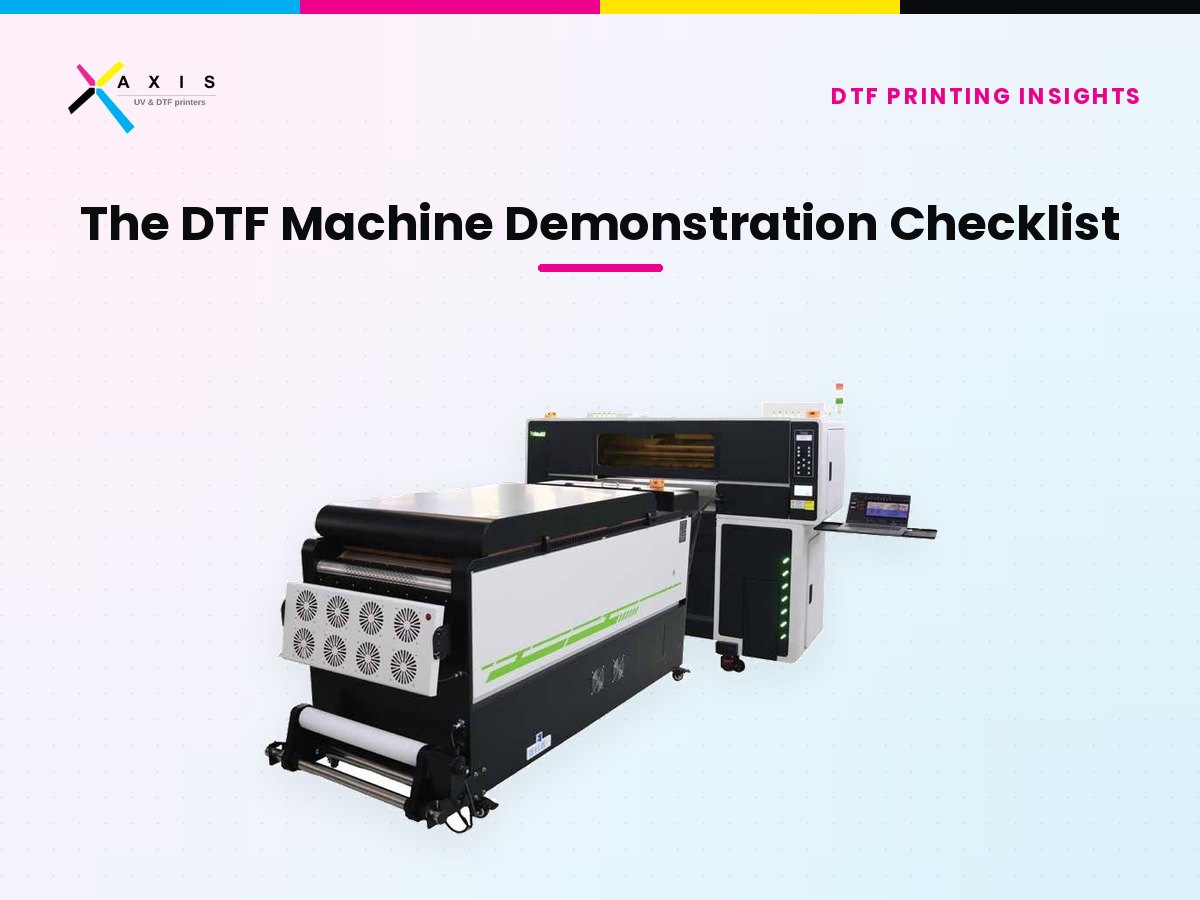
A live DTF machine demonstration is a supervised run where you watch the exact machine you intend to buy print, powder, cure and press your own artwork on your own fabric, from start to finish. Before paying, test five things: print quality on your own designs, real output speed including powdering and curing, white-ink behaviour after an idle pause, wash and stretch durability of the finished transfer, and the supplier's ability to explain settings and service. Insist on your files, your garments and unedited timing. A machine that performs on a controlled showroom sample can still fail on your daily jobs.
What exactly is a live DTF demonstration, and why does it decide your profit?
Direct-to-film (DTF) printing is a process that prints a design onto a coated film, applies adhesive powder, cures it, then heat-presses it onto fabric. A live demonstration is the only moment before purchase when you can verify that this full chain works on your own materials, not on a supplier's ideal sample.
The demonstration decides your profit because DTF is a system, not a single printer. The print engine, the white-ink circulation, the powder shaker, the curing unit and the heat press all have to work together on the fabrics you actually sell. If any stage is weak, your margins leak quietly through wastage and rework.
How big is the opportunity, and why does the wrong machine sink it?
The opportunity is large and growing, which is exactly why a poor machine choice is so costly. According to Grand View Research (2024), the global direct-to-film printing market was valued at USD 2,720.0 million in 2024 and is projected to reach USD 3,920.0 million by 2030, growing at a 6.0% annual rate. The same Grand View Research analysis found that dedicated DTF printers accounted for 45.0% of the market in 2024, a sign that buyers increasingly want purpose-built machines rather than converted desktop units.
Demand inside India is rising even faster. Per IMARC Group (2025), the India custom T-shirt printing market stood at USD 176.6 million in 2025 and is forecast to reach USD 407.9 million by 2034, a 9.75% compound annual growth rate.
The broader buying shift favours short runs and personalization. As reported by Grand View Research (2025), the global print-on-demand market was valued at USD 10.8 billion in 2025 and is projected to reach USD 57.5 billion by 2033, a 23.6% CAGR.
A machine that cannot hold colour, restart cleanly or run all day turns that demand into complaints and refunds. In a rising market, downtime is not a small inconvenience. It is lost orders handed to a competitor.
Why do so many DTF machine purchases disappoint?
Most disappointments trace to one root cause: buyers evaluate the printer, not the workflow. Advertised print speed usually measures film coming off the printer, while your customer only pays for a finished, powdered, cured and pressed transfer.
The technology is also shifting under buyers' feet. Grand View Research reports that the global digital textile printing market was USD 9.3 billion in 2025 and is projected to reach USD 24.2 billion by 2033 at a 13.0% CAGR, with Asia Pacific the fastest-growing region. New models, inks and film coatings arrive constantly, so a machine bought on last year's assumptions can already be behind.
Industry specialists are clear that DTF earns its place because of material range, not novelty. As Achim Bukmakowski, Head of Commercial and Industrial Printing at Epson Deutschland GmbH, told FESPA, "DTF is a very powerful printing process that has advantages especially in markets where printing is not only required on cotton, but on a wide variety of different materials."
"DTF is ideally suited for a wide range of apparel and fashion applications, wherever speed, locality and quality are required." Joachim Rees, Managing Director, Multi-Plot Europe GmbH, speaking to FESPA.
The lesson is simple. Speed, locality and quality only matter if you can verify them on your own jobs before money changes hands.
What new criteria should a smart buyer judge a DTF machine on?
Judge the machine on lifetime economics and reliability, not on sticker price or peak-speed claims. A cheaper machine with heavy wastage and frequent downtime often costs far more per finished print over three years.
Five criteria separate a profitable purchase from an expensive one:
- Total cost per sellable print. Include ink, film, powder, cleaning cycles, wastage and downtime, not just the purchase amount plus GST.
- Real utilization capacity. Match the machine to your genuine daily order volume at a realistic 60 to 70 percent utilization, not to a maximum-speed figure.
- Idle tolerance and white-ink stability. White ink settles and clogs, so the machine must restart cleanly after pauses, which is normal in a small shop.
- Local training and service depth. Installation, operator training and a defined service-response commitment matter more than one extra feature.
- Transparent, demonstrable settings. The operator should be able to show and explain temperature, pressure and profile settings, not hide them.
What should you look for in a DTF machine supplier?
Look for a supplier who treats the demonstration as your test, not their sales pitch. The right partner welcomes your files and your fabric, and shows you the whole process without editing the awkward parts.
- Look for a supplier who lets you run your own artwork and your own garments during the demonstration.
- Look for a supplier who shows unedited, full-cycle timing from print to peeled, pressed transfer.
- Look for a supplier who provides hands-on operator training, not only delivery and a manual.
- Look for a supplier who stocks critical spare parts locally in India and commits to a written response time.
- Look for a supplier who explains ink, film and powder as one compatible system and documents the settings.
- Look for a supplier who can connect you with existing customers running the same machine.
Which tests belong on your demonstration checklist?
Use this checklist during any live DTF demonstration. Ask the operator to run each item on your material, and record what you see rather than what you are told.
| :-: | :-: | :-: |
|---|---|---|
| What to test | Why it matters | What a passing result looks like |
| Print on your own artwork | Your designs reveal fine lines, gradients and white coverage that a demo file may hide | Sharp edges, smooth gradients, solid white under colour, no visible banding |
| Real output speed, full cycle | Advertised speed ignores powdering, curing, loading and finishing | A timed count of finished, peeled, pressed transfers per hour, not just printed film |
| White-ink behaviour after idle | White ink settles and clogs during normal pauses in a small shop | Machine restarts cleanly after a 30 to 60 minute pause with a clean nozzle check |
| Wash and stretch durability | Fresh prints can look perfect yet crack or peel after washing | A pressed sample survives stretching and a wash without cracking or lifting |
| Curing and heat-press control | Under-curing causes peeling, over-curing causes a stiff feel | Repeatable temperature, time and pressure the operator can show on the panel |
| Service and spare-parts response | Downtime stops revenue for a small business immediately | A named response time, confirmed local parts stock and technician availability in writing |
This is the same discipline that separates durable DTF work from weaker alternatives to screen printing and other print-on-demand methods. Verify the full workflow, not a single beautiful sample.
Where does the right machine and support actually come from?
Everything above describes how Axis Enterprises runs a demonstration. We sell DTF printing machines, heat presses and consumables backed by local installation, operator training and responsive after-sales support for garment-printing businesses across India. You bring your artwork and your fabric, and we show the full cycle, the real timing and the settings, with nothing hidden.
If you are weighing a DTF investment this year, the lowest-risk next step is to see the process on your own jobs first. You can book a free live DTF machine demonstration and use the checklist above to judge for yourself. When you are ready, arrange an on-site demonstration with your own designs and confirm the numbers before you commit a single rupee.
Frequently asked questions
How can I verify a seller's advertised printing speed before purchasing?
Ask the operator to time a full cycle on your artwork, from printing through powdering, curing, peeling and pressing, and count only finished transfers. Advertised speed usually measures film leaving the printer, which is not what your customer pays for. A timed, full-cycle count on your own file is the only honest measure.
Should I choose machine capacity based on current orders or expected future growth?
Size the machine to your realistic daily order volume at 60 to 70 percent utilization, with a clear upgrade path for growth. Buying far more capacity than you can fill ties up cash you need for consumables and marketing. A machine that can scale later protects you without overspending now.
What level of machine utilization is realistic for a new DTF business?
Most new shops should plan around 60 to 70 percent of theoretical maximum output once artwork preparation, curing and finishing are included. Planning at 100 percent of advertised speed almost always leads to missed deadlines. Build your costing and delivery promises on the realistic figure.
How do I confirm spare parts are genuinely stocked in India rather than imported after a failure?
Ask to see the local parts inventory and get the response and dispatch commitment in writing before payment. Also call an existing customer and ask how quickly a real breakdown was resolved. Genuine local stock and a named response time are what keep downtime short.
Does using third-party ink or film affect the machine or its results?
Ink, film and powder must be treated as one compatible system, because a mismatch can cause clogging, dull colour or poor adhesion even when each item is sold as DTF-ready. Test any consumable combination through wash and stretch checks, not only a fresh-print look. Ask your supplier which combinations they have validated on the machine.
Sources
- Grand View Research, Direct-to-Film Printing Market Size, Industry Report, 2024 to 2030
- IMARC Group, India Custom T-Shirt Printing Market Size and Report, 2025 to 2034
- Grand View Research, Print On Demand Market Size and Share Report, 2025 to 2033
- Grand View Research, Digital Textile Printing Market Size and Share Report, 2025 to 2033
- FESPA, What is the future of DTF printing?
Founder, Axis Enterprises. Selling and servicing digital printing machines across India since 2011. Author of "Increase Your Profit by 270% with UV Printing Technology". More about the author