Why Most DTF Print Head Failures in India Have Nothing to Do With How Much You Print
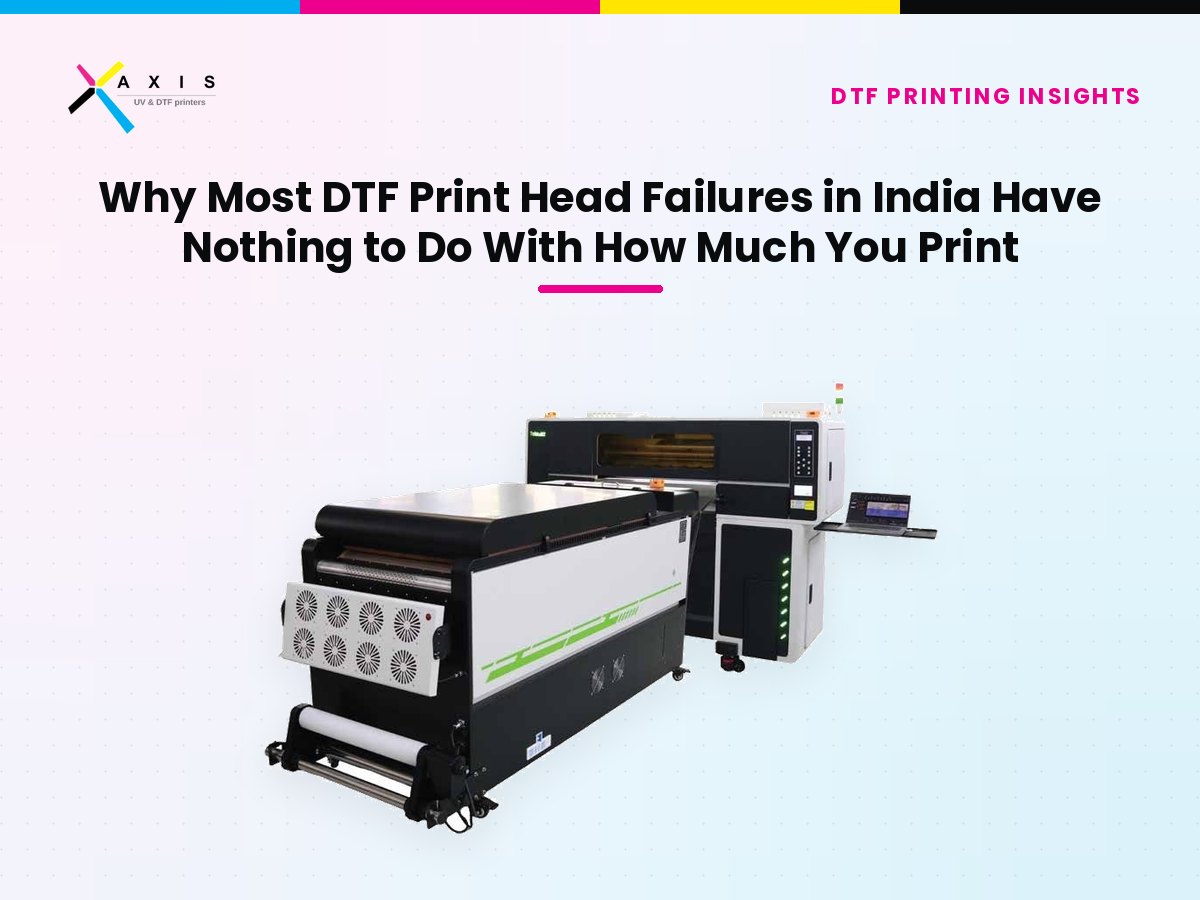
A DTF (direct-to-film printing) print head is the component that fires microscopic droplets of ink, using inkjet technology, through hundreds of nozzles onto film. It is usually the single most expensive part in the machine to replace. Most operators assume heavy daily printing wears a head out fastest, but in practice print volume is rarely the main cause of early failure.
Three other risk categories do most of the damage: unstable ink flow, electrical instability and environmental exposure. A machine that prints only occasionally but sits idle on unstable power in a dusty room will typically lose its head sooner than one run hard every day under controlled conditions.
Does Printing More Actually Wear Out a DTF Print Head Faster?
Not on its own. A print head is built to fire millions of droplets, so routine operation is not what typically ends its working life early. The nozzles that damage a head fastest are ink-flow interruptions, electrical stress and environmental exposure, and all three can occur on a machine that barely prints at all.
The global direct-to-film printing market is projected to grow from USD 2.72 billion in 2024 to USD 3.9 billion by 2030, a 6.0 percent compound annual growth rate, according to Grand View Research (2025). As more machines enter service industry-wide, the businesses that understand what actually damages a head, rather than assuming heavier use is the enemy, are the ones protecting their investment.
What Is the Real Cost of Getting This Wrong in 2026?
An unplanned print-head failure does not just cost the part. It costs the production days lost while a replacement is sourced and fitted, and the orders that go to a competitor in the meantime.
In India specifically, the direct-to-film printing market is projected to grow from USD 243.9 million in 2025 to USD 380.3 million by 2030, a 9.3 percent CAGR, according to Grand View Research (2025). That growth means more first-time buyers are entering the category every year, often without knowing which daily habits protect a head and which quietly destroy one.
- Downtime while a replacement head is sourced, often the longest and most expensive part of a failure.
- Lost customer confidence when a delivery date slips because of a machine problem.
- The cost of the print head itself, which varies by model and brand and is rarely a small expense.
Why Do DTF Print Heads Actually Fail?
Print heads fail because of three separate, controllable risk categories rather than one single cause. Understanding which category, including basic power quality, is at fault is the first step to preventing it.
| :-: | :-: | :-: |
|---|---|---|
| Risk category | What typically causes it | Practical safeguard |
| Ink-flow risk | White ink settling, mixed batches or brands, dried caps and dampers, air trapped in lines | Fixed circulation and agitation schedule, consistent ink batch and brand |
| Electrical risk | Voltage spikes or dips, poor earthing, no UPS or stabilizer, unstable mains supply | Certified earthing, voltage stabilizer and backup power sized for the machine |
| Environmental risk | High humidity, dust ingress, extreme room temperature, poor ventilation | Climate-controlled, enclosed workspace with regular dust checks |
India's power supply illustrates why the electrical category deserves particular attention. Equipment connected to a standard low-voltage supply is generally expected to tolerate only about a plus or minus 5 percent swing from the nominal 230/400 volt rating before performance and lifespan are affected, and correcting persistent instability typically pays for itself within 6 to 18 months depending on how severe the fluctuation is, according to B. Jindal, founder of Jindal Electric and Machinery Corp, writing in Electrical India (2021).
That tolerance matters because much of India does not consistently deliver it. A 2025 review of Indian power-outage reporting found that India ranked 108th out of 141 countries for the quality of its electricity supply in the Global Competitiveness Index, and that most electricity distribution companies still do not publish standardised outage data, according to The Leap Blog (2025). A printer plugged directly into that kind of supply, without protection, is absorbing stress the nozzles were never designed for.
The nozzles themselves are precision components. As Shunsuke Watanabe of Epson's Inkjet-Solution Technology and Business Development Department put it: "The performance of a piezoelectric inkjet rests entirely upon the performance of the elements." A head built around piezoelectric elements depends on those elements staying clean, correctly powered and free of contamination. It does not depend primarily on how many prints pass through them.
What Buying Criteria Actually Matter for Long Head Life?
The right buying criteria protect the head long after the sale, not just at installation. A smart buyer should weigh a supplier's ability to prevent failures, not only the machine's advertised specifications.
- Documented electrical setup guidance. Voltage stabilization, earthing and backup power should be part of the installation conversation, not an afterthought raised only after a failure.
- Consumable compatibility, not just price. Ink, film and powder tested together as a system reduce ink-flow risk far more than the cheapest individual components.
- Operator training on daily protocols. Circulation schedules, idle-machine shutdown routines and nozzle-check habits matter more than any single feature on a spec sheet.
- Transparent job costing. A true cost per print should include a maintenance and head-protection reserve, not just ink and film.
- Responsive local service and spare parts. When a head does eventually need attention, how fast a supplier can respond determines how many production days are lost.
What Should You Look For in a DTF Machine Supplier?
Look past the price tag on the machine itself and evaluate how the supplier treats the months and years after the sale. These are the practical markers of a supplier that protects your print head, not just your purchase order.
- Look for a supplier who walks through voltage stabilization, earthing and UPS sizing during installation, in writing, rather than leaving it to the electrician.
- Look for a supplier who recommends a complete, tested ink, film and powder system rather than encouraging you to mix the cheapest available consumables.
- Look for a supplier who trains your operators on a daily and weekly maintenance routine, with a physical checklist, not a one-time verbal demonstration.
- Look for a supplier who explains true cost per print, including a maintenance reserve, before you sign.
- Look for a supplier with a local service network that stocks print heads and spare parts rather than one that routes every issue through a distant call centre.
- Look for a supplier willing to show you a live demonstration under real production conditions, not a curated video.
This is exactly the standard Axis Enterprises was built around. Axis Enterprises supplies DTF printing machines, heat presses and consumables to Indian garment-printing businesses, and pairs every installation with proper electrical setup guidance, operator training and a local after-sales network, precisely because the data above shows that most head failures are preventable, not inevitable.
If you already own a DTF machine and want a second opinion on your setup, or you are comparing machines before a first purchase, the fastest way to see the difference is to book a free live DTF machine demonstration and walk through your electrical setup, ink handling and maintenance routine with someone who can show you what a protected print head actually looks like in daily production. It costs nothing to compare your current protocol against a proven one, and it is a faster way to find gaps than waiting for the next unexplained head failure. You can start that conversation any time at axisdtf.com.
Frequently asked questions
Does printing at high volume reduce the life of a DTF print head?
Not directly. A print head is designed to fire millions of droplets, so routine daily printing is rarely the primary cause of early failure. Ink-flow interruptions, electrical instability and environmental exposure typically do far more damage than sheer volume.
How do voltage fluctuations and poor earthing affect the print head?
Unstable voltage stresses the electronics that drive the print head, and poor earthing removes a layer of protection against that stress. Over time this can shorten head life even if the machine is otherwise well maintained, which is why a stabilizer, correct earthing and backup power are worth budgeting for at installation.
Can low-quality ink permanently damage a DTF print head?
Yes. Mismatched or low-quality ink can leave residue, clog nozzles and, in some cases, cause damage that cleaning cannot reverse. Using a tested, compatible ink, film and powder system reduces this risk significantly.
What is the average life of a DTF print head under normal Indian working conditions?
There is no single universal figure, because head life depends heavily on ink-flow discipline, power stability and workspace conditions rather than on the machine model alone. Two identical machines run under different maintenance and power conditions can have very different head lifespans.
Can unnecessary deep cleaning shorten print-head life?
Yes, over-cleaning can be as damaging as under-cleaning. Cleaning should follow a nozzle-test result rather than a fixed habit, so the head is cleaned when it needs it and left alone when it does not.
What causes print-head strikes, and how can operators prevent them?
Head strikes usually happen when film, garments or the carriage path are loaded incorrectly, causing the head to hit a raised surface. Training operators on correct loading procedure and a pre-print visual check is the most reliable way to prevent them.
Sources
- Grand View Research, "Direct-to-Film (DTF) Printing Market Size, Share & Trends Report" (2025)
- Grand View Research, "India Direct To Film Printing Market Size & Outlook" (2025)
- B. Jindal, "Managing the Menace of High Voltage," Electrical India (2021)
- The Leap Blog, "A Review of Outage Reporting by Indian DISCOMs" (2025)
- Epson, "Inkjet Printhead Technology" interview with Shunsuke Watanabe

Founder, Axis Enterprises. Selling and servicing digital printing machines across India since 2011. Author of "Increase Your Profit by 270% with UV Printing Technology". More about the author