Why a DTF Printer's Advertised Speed Will Not Match Your Real Daily Output (and How to Size Your Machine Correctly in 2026)
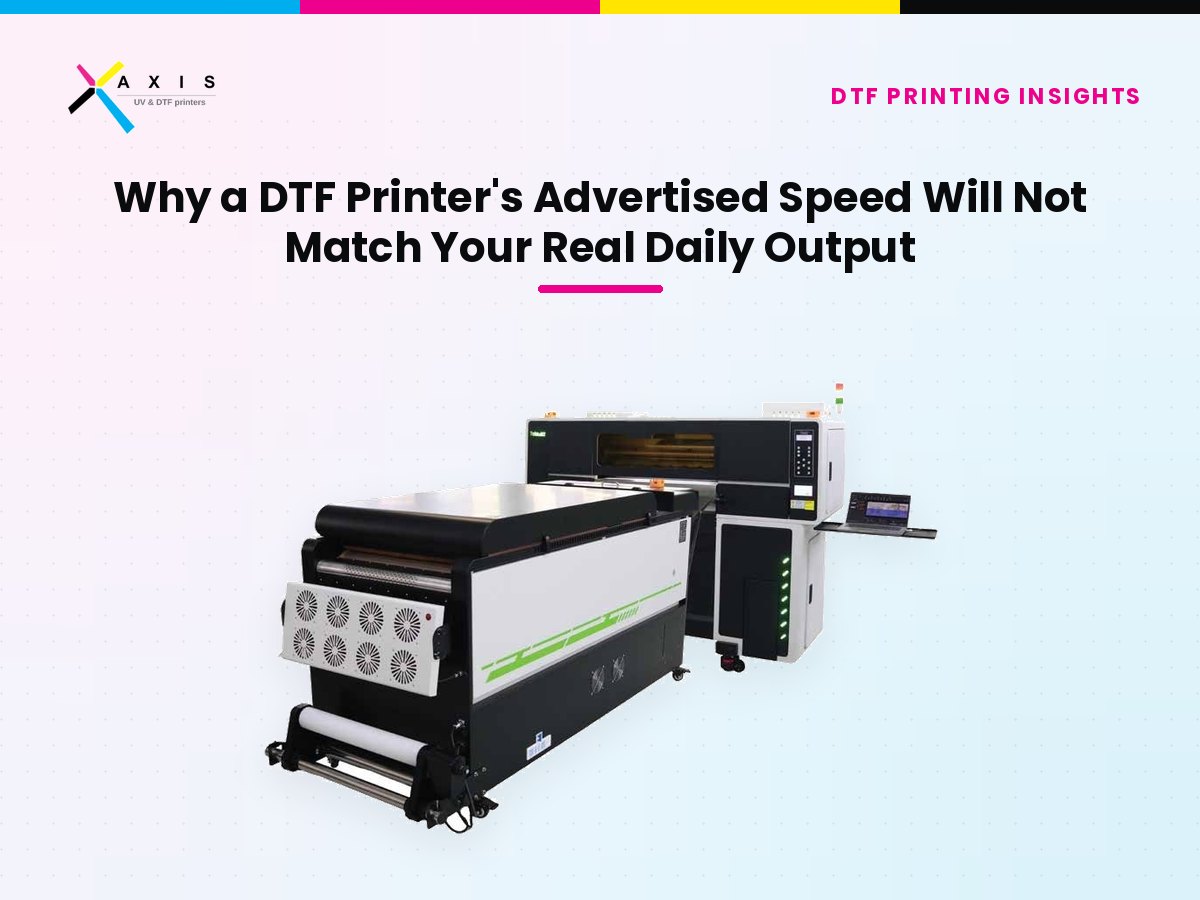
Here is a number most first-time buyers never hear on a showroom floor: a single operator can heat-press only about 50 shirts per hour. As reported by Screen Printing magazine (2024), Roland DGA application specialist Mike Davis puts the average at "approximately 50 shirts per hour" for a standard press. That single figure quietly caps your business, because no printer, however fast, can sell a transfer that has not yet been powdered, cured, pressed and finished.
So when a demonstration prints a wall of transfers in minutes, it is showing you the one stage of production that is almost never your bottleneck.
Quick answer: A DTF machine's advertised speed measures only the print head at full pace on ideal artwork. Your real daily output is set by the slowest stage in the full workflow, usually powdering, curing, pressing and finishing, not the printer itself. Size your machine to the volume you can actually sell at 60 to 70 percent utilization, allowing for artwork preparation, reject rates and operator breaks. Match capacity to your normal daily demand, not to a peak-speed demonstration. A right-sized machine with dependable service and trained operators will out-earn an oversized one that sits idle.
What is DTF printing, and what really sets your daily output?
DTF (direct-to-film) printing is a process that prints a design onto a special coated film, coats it with adhesive powder, cures it, and then transfers it onto a garment with heat and pressure. Your daily output is set not by print speed but by the slowest step in that chain.
Direct-to-film printing is popular because it works across cotton, polyester and blends without pre-treatment, which makes it more flexible than older methods such as screen printing for short and mixed runs.
But the printer is only one link. Powder application, curing, and the heat press stage each take time, and any one of them can become the ceiling on how many finished pieces leave your shop in a day.
Why does a DTF printer's advertised speed rarely match real output?
Advertised speed rarely matches real output because it is measured at maximum print pace on prepared artwork, with none of the surrounding work counted. Real production loses time at every other stage.
Maximum-speed demonstrations usually ignore artwork preparation, powdering, curing, loading and finishing. A machine rated for a high transfer count per hour still waits on a press that manages only around 50 shirts per hour per operator, according to the Roland DGA figures cited above.
The gap shows up in three predictable ways:
- Finishing bottleneck: pressing and peeling set your true ceiling, not printing. One fast printer can feed two or three presses before it is fully used.
- Utilization gap: few shops run at 100 percent. Planning at 60 to 70 percent utilization accounts for setup, cleaning, reject reprints and breaks.
- Hidden preparation: artwork checks, RIP processing and film loading consume operator time that a speed demo never shows.
"If you are consistently producing more than 50 transfers a day, you may want to consider adding a second desktop device or moving to a production-level machine." Mike Davis, Application Specialist, Roland DGA, quoted in Screen Printing magazine.
What is driving DTF and custom apparel demand in India in 2026?
Demand is rising steadily, which is exactly why sizing the machine correctly now protects your margins later. The market is growing, but so is competition, and idle or bottlenecked capacity is pure cost.
According to Grand View Research (2024), the global direct-to-film printing market was valued at USD 2,720 million in 2024 and is projected to reach USD 3,920 million by 2030, a compound annual growth rate of 6.0 percent.
India is moving faster than the global average. IMARC Group (2025) reports the India custom T-shirt printing market reached USD 176.6 million in 2025 and is forecast to hit USD 407.9 million by 2034, a CAGR of 9.75 percent.
The pull is coming from short-run, personalized orders. Grand View Research (2026) projects the global print-on-demand market to reach USD 57.49 billion by 2033, expanding at 23.6 percent a year from 2026, the kind of low-minimum work DTF is built for.
The broader shift to digital is structural, not a fad. Grand View Research (2024) valued the global digital textile printing market at USD 5,800.3 million in 2024, projected to reach USD 11,596.4 million by 2030 at a CAGR of 12.7 percent. Rising demand rewards shops that can deliver reliably, and punishes those whose real capacity was oversold to them.
How should a smart buyer judge DTF machine capacity?
Judge capacity by sellable output at realistic utilization across the whole workflow, not by the printer's peak speed. The right question is not "how fast does it print" but "how many finished, sellable pieces can this setup deliver on a normal day."
Five criteria separate a sound decision from an expensive one:
- Sellable throughput, not print speed: ask for output measured at the press and peel stage, at 60 to 70 percent utilization.
- Whole-workflow capacity: match the printer, powder shaker and curing capacity to each other, so no single stage strands the others.
- Transparent job costing: a supplier should help you calculate cost per print including ink, film, powder, garment, labour, wastage, electricity and a maintenance reserve, and apply GST correctly on quotes.
- Upgrade path: capacity you can add later (a second press, higher shaker capacity) is cheaper than replacing the whole setup in a year.
- Service and spare parts: a defined response commitment and local parts stock, because downtime, not print speed, is what actually loses orders.
What should you look for in a DTF machine and supplier?
Look for a supplier who sizes the machine to your demand and stands behind it after the sale. The equipment matters, but the support around it decides whether your capacity survives its first busy season.
- Look for a supplier who demonstrates realistic daily output, including powdering, curing and pressing, not just a burst of printing.
- Look for a supplier who provides structured operator training, so output does not depend on one person.
- Look for a supplier who commits to a clear service response time and keeps critical spare parts (dampers, caps, filters, wipers) in local stock.
- Look for a supplier who helps you build a transparent per-job cost sheet before you buy, GST included.
- Look for a supplier who offers an upgrade path rather than pushing the largest machine on day one.
- Look for a supplier who backs claims with existing customers you can actually speak to.
How much can each DTF machine class realistically produce per day?
The realistic figure is always lower than the advertised one, because finishing sets the ceiling. The planning estimates below assume a single 8-hour shift at 60 to 70 percent utilization, with normal artwork preparation and one to two press operators. Treat them as planning ranges, since actual output depends on artwork complexity, curing and finishing.
| :-: | :-: | :-: | :-: |
|---|---|---|---|
| Machine class | Typical role | Realistic sellable output per shift (planning estimate) | Best-fit business stage |
| Entry desktop (A3 / 30 cm) | Low-volume, mixed short runs | Roughly 150 to 300 finished pieces | New shops and side businesses testing demand |
| Mid-size (60 cm) with shaker | Steady daily orders, one to two presses | Roughly 400 to 700 finished pieces | Growing shops with recurring reseller work |
| Industrial roll-fed (60 cm plus, auto shaker) | High-volume, multi-press finishing | 1,000 plus finished pieces (press capacity permitting) | Established printers scaling capacity |
The pattern is clear: as you move up, the printer stops being the limit and your press and finishing line become the real constraint. Buying more printer than your finishing can absorb simply ties up cash.
How do you turn this into a working, profitable setup?
Everything above points to one practical need: a machine sized to your real demand, installed properly, and backed by people who stay reachable after the invoice is paid. This is exactly what Axis Enterprises is built to do for Indian garment printers. We supply DTF printing machines, heat presses and consumables, and pair them with installation, hands-on operator training and responsive local after-sales support and spare parts, so your capacity is real capacity, not a spec-sheet number.
The most useful next step costs you nothing. You can book a free live DTF machine demonstration that shows realistic daily output across the full workflow, printing, powdering, curing and pressing, on the kind of orders you actually run. Bring your typical artwork and volumes, and see the honest numbers before you commit a rupee.
Frequently asked questions
Is the "prints per hour" figure on a DTF machine useless?
Not useless, but incomplete. It tells you the printer's ceiling on ideal artwork, but your business is limited by the slowest stage, which is usually pressing and finishing at around 50 shirts per hour per operator. Use print speed as one input, not the deciding number.
What machine size should a new DTF business in India buy?
Most first-time shops are served well by an entry or mid-size machine matched to validated demand, rather than the largest option. Size to the orders you can prove you will sell, and keep working capital for garments, consumables and marketing. You can add capacity once demand is steady.
What does "60 to 70 percent utilization" mean in practice?
It means you should plan output assuming the machine runs productively for about two-thirds of the shift, not all of it. The remaining time goes to setup, cleaning, artwork checks, reject reprints and breaks. Planning this way keeps your delivery promises realistic.
Does DTF only work for T-shirts?
No. DTF transfers apply to cotton, polyester and blends, which opens up hoodies, uniforms, bags, caps and corporate merchandise. This flexibility is a big reason short-run, print-on-demand style orders are growing.
How do I check a supplier's after-sales support before buying?
Send a realistic technical question and see how fast and clearly they respond, and ask to speak with existing customers running similar machines. Confirm response time, local spare-parts stock and training in writing. If you want, you can talk to the Axis Enterprises team and test exactly that.
Sources
- Grand View Research, Direct To Film Printing Market Report (2024)
- IMARC Group, India Custom T-Shirt Printing Market (2025)
- Grand View Research, Global Print On Demand Market (2026)
- Grand View Research, Global Digital Textile Printing Market Outlook (2024)
- Screen Printing magazine, What Every Screen Printer Needs to Know About DTF Production (2024)
Founder, Axis Enterprises. Selling and servicing digital printing machines across India since 2011. Author of "Increase Your Profit by 270% with UV Printing Technology". More about the author