How DTF White-Ink Circulation Systems Actually Work, and Where They Quietly Fail in 2026
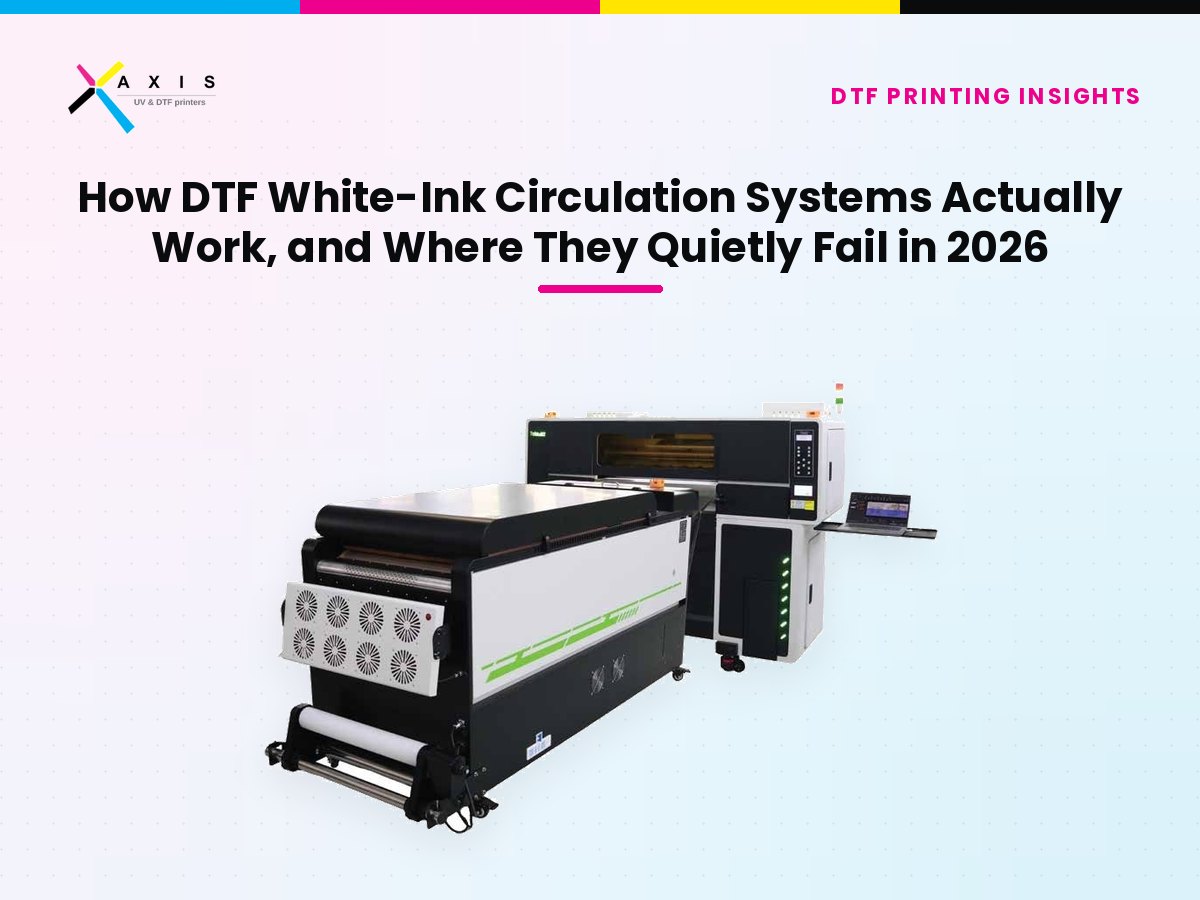
Quick answer: A DTF white-ink circulation system is the pump, damper, filter and tubing network that keeps heavy white pigment moving from the ink tank to the print head so it does not settle and block the nozzles. It fails most often not because the ink is bad, but because pumps weaken, tubes trap air or sediment, filters clog silently, or the machine sits idle without a scheduled agitation routine. Most failures give early warning signs (slower ink delivery, patchy nozzle tests, rising cleaning-fluid use) days before a full blockage stops production, which means the failure is usually preventable rather than sudden.
The White-Ink Problem That Isn't Really About the Ink
White DTF ink is the single largest and fastest-growing segment of the global direct-to-film (DTF) printing ink market, expected to post a double-digit compound annual growth rate through 2032 as more printers add it to handle dark and coloured garments, according to Grand Research Store's 2025 global DTF printer ink market report. That is the surprising part: the ink causing the most operator frustration is also the one manufacturers are investing in most heavily.
The frustration rarely comes from the chemistry of the ink itself. It comes from what happens to that ink between the tank and the print head, a mechanical journey most operators never learn to inspect until something has already gone wrong.
What Does a Clogged White-Ink System Actually Cost a Small DTF Shop?
Every hour a machine sits down for an avoidable white-ink blockage is an hour of paid orders that cannot move. Equipment failure, not software or cyber incidents, is the leading cause of unplanned downtime across manufacturing, accounting for 42 percent of stoppages, and average manufacturing downtime costs have climbed roughly 50 percent since 2019, according to a 2026 downtime-cost analysis by Info2Soft that compiles data from Siemens and Aberdeen Group research.
Those figures come from large manufacturers, so the rupee amount will look very different for a single-machine print shop. The pattern behind them does not change with scale: unplanned stoppages are disproportionately caused by equipment that was never inspected until it failed, not by ink quality or bad luck.
The competitive cost is just as real. India counted 633.9 lakh MSMEs as of the Udyam registration data reported in December 2022, with micro and small enterprises alone contributing roughly 33 percent of national GDP, according to Forbes Advisor India's MSME statistics roundup. A garment-printing entrepreneur who cannot deliver on a promised date because of a white-ink stoppage is handing that order to one of the many other small printers competing for the same customer.
Why Is White Ink More Prone to Failure Than Colour Ink?
White ink fails more often because it physically behaves differently inside the machine. Titanium dioxide, the pigment that gives white ink its opacity, is heavier and denser than the dye or pigment particles in colour inks, so it settles out of suspension far more readily whenever the machine is idle.
That is why every DTF printer built for serious production includes an active circulation loop rather than relying on gravity alone: a small pump keeps ink physically moving through dampers, filters and tubing so pigment stays suspended instead of forming sediment at the bottom of the tank or inside the lines. Colour inkjet channels rarely need this because their pigments are lighter and more stable in suspension.
Demand for this kind of engineering is rising because DTF adoption itself is rising. The global direct-to-film printing market is expanding from an estimated USD 2.72 billion in 2024 toward a projected USD 3.9 billion by 2030, while India's textile and apparel sector is forecast to grow at a 10 percent compound annual rate to reach USD 350 billion by 2030, according to Grand View Research's 2024 market report. "DTF is a very powerful printing process that has advantages especially in markets where printing is not only required on cotton, but on a wide variety of different materials," says Achim Bukmakowski, Head of Commercial and Industrial Printing at Epson Deutschland GmbH. As more Indian printers adopt DTF for exactly that versatility within the broader field of textile printing, more machines are running longer daily cycles, which puts more strain on the white-ink system than most buyers expect when they first invest.
How Does a DTF White-Ink Circulation System Actually Work from Tank to Print Head?
A circulation system works in a continuous loop: ink is drawn from a stirred or agitated tank, pushed by a small pump through a filter that catches sediment, passed through a damper that stabilises pressure, and delivered to the print head, with any excess returned to the tank rather than left sitting in the line. Each of those four components, pump, filter, damper and tubing, is a separate point where failure can start.
| Circulation type | How it works | Typical failure point | Best suited for |
|---|---|---|---|
| Manual agitation only | Operator shakes or stirs the ink cartridge by hand on a schedule | Inconsistent timing; pigment resettles quickly between manual checks | Very low-volume or entry-level setups |
| Timer-based automatic circulation | A pump runs on a fixed schedule regardless of machine activity | Pump wear goes unnoticed until output visibly drops | Small to mid-volume shops running daily production |
| Sensor-monitored circulation | Pump activity is continuous and paired with pressure or flow sensors that flag anomalies | Sensor or software faults, though these are rarer than mechanical wear | Multi-shift or high-order-volume operations |
Most quality problems trace back to one of three physical issues inside this loop: a weakening pump that can no longer maintain steady pressure, a filter that has silently clogged and is starving the print head, or air bubbles and sediment trapped in tubing that has not been inspected in weeks.
What Are the Early Warning Signs Before a Full Blockage?
The earliest sign is almost always a gradually degrading nozzle test, not a sudden dead stop. Operators who run and photograph a nozzle test before every shift can usually catch a developing problem three to five days before it becomes a full production stoppage.
Other early indicators include white ink taking noticeably longer to reach the print head after startup, a rise in cleaning-fluid or flushing-fluid consumption without a matching rise in order volume, and visible air bubbles or sediment when tubing is held up to light. Any one of these, treated as an isolated annoyance, is how a five-minute check becomes a two-day repair.
What Should a Smart Buyer Look for in a DTF Machine's Circulation System?
The right question is not "how fast does this machine print" but "how is this machine's white-ink system designed to keep working." That question matters more every year: India's custom T-shirt printing market alone is projected to grow from USD 176.6 million in 2025 to USD 407.9 million by 2034, according to IMARC Group's 2025 market report, and the shops with the fewest unplanned stoppages will capture a disproportionate share of that growth. Five criteria separate a circulation system built for daily Indian production conditions from one that only performs well in a showroom demo.
- Visible, accessible tubing. Lines you can inspect for air bubbles or sediment without disassembling the machine save hours of guesswork during troubleshooting.
- A documented daily and weekly circulation routine from the supplier, not a vague "clean regularly" instruction, so a new operator has something concrete to follow from day one.
- Locally stocked pumps, dampers and filters. A part that has to be imported turns a one-day fix into a two-week production loss.
- Transparent, itemised job costing that accounts for cleaning-fluid and consumable usage, so rising white-ink waste shows up as a number you can act on, not a feeling.
- Hands-on operator training at installation, covering exactly how to run and interpret a nozzle test, not just how to load ink.
Consistency across a fleet of machines matters here too. "We have the same print head technology all the way through... it means you can manage multiple different printers from Epson in a fleet and deliver the same image, the same quality," notes Duncan Ferguson, Vice President of Commercial and Industrial Printing at Epson Europe, speaking at FESPA 2026. The same principle applies to a single shop: predictable, repeatable maintenance behaviour matters more than any single spec on a brochure.
What to Look for Before You Buy or Upgrade: A Practical Checklist
Use this checklist during any machine demonstration, not just before your first purchase.
- Ask the seller to run a live nozzle test on a machine that has been idle for at least an hour, not one pre-warmed for the demo.
- Ask to see the pump, damper and filter physically, and ask how each one is accessed for cleaning or replacement.
- Request the written daily, weekly and monthly white-ink maintenance checklist the machine ships with.
- Confirm which circulation-system spare parts are stocked in India and get a real response-time commitment in writing.
- Ask what GST-compliant documentation you will receive for consumables and spare parts, since accurate invoices matter for both input-tax credit and warranty claims.
- Ask for operator training that includes troubleshooting, not only machine operation, before you sign.
Where Axis Enterprises Fits Into This
Axis Enterprises sells DTF printing machines, heat presses and consumables built around exactly this kind of dependable circulation engineering, backed by practical operator training and transparent job costing for Indian garment-printing businesses. Every machine ships with a documented daily white-ink routine, and our after-sales team stocks the pumps, dampers and filters that keep circulation systems running instead of leaving shops waiting on imported parts. If you want to see a live DTF machine demonstration that includes an honest look at the white-ink system, not just a speed run, that is exactly what we show.
The most useful next step is not a brochure, it is watching the machine work under realistic conditions. Book a free live DTF machine demonstration at axisdtf.com and ask us to run the idle-then-nozzle-test check described above; we expect every serious buyer to ask for it. You can also talk directly to our team about operator training and after-sales support plans before you commit to any machine, ours or anyone else's.
Frequently asked questions
How does a DTF white-ink circulation system work from tank to print head?
Ink is drawn from an agitated tank, pushed by a pump through a filter and damper, and delivered to the print head in a continuous loop, with excess ink returned rather than left standing in the line. This constant movement is what keeps the heavier white pigment from settling out and blocking the nozzles.
Which pumps, dampers, filters and tubes are involved in white-ink circulation?
A typical system includes a circulation pump, one or more dampers that stabilise ink pressure before it reaches the head, an inline filter that traps sediment, and the tubing connecting the tank, pump and print head. Each component can be inspected and replaced individually, which is why accessible tubing and locally stocked spares matter so much.
What symptoms indicate that the white-ink circulation pump is becoming weak?
A weakening pump usually shows up first as slower ink delivery after startup, inconsistent white coverage across a print, and a nozzle test that degrades gradually over several days rather than failing all at once. Rising cleaning-fluid consumption without a matching rise in order volume is another common sign.
Should white ink circulate continuously or only at scheduled intervals?
Most machines built for daily production run continuous or near-continuous circulation during operating hours, supplemented by a defined idle-protocol routine for evenings, weekends and holidays. Relying on manual agitation alone is workable only for very low print volumes.
Can air bubbles, sediment or leaks stop white ink from circulating correctly?
Yes. Air bubbles disrupt steady flow and pressure, sediment gradually narrows tubing and filters until flow slows to a crawl, and even a small leak can starve the print head while quietly wasting ink. All three are usually visible if tubing is inspected on a regular schedule rather than only after a problem appears.
When should operators stop inspecting the white-ink system and escalate to a technician?
Operators should escalate as soon as a nozzle test fails to recover after the standard cleaning cycle, or if they notice discoloured ink, persistent air bubbles, or a pump that no longer sounds or feels normal. Continuing to run repeated aggressive cleaning cycles without improvement usually wastes ink and can damage the print head further.
Sources
- Grand Research Store, "Global DTF Printer Ink Market Report" (2025)
- Grand View Research, "Direct To Film Printing Market Size, Industry Report" (2024)
- IMARC Group, "India Custom T-Shirt Printing Market Size and Report" (2025)
- Info2Soft, "Unplanned Downtime Cost (2026 Updated): 55+ Data Points"
- Forbes Advisor India, "MSME Statistics And Trends"
- FESPA, "What is the future of DTF printing?"
- Texintel, "Digital Textile Printing is Changing Fast: Here's what Epson's Duncan Ferguson had to say at FESPA 2026"

Founder, Axis Enterprises. Selling and servicing digital printing machines across India since 2011. Author of "Increase Your Profit by 270% with UV Printing Technology". More about the author