Why Does DTF White Ink Keep Clogging Machines in 2026, and What Should Operators Do About It?
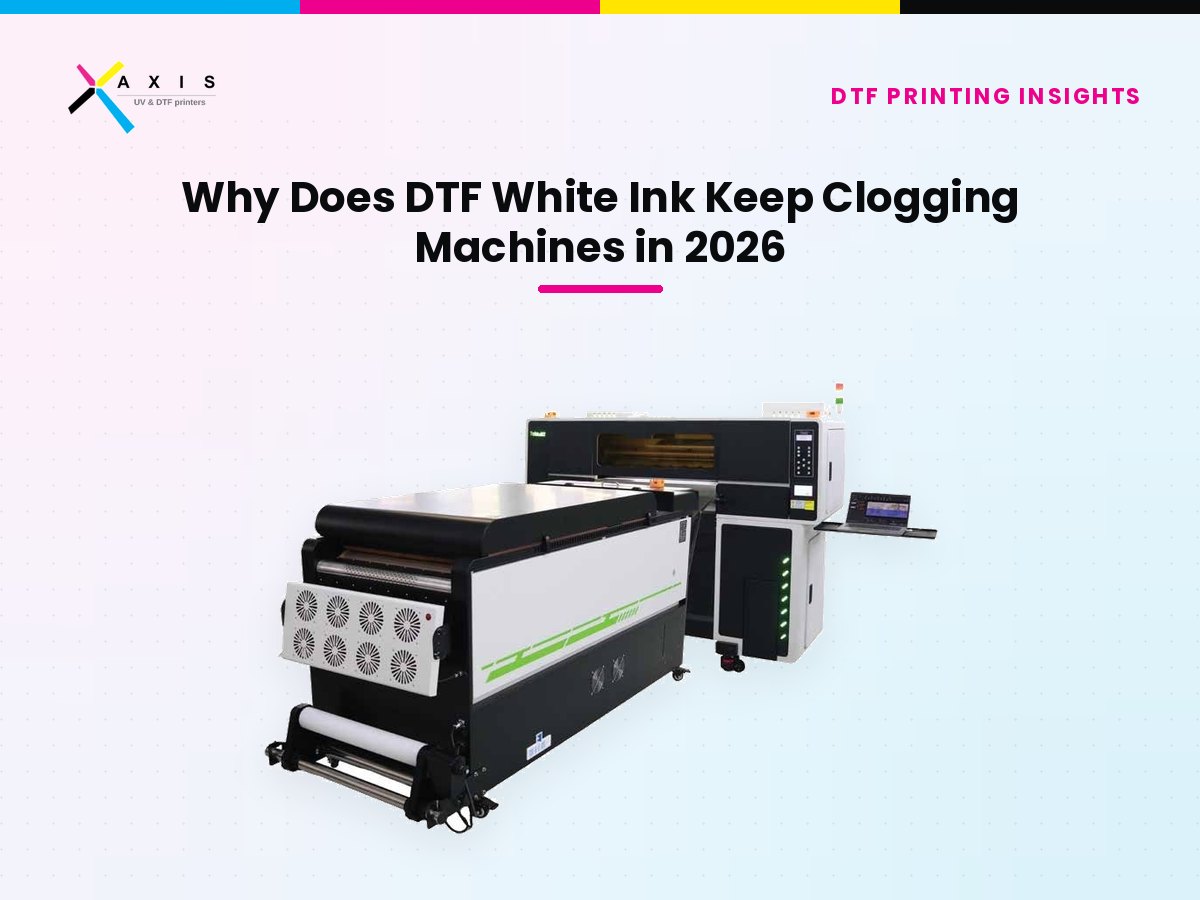
White ink in direct-to-film (DTF) printing settles quickly because its titanium dioxide pigment is denser than the surrounding CMYK inks, and it separates whenever the machine sits idle. According to Jaime Ghisays, CEO of Allprintheads, this is "the number one cause for printheads to become clogged." Left unmanaged, settled white ink blocks dampers and nozzles, halts production, and forces expensive printhead replacements. The reliable fix is not a special ink or a one-time repair. It is a disciplined daily routine: scheduled agitation or automated circulation, correct idle-time protocols, and periodic deep cleaning, backed by a written checklist any operator can follow every shift, without exception.
What is white ink settling, and why does it matter in DTF printing?
White ink settling is the separation of heavy titanium dioxide pigment from the ink's liquid carrier when the ink is not kept in motion. It matters because DTF printing depends on a solid white base layer to make CMYK colours opaque and vibrant on dark or coloured garments.
Unlike screen printing inks, which are mixed fresh before each pull, DTF white ink sits inside sealed tanks, tubes, dampers and print head channels for hours or days at a time. Titanium dioxide, the pigment that gives DTF white ink its opacity, has a density of about 4.23 grams per cubic centimetre in its common rutile form, several times heavier than the water-based liquid carrying it, so the pigment steadily sinks in any space where the ink is not actively circulating.
Once that settled pigment thickens near the nozzle plate or inside a damper, it partially or fully blocks ink flow. The result is streaky prints, missing white sections, weak opacity on dark fabric, and, in the worst cases, a damaged print head.
Why do DTF print heads fail, and how much of it comes down to white ink?
Most DTF print head failures trace back to maintenance gaps rather than manufacturing defects, and white ink is the leading cause among those gaps. Michael Litardo, Marketing Manager at Mutoh America, Inc., told Digital Output Magazine: "Poor maintenance procedures are the number one reason a printhead will fail early."
In the same article, Jaime Ghisays, CEO of Allprintheads, was even more specific about white ink itself.
"Since white ink is denser than CMYK colors, it causes more clogging issues and is the number one cause for printheads to become clogged." (Jaime Ghisays, CEO, Allprintheads)
This is not a small-business problem alone. It is a structural feature of how titanium dioxide behaves in any inkjet system, from entry-level desktop DTF printers to high-volume industrial machines.
How big is the cost of getting this wrong in 2026?
The financial stakes are rising because the DTF market itself is growing fast. According to Grand View Research (2025), India's direct-to-film printing market was valued at USD 243.9 million in 2025 and is projected to reach USD 380.3 million by 2030, a 9.3 percent compound annual growth rate. The same report puts India at 8.3 percent of the global DTF printing market in 2025, with dedicated DTF printers holding the largest equipment segment share at 44.65 percent in 2024.
Order volumes are climbing alongside it. IMARC Group (2025) reports that India's custom T-shirt printing market reached USD 176.6 million in 2025 and is expected to grow to USD 407.9 million by 2034, a 9.75 percent CAGR.
Globally, the picture is similar. Grand View Research (2025) values the global digital textile printing market at USD 9.3 billion in 2025, growing to USD 24.2 billion by 2033 at a 13.0 percent CAGR.
More volume means more machine hours, more idle periods between jobs, and more exposure to settling. A printer that produces occasional one-off jobs can often get away with loose habits. A printer chasing this growth cannot: every hour a machine sits down for an avoidable clog is an hour of paid orders not being fulfilled.
Market growth at a glance
| Market | 2025 value | Projected value | CAGR | Source |
|---|---|---|---|---|
| India DTF printing | USD 243.9 million | USD 380.3 million by 2030 | 9.3% | Grand View Research |
| India custom T-shirt printing | USD 176.6 million | USD 407.9 million by 2034 | 9.75% | IMARC Group |
| Global digital textile printing | USD 9.3 billion | USD 24.2 billion by 2033 | 13.0% | Grand View Research |
Full source links for the figures in this table are cited in the paragraphs above and in the Sources section below.
Why is this problem becoming more visible now, not less?
Two forces are converging on Indian printers at the same time: rising order volume and rising customer expectations. Both make white ink settling harder to ignore.
On the volume side, the growth numbers above mean more printers are running machines longer and more often, including overnight and weekend gaps where ink sits still the longest. On the expectations side, India's textile printing sector is professionalising quickly. The Production Linked Incentive scheme for textiles had attracted Rs 8,117.64 crore in investment and created 33,427 direct jobs as of March 31, 2026, according to the Ministry of Textiles.
As formal investment flows into textile manufacturing, brands and corporate buyers increasingly compare small DTF printers against larger, better-equipped shops. A streaky white base or a missed delivery because of a clogged print head no longer just costs one order. It costs the referral, the repeat order, and often the reputation that took months to build.
There is also a second, quieter trend: print on demand business models are pushing printers toward smaller, more frequent batches instead of large weekly runs. Smaller batches mean more start-stop cycles, and more start-stop cycles mean more opportunities for white ink to sit still between jobs.
What should a smart buyer look for to avoid this problem long term?
The right response is not to avoid DTF because of white ink risk. It is to change how a buyer evaluates a machine and a supplier before signing anything. Five criteria matter more than headline print speed.
- Built-in circulation, not just manual stirring. A machine with automated or assisted white ink agitation reduces how much depends on an operator remembering to act every few hours.
- Serviceable print head and ink path design. Dampers, tubes and capping stations that are easy to inspect and replace shorten downtime when something does go wrong.
- Documented maintenance protocols, not verbal tips. A written, model-specific checklist for opening, closing, and idle periods removes guesswork from every shift.
- Transparent job costing that includes consumables and downtime risk. A true cost-per-print figure should already account for realistic ink wastage and maintenance time, not just ink price per litre.
- Responsive local after-sales support and spare parts. A damper or capping station that takes two weeks to arrive turns a ten-minute fix into a two-week production stoppage.
What should you actually check before buying a DTF machine or consumables?
Turn the five criteria above into a checklist you can use on a showroom floor or a video call with any supplier.
- Look for a supplier who demonstrates the white-ink agitation or circulation system live, including what happens after the machine has been idle overnight.
- Look for a supplier who trains operators on the exact daily, weekly, and monthly maintenance routine for that specific machine model, not generic advice.
- Look for a supplier who keeps dampers, capping stations, and print heads in local stock rather than importing them on request.
- Look for a supplier who can show you a real job-costing worksheet, including ink, film, powder, labour, electricity, and a maintenance reserve.
- Look for a supplier who offers a documented after-sales response time, not just a phone number.
- Look for a supplier willing to run a cold-start test during your demonstration, printing immediately after the machine has sat unused, so you can see how the white ink behaves.
So what is the practical next step?
Everything above points to the same conclusion: white ink settling is manageable, but only with the right machine design, the right training, and the right ongoing support in place from day one. This is exactly the combination Axis Enterprises builds its DTF machines, training, and after-sales service around for Indian garment printers.
Axis Enterprises supplies DTF printing machines, heat presses, and consumables alongside installation, operator training, and ongoing maintenance support, so the daily circulation routine and idle-time protocol are part of how a machine is set up from the start, not an afterthought discovered after the first clog. Printers who book a free live DTF machine demonstration can see the white-ink handling behaviour for themselves before committing.
If you are evaluating a new DTF machine, or trying to work out why an existing one keeps clogging, the most useful next step is a live look at the equipment and the maintenance routine together. You can book a free live DTF machine demonstration with Axis Enterprises to see a cold-start test, a real circulation system, and a walkthrough of the maintenance checklist an operator would actually follow, so you can compare it directly against whatever you are using or considering today. It costs nothing to look, and it is the fastest way to know whether your next machine, or your next training session, will solve the settling problem for good. Reach out through Axis Enterprises' after-sales and demonstration team at axisdtf.com to schedule a time that works for you.
Frequently asked questions
How often should white ink be agitated to prevent settling?
Most manufacturers recommend automated or manual agitation at fixed intervals throughout the working day, plus a full circulation cycle at start-up and before shutdown. The exact interval depends on the machine model, so follow the supplier's written schedule for that specific printer rather than a generic rule.
Can settled white ink permanently damage a print head?
Yes, if it is left unaddressed. Dried or thickened pigment inside a nozzle channel can cause permanent blockages that no amount of standard cleaning will clear, which is why Michael Litardo of Mutoh America calls poor maintenance the leading cause of early print head failure.
Is white ink settling worse in humid or dusty Indian workshops?
Heat, dust, and inconsistent power quality can all accelerate ink degradation and clogging risk. A stable, ventilated workspace with a voltage stabiliser and a consistent maintenance routine reduces the added strain that Indian shop-floor conditions can place on white ink systems.
What should I do if my machine has already been idle for several days?
Do not simply run a print job. Run the manufacturer's recommended circulation and nozzle-check routine first, inspect the printed nozzle check pattern for gaps, and only proceed to production once the pattern is clean.
Does a more expensive DTF machine automatically solve white ink settling?
Not automatically. Price alone does not guarantee a well-designed circulation system, serviceable ink path, or good local support. Evaluate the specific agitation system, service network, and training that come with the machine rather than price alone.
How much does white ink clogging typically cost a small DTF business?
The direct cost is a mix of wasted ink, wasted film and powder on failed prints, lost production hours, and, in severe cases, print head replacement. As India's DTF and custom apparel markets keep growing at the pace shown in the market data above, the opportunity cost of repeated downtime rises with them, since every clogged run is a missed order in a more competitive market.
Sources
- Grand View Research, India Direct To Film Printing Market Size & Outlook (2025)
- IMARC Group, India Custom T-Shirt Printing Market Size and Report (2025)
- Grand View Research, Digital Textile Printing Market Size & Share Report (2025)
- Digital Output Magazine, Peak Performance: Proper Care and Maintenance for Printheads
- Apparel Resources, citing the Ministry of Textiles, PLI Scheme for Textiles Investment Update (2026)
Founder, Axis Enterprises. Selling and servicing digital printing machines across India since 2011. Author of "Increase Your Profit by 270% with UV Printing Technology". More about the author