The Early Warning Signs of White-Ink Blockage Every DTF Printer in India Should Catch Before Production Stops
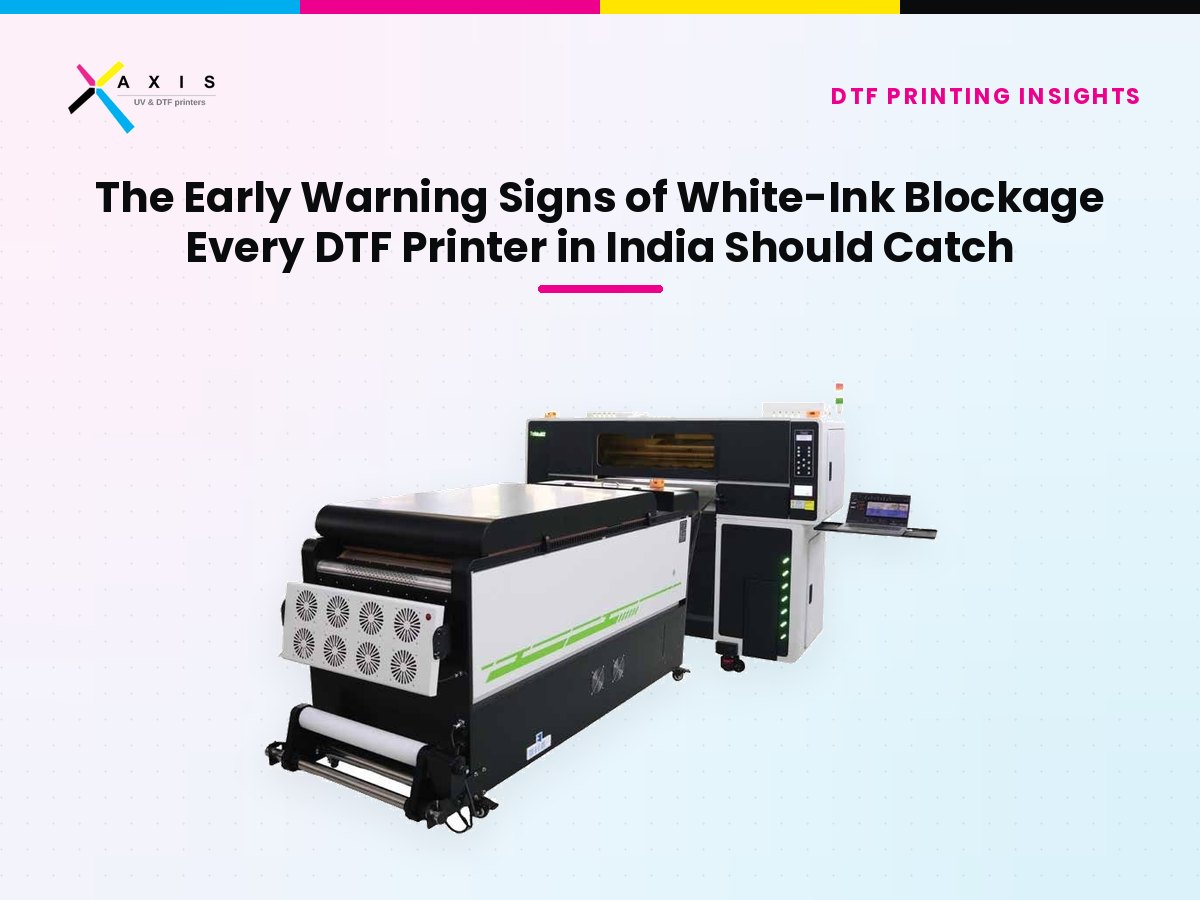
The same white ink that makes a DTF print pop on black cotton is, chemically, always trying to sink to the bottom of its own ink line. White DTF ink is a pigment, not a dye, so its titanium dioxide particles are denser than the liquid carrying them. Left still for even a few hours, they settle. That single fact explains most white-ink failures, and most of them give warning signs for a day or two before a machine actually stops.
Quick answer: White-ink blockage is what happens when the titanium dioxide pigment in DTF white ink settles, thickens or dries inside the ink lines, dampers or nozzles, cutting off flow to the print head. The earliest signs include a weaker or patchier white underbase, dull or grey-looking whites, faint or broken edges on light-coloured film, unusual gurgling or weak suction from the circulation pump, and a rising need for cleaning cycles between jobs. Catching any of these within the first day or two, rather than after the print head stops accepting white ink altogether, is what separates a five-minute fix from a lost production day.
What Is White-Ink Blockage, and Why Does It Happen in DTF Printing?
White-ink blockage is the partial or complete obstruction of ink flow caused by settled pigment, dried residue or air pockets inside a DTF printer's white-ink system. It happens because white DTF ink is a pigment ink, not a dye, and the titanium dioxide particles that make it opaque are denser than the ink itself.
Left undisturbed, even briefly, those particles sink and cluster. In direct-to-film printing, the white layer is also printed first and in the largest volume of any colour, so it passes through the narrowest, most failure-prone part of the system on almost every job.
How Much Does Unplanned Downtime Really Cost a Printing Business?
Unplanned downtime costs far more than the ink or the repair. According to the Siemens True Cost of Downtime 2024 report, the world's largest manufacturers now lose $1.4 trillion a year, equal to 11 percent of total revenue, to unplanned stoppages, and heavy industry alone pays as much as $59 million for every hour a line stands still, 1.6 times higher than in 2019.
A DTF print shop is a fraction of that scale, but the mechanics are identical. A blocked print head does not only cost the price of a service call. It costs every order queued behind it, every customer waiting on a same-day turnaround, and every metre of film and litre of ink used in the reprints that follow.
| Early symptom | What is happening inside the machine | Risk if ignored |
|---|---|---|
| Weaker, patchier white underbase | Pigment has begun settling in the ink line or damper, reducing flow density | Colours printed over white lose vibrancy and consistency, driving reprints |
| Grey or dull whites instead of bright white | Partial nozzle blockage is mixing air or residue into the white channel | Customer rejections on light-coloured and dark-garment transfers alike |
| Faint or broken edges on film | Individual nozzles are clogging, breaking up fine detail and edges | Small text and thin lines disappear, a common cause of reprint disputes |
| Gurgling or weak suction from the pump | Air has entered the circulation line, often from a dried or cracked seal | Circulation stops entirely, halting all white-ink printing without warning |
| Rising cleaning-cycle frequency | The system is compensating for a developing blockage between jobs | Ink and downtime costs climb quietly until a full head replacement is needed |
Why Is White-Ink Blockage a Bigger Risk for Indian DTF Printers in 2026?
The risk is growing simply because far more DTF machines are now running in India than a few years ago. India's direct-to-film printing market reached roughly $243.9 million in 2025 and is projected to reach $380.3 million by 2030, according to Grand View Research (2025), and India's custom T-shirt printing market alone was valued at USD 176.6 million in 2025, projected to reach USD 407.9 million by 2034, according to IMARC Group (2025).
Much of that growth is coming from small, on-demand operators rather than large factories, as more custom apparel and print on demand businesses add a DTF printer and heat press alongside their existing equipment. Satyajeet Satpathy, Director of Sales and Marketing at Epson India, notes that "on the on-demand side, Epson DTF printers have gained strong traction among small and midscale businesses, startups, and custom apparel brands," as reported by Indian Printer & Publisher (January 2026). Many of these new owners are running machines without a written maintenance routine, which is exactly when white-ink settling problems tend to surface first.
India's broader textile sector is expanding alongside it. The domestic textile market grew from Rs. 6 lakh crore to Rs. 13 lakh crore in 2025, Textiles Minister Giriraj Singh said, as reported by All India Radio (January 2026). More garment volume moving through textile printing businesses means more machines running longer hours, more idle weekends during festival season, and more variation in power supply, humidity and ink handling, all of which accelerate white-ink settling.
What New Buying Criteria Should Guide a DTF Machine Purchase or Upgrade in 2026?
The right criteria shift the question from "which machine prints fastest" to "which setup keeps printing reliably." Five criteria matter most for avoiding white-ink downtime specifically.
- Circulation system design. Machinery built for stable circulation and gentle agitation even during idle periods, not only during active printing, and matched to a reliable heat press for consistent curing.
- Practical, ongoing operator training. Training that covers daily agitation checks, cap and damper inspection, and an idle-machine protocol, not a one-time installation walkthrough.
- Transparent job costing. Costing that accounts for cleaning frequency, ink consumption and downtime risk, not just the headline price per print, inclusive of GST on consumables and service.
- Responsive local after-sales service. A supplier who can reach a blocked machine quickly, with common spare parts already in local stock.
- Documented maintenance protocols. A written, repeatable routine the buyer can hand to any operator, rather than knowledge that lives only with the machine seller or one technician.
What Should You Look for in a DTF Machine Supplier Before You Buy?
Look for a supplier who can be judged on these points before any purchase, not after the first blockage.
- Look for a supplier who trains you to recognise early white-ink symptoms, weak underbase, dull whites, faint edges, during onboarding, not after a breakdown call.
- Look for a supplier who demonstrates the machine's white-ink circulation and cleaning cycle live, not only finished print samples.
- Look for a supplier who hands over a written daily, weekly and idle-period maintenance protocol, including what to do over weekends and festival closures.
- Look for a supplier who stocks common spare parts, dampers, caps, filters, locally, and quotes a realistic response time in writing.
- Look for a supplier who is transparent about total cost of ownership, including consumables, cleaning frequency and GST-inclusive service charges, not just the machine price.
- Look for a supplier who offers refresher training as order volume grows or new staff join the production floor.
Where Reliable Machinery and Local Support Come Together
This is precisely where Axis Enterprises works with Indian garment printers every week. Axis Enterprises builds its DTF machines, heat presses and consumable programs around exactly these criteria: circulation systems designed for Indian operating conditions, structured operator training, transparent job costing and a local after-sales network that stocks the parts that matter.
Printers already running a machine can get a written white-ink maintenance protocol from Axis Enterprises to reduce blockage risk without buying anything new. Those evaluating a first or second machine can compare Axis Enterprises' DTF machine range and review the after-sales and spare-parts program before making a decision.
The most useful next step is usually the simplest one: watching the circulation system run under real conditions before committing to any machine. Printers considering a purchase or upgrade can book a free live DTF machine demonstration at axisdtf.com and see the white-ink circulation, cleaning cycle and job costing explained on the actual production floor, with no obligation to buy on the spot.
Frequently Asked Questions
How quickly does white-ink blockage usually develop?
It typically develops over one to several days of reduced circulation or inconsistent maintenance, not instantly. Early symptoms such as a weaker underbase or dull whites usually appear well before the print head stops accepting ink entirely.
Can white-ink blockage damage the print head permanently?
Yes, if pigment is allowed to dry fully inside the nozzles or dampers, standard cleaning cycles may not clear it, and a permanent print head replacement can become necessary. Catching the early symptoms and running a proper cleaning or circulation cycle promptly usually prevents this outcome.
Does buying a more expensive DTF machine eliminate white-ink settling?
No single machine eliminates settling entirely, because it is a property of the pigment ink itself, not a defect unique to one brand. A well-designed circulation system, disciplined agitation routine and a documented idle-machine protocol reduce the risk far more than price alone.
What should an idle-machine protocol include over weekends or festival closures?
It should include scheduled circulation or agitation before shutdown, a cap and damper inspection, and a defined restart check the following working day. Longer festival closures generally need an additional mid-break circulation cycle rather than none at all.
Is white-ink blockage more common in humid Indian conditions?
Humidity and temperature swings can affect ink viscosity and drying behaviour, making consistent circulation even more important in many Indian workshop environments. A stable, climate-aware workspace and a fixed circulation schedule both reduce this added risk.
Sources
- Association of Electrical and Mechanical Trades (AEMT), "The True Cost of Downtime 2024: A Comprehensive Analysis," citing Siemens True Cost of Downtime 2024
- Grand View Research, "India Direct To Film Printing Market Size & Outlook, 2030" (2025)
- IMARC Group, "India Custom T-Shirt Printing Market Size and Report, 2034" (2025)
- Indian Printer & Publisher, "Epson India on sustainable textile printing" (January 2026)
- All India Radio (newsonair.gov.in), "Textile Sector Has Seen Tremendous Growth in Last Decade... Textiles Minister Giriraj Singh" (January 2026)
Founder, Axis Enterprises. Selling and servicing digital printing machines across India since 2011. Author of "Increase Your Profit by 270% with UV Printing Technology". More about the author