How Fast Does a DTF Printing Machine Pay for Itself in India in 2026? The ROI Math Most Sellers Skip
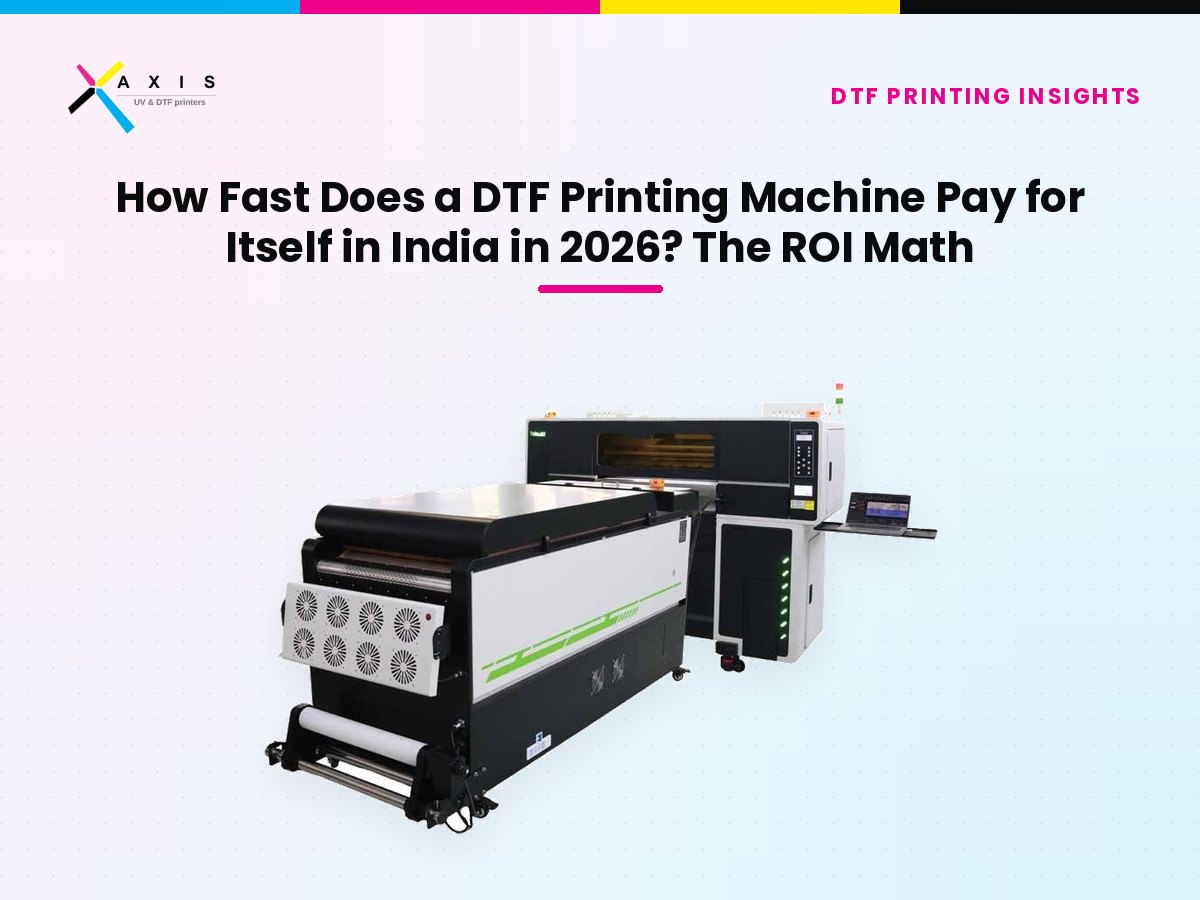
Quick answer: A DTF printing machine in India usually pays for itself within about 6 to 18 months, depending on daily order volume, pricing and running costs. The math is simple: divide the total setup cost by your average monthly profit after ink, film, powder, labour and electricity. A small setup costing around Rs. 3 to 5 lakh, printing 40 to 60 garments a day at a healthy margin, can recover its cost inside a year. The three numbers that decide payback are cost per print, monthly break-even orders and net profit per order. Get those right before you buy, not after.
What is DTF printing, and why is demand climbing so fast in India in 2026?
Direct-to-film printing is a method where a design is printed onto a special film, coated with adhesive powder, cured, and then heat-pressed onto fabric. It works on cotton, polyester, blends and dark garments without the setup work that older methods demand.
Demand is climbing because the market underneath it is expanding quickly. According to Grand View Research (2025), India's print-on-demand market was valued at USD 857.9 million in 2025 and is projected to grow at a 26.2% CAGR to USD 5,419 million by 2033. That is nearly a six-fold expansion in eight years.
For a small printer, this means the orders are coming. The question in 2026 is whether your machine turns those orders into recovered investment or into a monthly loss.
Why do most new printers misjudge how long a machine takes to pay back?
Most buyers misjudge payback because they focus on the sticker price and ignore the three numbers that actually decide it: cost per print, break-even order count, and net profit per order. A cheap machine with high running costs can take longer to pay back than a costlier, efficient one.
The market context makes this risk expensive. IMARC Group (2025) reports India's custom T-shirt printing market reached USD 176.6 million in 2025 and is set to hit USD 407.9 million by 2034 at a 9.75% CAGR, so competition for each order is rising every year.
When you cannot state your true cost per print, you either underprice and erode margin, or overprice and lose the job. Both push your payback date further away. This is the single most common reason a machine that looked profitable on paper drains cash in practice.
What is actually changing in the garment-printing market in 2026?
The underlying apparel market is growing, and digital methods are taking share from older ones. According to IBEF (2026), India's textile and apparel market is projected to reach US$ 350 billion by 2030 at a 10% CAGR, with textile and apparel exports at US$ 32.63 billion in FY26.
Globally the shift toward film-based printing is measurable too. Grand View Research (2024) estimated the global direct-to-film printing market at USD 2,720 million in 2024, projected to reach USD 3,920 million by 2030 at a 6.0% CAGR.
Industry leaders read the same signal. Duncan Ferguson, Vice President of Commercial and Industrial Printing at Epson Europe, told Texintel at FESPA 2026:
"The market for textiles has been very difficult over the last three years. I'm not going to hide the truth there. But the tide is turning."
That turning tide favours flexible, short-run methods like DTF, which sit closer to the customer than traditional screen printing and feed the growing print-on-demand model.
How do you actually calculate the payback period on a printing machine?
Payback period equals total setup cost divided by average monthly net profit. To use it, you first need cost per print (ink plus film plus powder plus a share of labour and electricity), then net profit per order (your price minus that cost), then monthly volume.
Here is a simple worked example. If a machine plus setup costs Rs. 6,50,000, and you net Rs. 70 profit on each print after all consumables and the heat press curing step, then at 60 prints a day across 26 working days you earn about Rs. 1,09,200 a month. Payback is roughly Rs. 6,50,000 divided by Rs. 1,09,200, or about six months at steady volume.
The table below shows three illustrative setups. These figures assume consistent daily utilisation; real payback is usually slower during the first months while you build orders, and you should also budget for GST on the machine and consumables.
| :-: | :-: | :-: | :-: | :-: | :-: |
|---|---|---|---|---|---|
| Setup scale | Machine + setup cost | Avg. prints/day | Net profit/print | Monthly net profit (26 days) | Approx. payback at full volume |
| Entry (A3 desktop) | Rs. 3,00,000 | 30 | Rs. 60 | Rs. 46,800 | About 6 to 7 months |
| Mid (A3+ with shaker) | Rs. 6,50,000 | 60 | Rs. 70 | Rs. 1,09,200 | About 6 months |
| Growth (60 cm roll-to-roll) | Rs. 12,00,000 | 120 | Rs. 55 | Rs. 1,71,600 | About 7 months |
The lesson is not the exact months. It is that payback is driven by profit per print and daily volume, not by how cheap the machine looked on day one.
What should a smart buyer look for to protect their return on investment?
A smart buyer should judge a machine by total cost of ownership and uptime, not just purchase price. The criteria that actually protect your payback are the ones that keep the machine running and your cost per print predictable.
- Dependable machinery: stable print heads and consistent white-ink circulation, because every hour of downtime pushes your payback date out.
- Transparent job costing: a seller who can show you real cost per print on your fabrics, so your pricing is grounded in numbers, not guesses.
- Practical operator training: trained hands waste less film and ink, which directly lifts net profit per order.
- Responsive local after-sales service: fast access to spare parts and support, so a small fault does not become a week of lost production.
What separates a machine that pays back from one that drains cash?
The difference is rarely the brand on the box. It is the support, training and consumable economics around it. Use this checklist when you evaluate any supplier.
- Look for a supplier who demonstrates the machine live on your own fabric before you pay.
- Look for a supplier who quotes real cost per print, including ink, film and powder, not just the machine price.
- Look for a supplier who provides hands-on operator training and installation, not just delivery.
- Look for a supplier who stocks genuine consumables and spare parts locally, with a clear service response time.
- Look for a supplier who stays reachable after the sale, because your payback depends on uptime for years, not weeks.
Where does Axis Enterprises fit into this?
Everything above describes how Axis Enterprises works with Indian garment printers. We supply DTF printing machines, heat presses and genuine inks, film and powder, and we back them with installation, operator training, maintenance and responsive local after-sales support. The aim is not to sell you a box, but to help you reach a measurable payback and a profitable printing business.
Before you buy, we will sit with your numbers and show you honest per-print job costing on the fabrics you actually plan to sell, plus the operator training and installation that keep those numbers steady.
What is the simplest next step?
The lowest-risk way to test all of this is to see a machine print your own design, on your own fabric, before spending a rupee. You can book a free live DTF machine demonstration and watch the full workflow, from film to finished garment, while we walk through the real cost per print and payback for your setup. It is a practical, no-pressure way to turn the ROI math in this article into your own numbers.
Frequently asked questions
How much does a DTF printing setup cost in India in 2026?
A basic A3 desktop setup typically starts around Rs. 3 lakh, mid-range A3+ systems with a powder shaker run roughly Rs. 6 to 8 lakh, and 60 cm roll-to-roll production machines can cross Rs. 12 lakh. Remember to add GST and a monthly consumables budget. The right choice depends on your expected daily volume, not on picking the cheapest option.
How many t-shirts do I need to print daily to break even?
Break-even depends on your net profit per print and fixed monthly costs like rent and salaries. As a rough guide, a mid-range setup earning about Rs. 70 profit per print needs roughly 25 to 40 prints a day to cover typical fixed costs and start recovering the machine. Track your own numbers weekly, because pricing and fabric mix change the figure.
Is DTF cheaper than screen printing for small orders?
For small and mixed orders, DTF is usually more economical because it has almost no per-design setup cost, unlike screen printing which needs screens made for each colour. Screen printing regains its cost advantage on very large single-design runs. Most small Indian printers handle varied, short-run orders, which is where DTF economics work best.
What ongoing costs affect DTF profitability the most?
The biggest ongoing costs are white and colour ink, film, adhesive powder, electricity and labour, followed by occasional print-head maintenance. White ink use and wastage from poor calibration are where many printers quietly lose margin. Disciplined maintenance and trained operators keep cost per print low and payback on schedule.
How do I calculate cost per print?
Add the ink, film and powder used for one print, then add a share of labour and electricity for the time it takes. Divide total monthly consumable and running cost by the number of prints that month for an accurate average. Knowing this number lets you price every job with a real, protected margin.
Sources
- Grand View Research: India Print On Demand Market Size & Outlook, 2026-2033
- IMARC Group: India Custom T-Shirt Printing Market Size and Report
- India Brand Equity Foundation (IBEF): Textile Industry & Market Growth in India
- Grand View Research: Direct To Film Printing Market Size, Industry Report, 2030
- Texintel: Digital Textile Printing is Changing Fast, Epson's Duncan Ferguson at FESPA 2026
Founder, Axis Enterprises. Selling and servicing digital printing machines across India since 2011. Author of "Increase Your Profit by 270% with UV Printing Technology". More about the author