Feature Lists Do Not Keep a DTF Machine Running: What Actually Protects Your Uptime in 2026
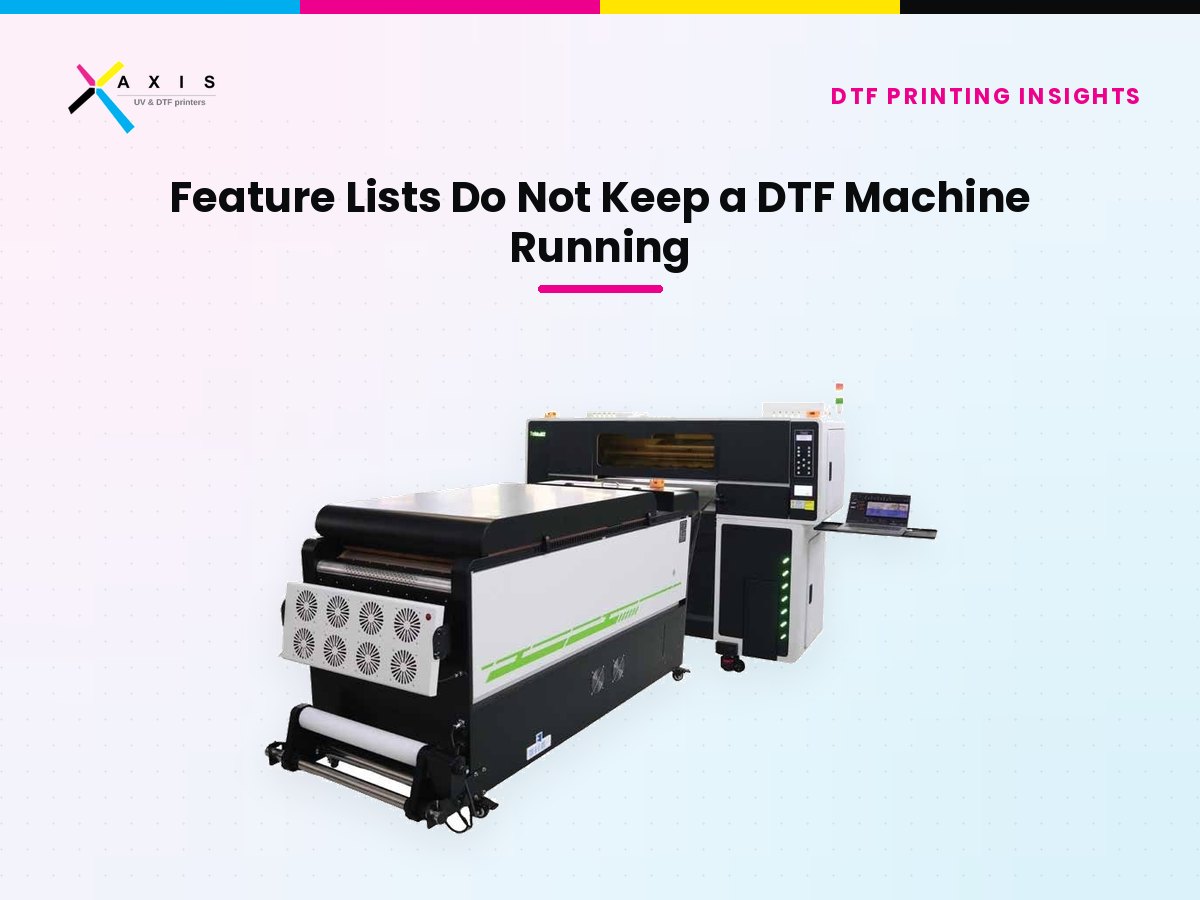
Most first-time buyers compare direct-to-film machines by counting features on a brochure. Yet across equipment-dependent businesses, the largest hidden cost is rarely the machine. It is the hours the machine sits idle. Equipment failure alone causes 42% of all unplanned downtime incidents, and across manufacturing that idle time now costs an average of about USD 260,000 an hour, according to data compiled by ReliaMag (2026) citing Aberdeen Research. Your printer is a small version of the same problem: a stopped machine earns nothing, whatever its specification sheet promised.
Quick answer: when buying a DTF machine, local service and spare parts matter more than extra features because uptime, not specifications, decides how much you earn. A feature rich printer that sits idle waiting for a technician or an imported part produces nothing, while a simpler machine backed by fast local support keeps shipping orders. Prioritise a supplier who stocks critical spare parts in India, responds quickly when production stops, trains your operators, and puts service commitments in writing. Match the machine to your real daily volume, then judge the supplier's support before you judge the brochure.
What does "extra features versus service" actually mean when buying a DTF machine?
It means separating what a machine can do on paper from what keeps it producing sellable work every day. Direct-to-film printing is a process that prints a design onto a film, coats it with adhesive powder, cures it, and bonds it to fabric with a heat press. Features describe the printing step. Service and spare parts decide whether all of those steps keep happening after something breaks.
A feature is a capability: extra heads, a wider carriage, a faster print mode, a fancier interface. Service is the response you receive when a nozzle blocks, a damper fails, or a board stops responding mid-order. The two are not the same purchase, even though they are sold together.
Why does downtime cost more than any missing feature?
Downtime costs more because a missing feature slows you down, while a stopped machine stops your revenue completely. The scale of the problem is now measurable. The 500 largest global companies lose a combined USD 1.4 trillion a year to unplanned downtime, equal to 11% of their total revenues, up from 8% in 2019 and 2020, per the Siemens True Cost of Downtime 2024 analysis, as reported by ReliaMag (2026).
Large factories can absorb a bad week. A small printing shop usually cannot. When festival, school or corporate orders arrive together and your only printer is down waiting for a part, you refuse work you had already won and hand it to a competitor.
This is why the machine with the longest feature list is often the wrong choice. Extra capability you rarely use does not protect you on the day the machine fails. Fast service and an available spare part do.
Why is demand rising fast enough to make uptime critical in 2026?
Uptime matters more every year because the custom apparel market is expanding quickly, and lost production days now cost more than they used to. The India direct-to-film printing market generated USD 243.9 million in 2025 and is expected to reach USD 380.3 million by 2030, a 9.3% compound annual growth rate, according to Grand View Research (2026).
The wider apparel category is growing even faster. The global custom t-shirt printing market is forecast to rise from USD 5.16 billion in 2024 to USD 9.82 billion by 2030, an 11.5% compound annual growth rate, with Asia Pacific already holding over 39.4% of global revenue in 2024, per Grand View Research (2026).
Rising demand is the reason so many shops are adding this technology in the first place. Mike Davis, an Application Specialist at Roland DGA, explains the shift in Screen Printing magazine (2025):
"Apparel decorators are adding DTF to their shops because short-run and on-demand requests are becoming more frequent, and because many shop owners are seeing that their competition is offering this type of production in-house." (Mike Davis, Application Specialist, Roland DGA)
More demand means more days when a stopped machine directly costs you an order. In a growing market, uptime is the constraint, not capability.
Why do suppliers push features while parts and service quietly decide profit?
Suppliers emphasise features because features sell machines, but the money in equipment is made afterwards, in parts and support. Spare parts and services typically deliver over 50% of manufacturer profits, and aftermarket services run at margins roughly 2.5 times higher than new-equipment sales, according to Deloitte.
Read that from the buyer's side. The part of the relationship the seller profits from most, parts and service, is exactly the part a feature-focused sales pitch says least about. That silence is a signal.
Reliability also depends on using the correct consumables, which is a support question, not a feature. Mike Davis notes a common failure point in the same Screen Printing magazine guidance:
"DTF doesn't require the same level of ink viscosity as DTG, therefore DTG/DTF inks are more likely to lead to printhead clogs or print issues." (Mike Davis, Application Specialist, Roland DGA)
A print head clogged by the wrong ink is not fixed by a longer feature list. It is prevented by training and solved by a supplier who answers the phone.
How should a smart buyer rank a DTF machine in 2026?
A smart buyer ranks the total ability to keep producing, not the specification alone. The following criteria consistently protect a printing business better than any extra feature.
- Local spare-parts stock: critical components (dampers, caps, wipers, filters, boards, print heads) held in India, not imported only after a failure.
- Fast service response: a promised response time when production stops, in writing, with remote support and site visits defined.
- Practical operator training: hands-on training so your team prevents clogs and diagnoses faults before they become breakdowns.
- Transparent running costs: honest figures for ink, film, powder, wastage and maintenance, so your cost per sellable print (and your GST-inclusive quotes) are accurate.
- A machine matched to real volume: the smallest configuration that clears your daily orders with headroom, so you are not paying for capability you never use.
Spec-first buyer or uptime-first buyer: which one keeps earning?
The uptime-first buyer earns more over the life of the machine, because service and parts decide the days that actually matter. The table below compares two owners who spend a similar amount but judge the purchase differently.
| :-: | :-: | :-: |
|---|---|---|
| Decision moment | Buyer who prioritises the feature list | Buyer who prioritises local service and spare parts |
| Peak-season breakdown | Waits days for an imported part; refuses new orders | Local part fitted quickly; keeps shipping |
| New operator makes an error | No training included; learns by trial and costly reprints | Trained operator prevents most faults from the start |
| Wrong consumable causes a clog | Blames the machine; long guesswork | Supplier diagnoses and corrects the ink or film system |
| Annual uptime | High capability, low realised output | Modest capability, high realised output |
| Real cost per sellable print | Rises with every idle day and reprint | Stays predictable and quotable |
What should you look for in a DTF machine supplier?
Look for a supplier whose support model is as clear as the machine specification. Treat the following as objective checks before you pay any advance.
- Look for a supplier who stocks critical spare parts locally in India and can name the exact components held in stock.
- Look for a supplier who commits, in writing on the quotation or invoice, to a response time when your production stops.
- Look for a supplier who installs the machine, trains your operators, and provides written standard operating procedures rather than only a delivery.
- Look for a supplier who explains real running costs openly, so your job costing and margins are not built on guesswork.
- Look for a supplier who will run your own difficult design live, so you judge actual finished output rather than an advertised speed.
- Look for a supplier whose existing customers confirm quick service and genuine parts availability after the sale.
Notice that none of these are features. They are the conditions that keep textile printing work flowing on the days a feature list cannot help you.
Where does the right supplier fit in?
Everything above describes a specific kind of partner: dependable machinery backed by practical training, transparent job costing, responsive local after-sales service, and genuine spare parts held in India. That is exactly how Axis Enterprises is built to support Indian garment printers and first-time apparel-printing businesses. The machine matters, and the service that keeps it running matters just as much.
Axis Enterprises supplies DTF printing machines, heat presses and consumables with installation, operator training and after-sales support designed to protect your uptime, not just complete a sale. If you want to see how the equipment is installed, trained and supported in real conditions, the fastest way to judge it is to watch it work.
What is the simplest next step?
The lowest-risk next step is to see a machine run your own artwork before you commit to anything. You can book a free live DTF machine demonstration and bring a difficult design, gradients, fine text and solid white included, to judge finished output for yourself. Ask about spare-parts stock, response times and training while you are there, and talk to the Axis Enterprises support team about what a dependable setup for your daily volume looks like. A short demonstration tells you more about future uptime than any brochure ever will.
Frequently asked questions
What response time should a DTF supplier promise when production stops?
Ask for a specific, written response commitment rather than a vague promise of good support. A dependable supplier defines how quickly they respond remotely, when a technician can visit, and how fast a spare part is dispatched. Get these terms on the quotation or invoice before you pay.
How can I confirm that spare parts are genuinely stocked in India?
Ask the supplier to name the exact critical parts held in local stock, such as dampers, caps, wipers, filters, boards and print heads, and to state current availability. Parts imported only after a failure can stop your line for days. Existing customers in your region are the most reliable way to verify the claim.
Does a good service agreement cover remote support, site visits and spare-part dispatch?
Yes. A complete service commitment should cover remote diagnosis, on-site visits, and the dispatch time for parts, plus who pays technician travel and labour. If any of these is left undefined, assume it is not included. Clarify it in writing before purchase.
Are extra features ever worth paying for on a DTF machine?
Extra features are worth paying for only when they match work you actually do, such as higher heads for genuine bulk volume. A feature you rarely use adds cost without protecting uptime. Match the configuration to your real daily order volume, then weigh service and parts.
How is DTF different from older methods like screen printing for a small shop?
Screen printing suits long identical runs, while direct-to-film handles short runs and full-colour designs on demand without making screens for each job. That flexibility is why DTF fits the growing print on demand market. For a small shop, low minimum orders and quick turnaround usually matter more than raw run length.
Sources
- Grand View Research, India Direct To Film Printing Market Size and Outlook (2026)
- Grand View Research, Custom T-shirt Printing Market Size and Trends (2026)
- ReliaMag, The Real Cost of Unplanned Downtime in Manufacturing (2026), citing Aberdeen Research and the Siemens True Cost of Downtime 2024
- Deloitte, Aftermarket Services: The Digital Differentiator
- Screen Printing magazine, What Every Screen Printer Needs to Know About DTF Production (2025)
Founder, Axis Enterprises. Selling and servicing digital printing machines across India since 2011. Author of "Increase Your Profit by 270% with UV Printing Technology". More about the author