Festivals, Elections and Weddings: How to Turn India's Seasonal Demand Into 12 Months of Printing Orders
Here is a number most print shop owners have never paused on. In a single festive window, from Navratri to Diwali 2025, Indian traders recorded roughly Rs 6.05 lakh crore in sales, the highest festive trade in the country's history. Garments were one of the largest categories inside that spend. Yet most small printing businesses treat festivals as a lucky rush rather than a plannable, repeatable revenue engine.
Quick answer: A seasonal print campaign means planning your production, stock and marketing around India's recurring buying occasions, festivals, weddings, elections, school terms, corporate events and sports seasons, instead of waiting for random walk-in orders. Because these occasions repeat on a known calendar, a printer who prepares blanks, designs and machine capacity in advance can convert predictable spikes in demand into steady monthly income. The goal is simple: replace feast-and-famine sales with a rolling 12-month demand calendar that keeps the machine, and the cash, moving all year.
How big is India's seasonal celebration economy?
The seasonal economy is enormous, and a meaningful share of it flows through custom apparel and printed merchandise. According to a Confederation of All India Traders report covered by Business Today (2025), Diwali 2025 alone generated a record Rs 6.05 lakh crore in festive-season sales, with garments and gifts each making up about 7% of that trade.
Weddings tell the same story on a different calendar. CAIT (2025) estimated the 2025 wedding season at Rs 6.5 lakh crore of business across roughly 46 lakh weddings in a single 45-day window. Every one of those events carries demand for coordinated apparel, welcome kits, staff uniforms and personalised favours.
"The Indian wedding season continues to demonstrate the enormous power of domestic trade and self-reliance. Under Prime Minister's call for Vocal for Local, Indian goods have truly become the heartbeat of every celebration."
Praveen Khandelwal, Secretary General, Confederation of All India Traders
Add elections, school and college fests, corporate onboarding drives and cricket seasons, and the picture is clear. Demand for printed apparel does not disappear between festivals. It simply moves to the next occasion on the calendar.
Why do most print shops still earn unevenly across the year?
Most shops earn unevenly because they sell one product to whoever walks in, instead of matching many products to occasions that are already coming. The result is a spike during Diwali or exam season, then quiet weeks when the phone stops ringing.
A second reason is a narrow view of what the technology can do. Many owners still think of themselves as T-shirt printers, when the same setup can decorate hoodies, jerseys, bags, caps, aprons, cushion covers and corporate kits. This is the classic trap: believing the craft is limited to one garment and missing the more profitable occasions around it.
The financial cost of this is real. Idle capacity in the off weeks still carries rent, electricity, loan repayment and GST obligations, whether or not the machine is running. A printer who fills those weeks with pre-planned occasion orders spreads the same fixed costs across far more billable output.
What is a seasonal print campaign, and why is occasion-based demand rising?
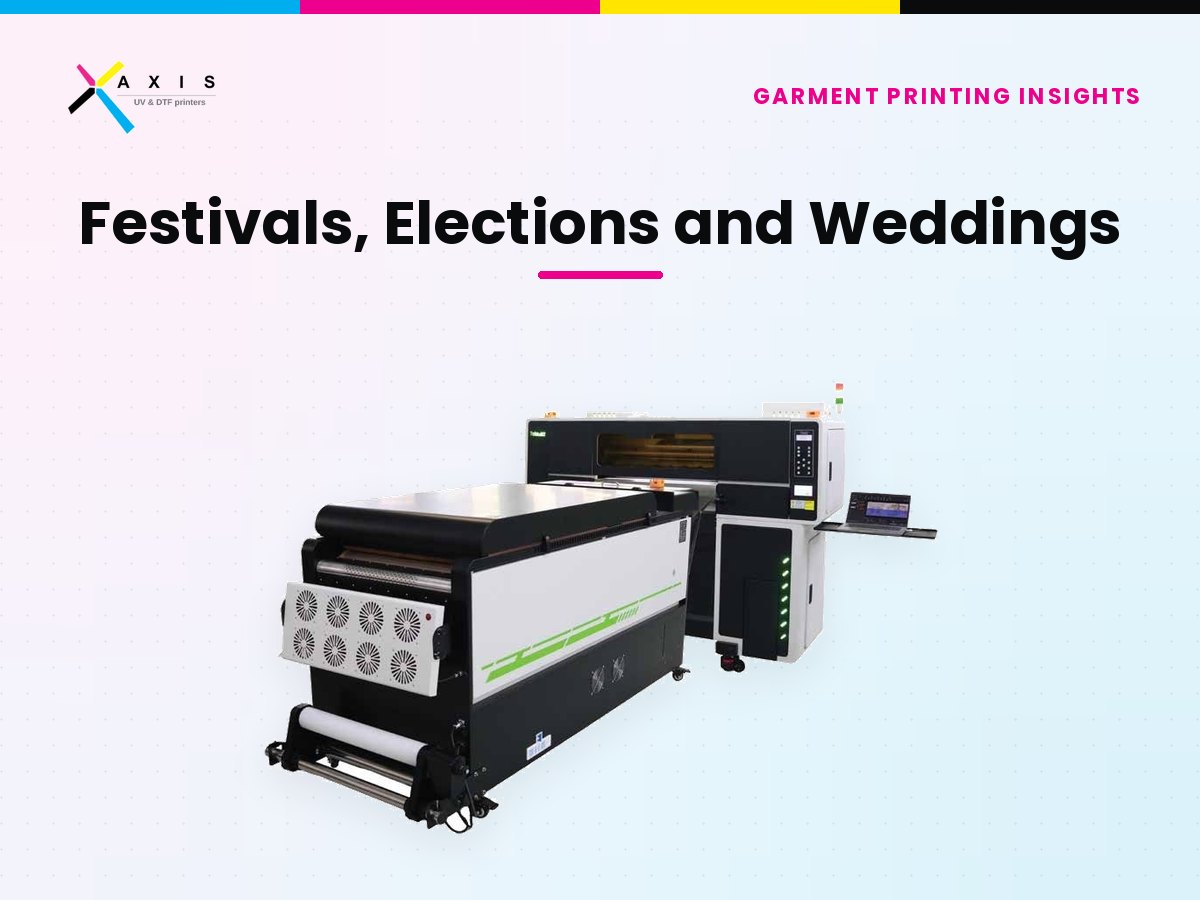
Direct-to-film (DTF) printing is a method of printing a design onto a special film, coating it with adhesive powder, curing it and then heat pressing it onto fabric. Because it works across cotton, polyester, blends and dark garments without the setup cost of screen printing, it is well suited to short, varied, occasion-driven runs where every order looks different.
Occasion-based demand is rising because personalisation itself is rising. Grand View Research (2025) projects the global print-on-demand market to reach USD 57.49 billion by 2033, growing at about 23.6% a year from 2026, as buyers increasingly expect names, dates, team logos and event themes on what they wear.
India is riding the same wave. IMARC Group (2025) valued India's custom T-shirt printing market at USD 176.6 million in 2025 and projects USD 407.9 million by 2034, a compound annual growth rate of 9.75%. The technology underneath is maturing in parallel, with Grand View Research (2024) estimating the global direct-to-film printing market at USD 2,720 million in 2024 and forecasting USD 3,920 million by 2030.
"DTF is set to not only sustain its position as a viable keystone in textile customisation but also evolve into an even more versatile, sustainable, and user-friendly technology, shaping the future landscape of the garment decoration industry."
Debbie McKeegan, Textile Ambassador, FESPA (via Texintel)
Which occasions should sit on a printer's 12-month demand calendar?
The most useful step is to map the year into recurring occasions, then attach a product, a buyer and a lead time to each one. The table below shows how a single DTF and heat press setup can serve very different occasions from the same shop floor.
| :-: | :-: | :-: | :-: | :-: |
|---|---|---|---|---|
| Occasion or season | Typical months | High-demand printed products | Primary buyers | Planning lead time |
| Major festivals (Diwali, Durga Puja, Onam, Navratri) | September to November | Themed tees, family sets, hampers, gift textiles | Retailers, families, gifting shops | 6 to 8 weeks |
| Wedding season | November to February, April to June | Coordinated family apparel, welcome kits, staff uniforms, favours | Wedding planners, families, decorators | 4 to 6 weeks |
| Elections and campaigns | Varies by state and national cycle | Party tees, caps, flags on fabric, volunteer kits | Political parties, local candidates, agencies | 2 to 3 weeks |
| School and college calendar | April to July, farewell season | Uniform add-ons, sports tees, fest and farewell merchandise | Schools, colleges, student committees | 3 to 5 weeks |
| Corporate events | Year round, peaks at onboarding and annual days | Onboarding kits, event tees, branded merchandise | HR teams, event agencies, startups | 2 to 4 weeks |
| Sports and tournament seasons | Around IPL and local leagues | Team jerseys, fan tees, name and number prints | Clubs, academies, fan groups | 1 to 2 weeks |
Once the calendar exists, the off weeks shrink. As one occasion winds down, preparation for the next has already begun, which is exactly how a shop converts scattered spikes into steady monthly billing.
How should a smart buyer plan machine capacity for seasonal peaks?
Plan capacity around your busiest realistic week, not the machine's advertised top speed. Seasonal demand arrives in concentrated bursts, so the real question is whether your setup can hold quality and deadlines when several occasions overlap.
Smart buyers weigh a few criteria before they commit:
- Uptime under load: a machine that runs reliably through a festive rush protects more revenue than one with a slightly higher spec sheet that stalls when it matters.
- Trained operators: peak season is the worst time to learn, so structured operator training decides whether extra demand becomes profit or chaos.
- Clear job costing: knowing the true cost per print, including ink, film, powder, garment, labour, wastage and electricity, lets you price festive and rush orders without eroding margin.
- Local service and spare parts: a print head or heater failure during Diwali week is a lost month unless service and parts are genuinely available nearby.
What should you look for in a machine and supplier before a festive rush?
Look for a supplier who prepares you for the busy weeks, not just the sale. The right partner treats your peak season as their responsibility too.
- Look for a supplier who lets you see a live demonstration on real garments before you buy, so output claims are proven, not promised.
- Look for a supplier who provides hands-on operator training, so your team can run, clean and troubleshoot the machine without waiting for help.
- Look for a supplier who explains job costing openly, so you can quote seasonal orders profitably under GST.
- Look for a supplier who commits to a service response time and keeps common spare parts in stock, so downtime during a festival does not become a lost order.
- Look for a supplier who supports consumables, film, ink and powder, as a matched system, so print quality stays consistent across a long seasonal run.
- Look for a supplier who is contactable locally and answers technical questions quickly, before and after payment.
How do you put this into action for the next season?
Start by picking the next three occasions on your calendar and lining up demand before you invest further. Interview a handful of local buyers, uniform dealers, event agencies, schools and corporate HR teams, and pre-sell packaged offers rather than waiting for orders to appear.
This is where Axis Enterprises fits in. Axis Enterprises supplies DTF printing machines, heat presses and matched consumables built for Indian operating conditions, along with installation, operator training, transparent job costing guidance and responsive local after-sales service and spare parts. It is the same combination of dependable machinery and practical support that lets a small shop say yes to a festive or wedding rush with confidence.
If you are planning for the coming season, the lowest-risk next step is to see the output for yourself. You can book a free live DTF machine demonstration on real garments, ask the hard questions about running costs and service, and judge the results before you commit a rupee. Bring your busiest week in mind, and let the Axis Enterprises team show you how the machine handles it.
Frequently asked questions
What seasonal products can I sell during festivals, weddings and events?
You can sell far more than T-shirts. Themed festival tees, coordinated wedding family apparel, welcome kits, staff uniforms, event caps, tote bags, cushion covers and personalised gifting textiles all use the same DTF and heat press setup. Matching the product to the occasion is what raises the average order value.
How can I test demand for a new seasonal product before buying large quantities of blanks?
Pre-sell before you stock. Show a small batch of samples to a few likely buyers such as event agencies, schools or corporate HR teams, and confirm interest with a paid sample or a small deposit. Only order blanks in volume once you have signed or repeat demand for that occasion.
How far in advance should I plan for a festive or wedding rush?
Plan four to eight weeks ahead for major festivals and weddings, and two to three weeks for faster occasions like elections or corporate events. The lead time covers design approval, blank sourcing, sample confirmation and production capacity, so deadlines are met without last-minute quality compromises.
Is one DTF machine enough to handle multiple occasions in a year?
For most small and medium shops, yes, provided you plan capacity around your busiest realistic week rather than the machine's top speed. Reliable uptime, trained operators and a stocked spare-parts supply matter more than raw speed when several occasions overlap.
How do I price seasonal orders so they stay profitable?
Price from the true cost of one sellable print, including ink, film, powder, garment, labour, wastage, electricity and a maintenance reserve, then add your margin and applicable GST. Larger designs and heavy white ink coverage should carry higher charges, so busy festive orders protect your profit instead of eroding it.
Sources
- Business Today, Diwali 2025 sales hit Rs 6.05 lakh crore: CAIT report (2025)
- Confederation of All India Traders (CAIT), Wedding season 2025 to generate Rs 6.5 lakh crore (2025)
- IMARC Group, India Custom T-Shirt Printing Market (2025)
- Grand View Research, Print On Demand Market (2025)
- Grand View Research, Direct To Film Printing Market (2024)
- Texintel, The Impact of Direct to Film Printing for Sportswear and Product Personalisation (Debbie McKeegan, FESPA)

Founder, Axis Enterprises. Selling and servicing digital printing machines across India since 2011. Author of "Increase Your Profit by 270% with UV Printing Technology". More about the author