The First 90 Days of a DTF Printing Business: A Week-by-Week Launch Plan for Indian Owners
Quick answer: A 90-day DTF launch plan is a written, week-by-week budget that turns a new direct-to-film printing business into a controlled launch instead of a gamble. It sets specific weekly targets for sales, production output, marketing activity and cash on hand, so an owner can spot trouble early and correct it. The plan splits the first quarter into three phases: setup and first jobs (days 1 to 30), steady repeat orders (days 31 to 60), and disciplined scaling (days 61 to 90). Its purpose is simple: reach break-even before your working capital runs out, not after.
What is a 90-day DTF launch plan, and why does it decide your first quarter?
A 90-day DTF launch plan is a week-by-week budget that assigns clear targets for sales, production, marketing and cash from the very first day of trading. It matters because the opening quarter is when a new printing business is most fragile: rent and salaries are fixed, orders are unpredictable, and cash reserves are thin.
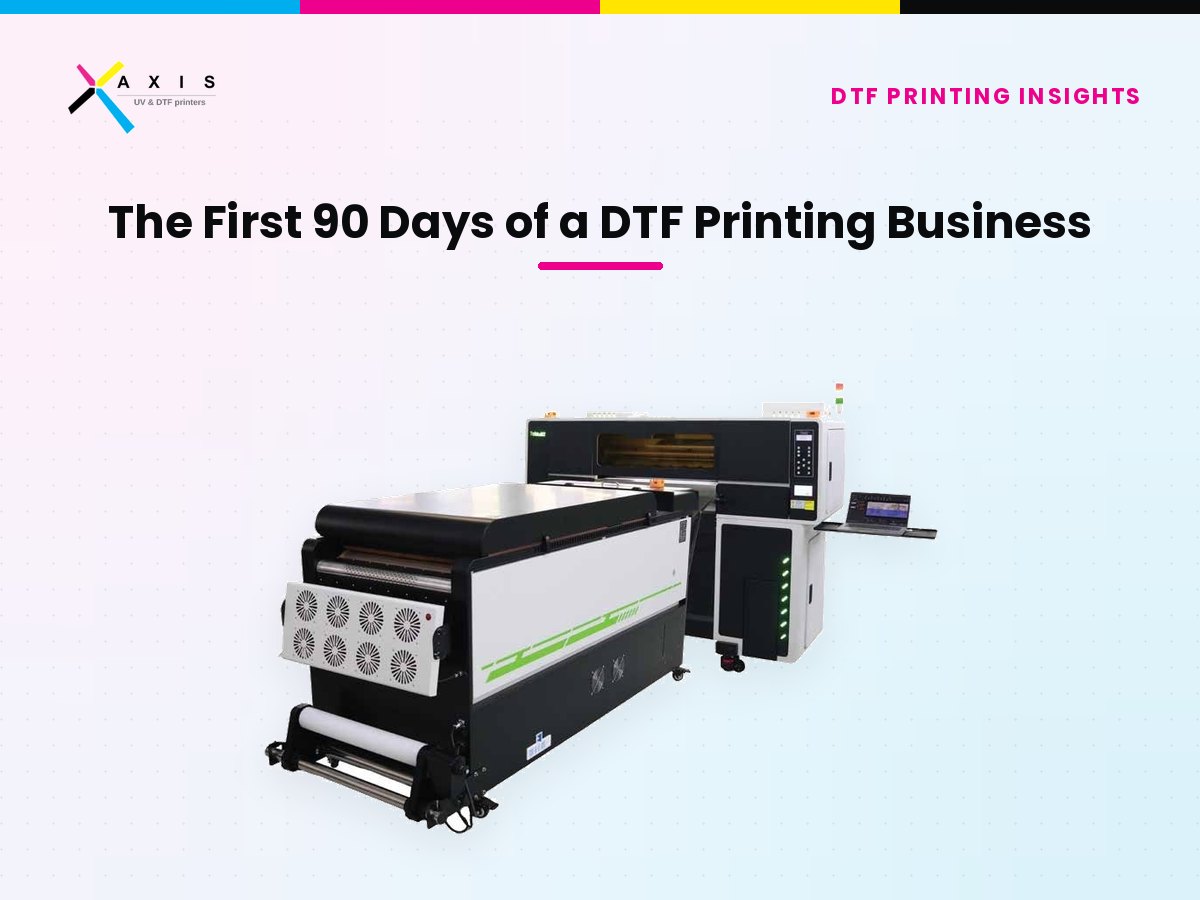
Direct-to-film printing is a process of printing a design onto a coated film, applying adhesive powder, and heat-pressing the transfer onto fabric. The machine is only one part of the business. The plan is what keeps the machine busy and paid for.
Why do new printing businesses run out of money before they run out of demand?
Most new businesses fail on cash flow, not on a shortage of interest in their product. The status quo of launching without a weekly budget is far riskier than most first-time owners assume.
According to CB Insights (2021), 70% of failed startups collapsed because they ran out of capital, and 43% failed because of poor product-market fit. For a printing shop, that translates into two avoidable mistakes: spending the launch budget before repeat orders begin, and buying a machine before confirming who will buy the prints.
A 90-day plan attacks both risks directly. It forces you to test demand in the first weeks and to protect a cash cushion for the months when orders are still building.
What is changing in India's custom apparel market right now?
Demand for short-run, full-colour custom apparel is growing quickly, which is exactly why disciplined launch planning pays off. The opportunity is real, but so is the competition entering alongside you.
According to IMARC Group (2025), the India custom T-shirt printing market reached USD 176.6 million in 2025 and is projected to reach USD 407.9 million by 2034, a compound annual growth rate of 9.75%. Globally, Grand View Research (2025) values the print on demand market at USD 10.8 billion in 2025, expanding to USD 57.5 billion by 2033 at a 23.6% CAGR.
This growth is pulling work away from older methods like screen printing for small, colourful batches. A well-planned first 90 days lets you capture that shift instead of watching faster-moving competitors take it.
How many first-time owners are entering DTF today?
A large share of new DTF buyers are opening their first printing business, which means your competition is often as new as you are. That is an advantage only if your launch is more organised than theirs.
According to the Images Magazine State of the DTF Market Report (2025), the global DTF market grew from USD 2.72 billion in 2024 to USD 2.89 billion in 2025. In that same report, Andy Gregory, Sales Director at Hybrid Services, notes: "What's been notable is the breadth of businesses taking it on, both new entrants and established decorators."
The same report quotes Jamie Turner, Managing Director of 1ClickPrint, who reports: "Our sales have more than doubled this year, with around a 50/50 split between customers buying their first machine." For a new owner, the lesson is clear: many buyers around you are learning as they go, so a written plan is a genuine edge.
How should a smart owner plan the first 90 days?
Plan around cash and repeat orders first, and around equipment second. A smart 90-day plan is built on a few criteria that separate a controlled launch from a hopeful one:
- Weekly cash targets: Track cash on hand every week, not just monthly revenue, so a slow fortnight cannot quietly drain your reserve.
- A single repeatable offer: Pick one high-demand product, such as custom team T-shirts, and master its cost and turnaround before adding variety.
- Dependable equipment and consumables: Unplanned downtime in month one destroys both cash and reputation, so machine reliability is a financial decision, not just a technical one.
- Trained hands from day one: An operator who wastes film and mishandles white ink turns a thin margin negative before you notice.
- Transparent job costing: Know your true cost per print, including film, ink, powder, garment, labour, electricity and wastage, so every quotation protects your margin.
What should your 90-day launch budget actually contain?
Your launch budget should assign a specific sales, production, marketing and cash target to each 30-day phase. The table below shows how a disciplined first quarter is structured, so no phase is left to guesswork.
| :-: | :-: | :-: | :-: | :-: |
|---|---|---|---|---|
| Phase | Sales focus | Production target | Marketing action | Cash-control rule |
| Days 1 to 30: Setup and first jobs | Convert 10 to 15 trial buyers you already know | Master one repeatable product and its \heat press\ settings | Local outreach: uniform dealers, schools, gyms, gifting shops | Spend only on consumables that produce a paid order |
| Days 31 to 60: Steady repeat orders | Turn first buyers into repeat and referral orders | Raise daily output while holding rejection rate low | Collect samples and reviews to win larger accounts | Keep at least one month of fixed costs in reserve |
| Days 61 to 90: Disciplined scaling | Sign two or three recurring B2B accounts | Add a shift or improve scheduling before adding machines | Reinvest a fixed share of profit, not the whole cushion | Confirm you have crossed weekly break-even before scaling |
According to Grand View Research (2024), the global direct-to-film printing market stood at USD 2,720.0 million in 2024 and is forecast to reach USD 3,920.0 million by 2030 at a 6.0% CAGR, so a business that survives its first quarter is entering a steadily expanding market.
What should you look for in a machine supplier before you launch?
Look for a supplier who protects your first 90 days, not only one who sells you a machine at the lowest price. Before you commit, check for the following:
- Look for a supplier who offers a live demonstration on your own artwork and fabric, so you see real output before paying.
- Look for a supplier who includes practical operator training, not just a delivery and a manual.
- Look for a supplier who stocks genuine ink, film, powder and spare parts locally, so a small fault does not stop production for days.
- Look for a supplier who gives transparent, written costs for consumables and service, so your job costing stays accurate.
- Look for a supplier who provides responsive after-sales support and a clear response time in writing.
- Look for a supplier who understands Indian production conditions, including power fluctuation, dust and humidity.
Where does Axis Enterprises fit into your launch?
Given everything above, a launch succeeds when the machine, the training and the support all arrive together and stay dependable through the fragile first quarter. Axis Enterprises supplies DTF printing machines built for Indian production floors, along with heat presses, genuine inks, film and powder. We pair every machine with on-site installation and hands-on operator training, plus responsive local after-sales support and spare parts so a minor issue never becomes a lost week.
What is the simplest next step for a new owner?
The lowest-risk way to test your plan is to watch a real machine print your own design before you spend a rupee on equipment. You can book a free live DTF machine demonstration at axisdtf.com, bring your own artwork and fabric, and see the true output, quality and cost per print for yourself. That single visit turns your 90-day plan from an assumption into a tested decision.
Frequently asked questions
How much working capital should a DTF business keep during the first 90 days?
Keep enough to cover at least one month of fixed costs, such as rent, salaries and electricity, on top of your consumables. This reserve is what lets you survive a slow fortnight without stopping marketing or delaying orders. Track it weekly, because monthly checks hide problems until they are expensive.
Should a new owner offer many products or just one in the first month?
Start with one repeatable product and master its cost and turnaround before adding variety. A single well-priced offer, such as custom team T-shirts, builds referrals faster than a wide menu you cannot deliver consistently. Add products only once your first offer is profitable and predictable.
Do I need GST registration to start a DTF printing business in India?
Most B2B printing work in India requires a GST registration so you can raise proper tax invoices and claim input tax credit on machines and consumables. Registering early keeps your job costing clean and your business credible with corporate and school clients. Confirm your specific requirement with a qualified accountant.
What is the biggest cause of loss in the first 90 days?
The two most common causes are unplanned machine downtime and inaccurate job pricing. Downtime stops paid orders while fixed costs continue, and mispriced quotations quietly erase your margin. Dependable equipment, trained operators and a true cost-per-print figure prevent both.
How do I know when it is safe to scale after 90 days?
Scale only after you have crossed weekly break-even and secured a few recurring accounts. Add a shift or improve scheduling before buying a second machine, because existing capacity is often underused. Reinvest a fixed share of profit rather than your whole cash cushion.
Sources
- Grand View Research, Direct To Film Printing Market Size, Industry Report (2024)
- Grand View Research, Print On Demand Market Size And Share Report (2025)
- IMARC Group, India Custom T-Shirt Printing Market Size and Report (2025)
- CB Insights, Why Startups Fail: Top Reasons (2021)
- Images Magazine, State of the DTF Market Report (2025)
Founder, Axis Enterprises. Selling and servicing digital printing machines across India since 2011. Author of "Increase Your Profit by 270% with UV Printing Technology". More about the author