Five Mistakes Indian DTF Printers Make Every Time Their Machine Sits Idle Over a Weekend or Festival Holiday
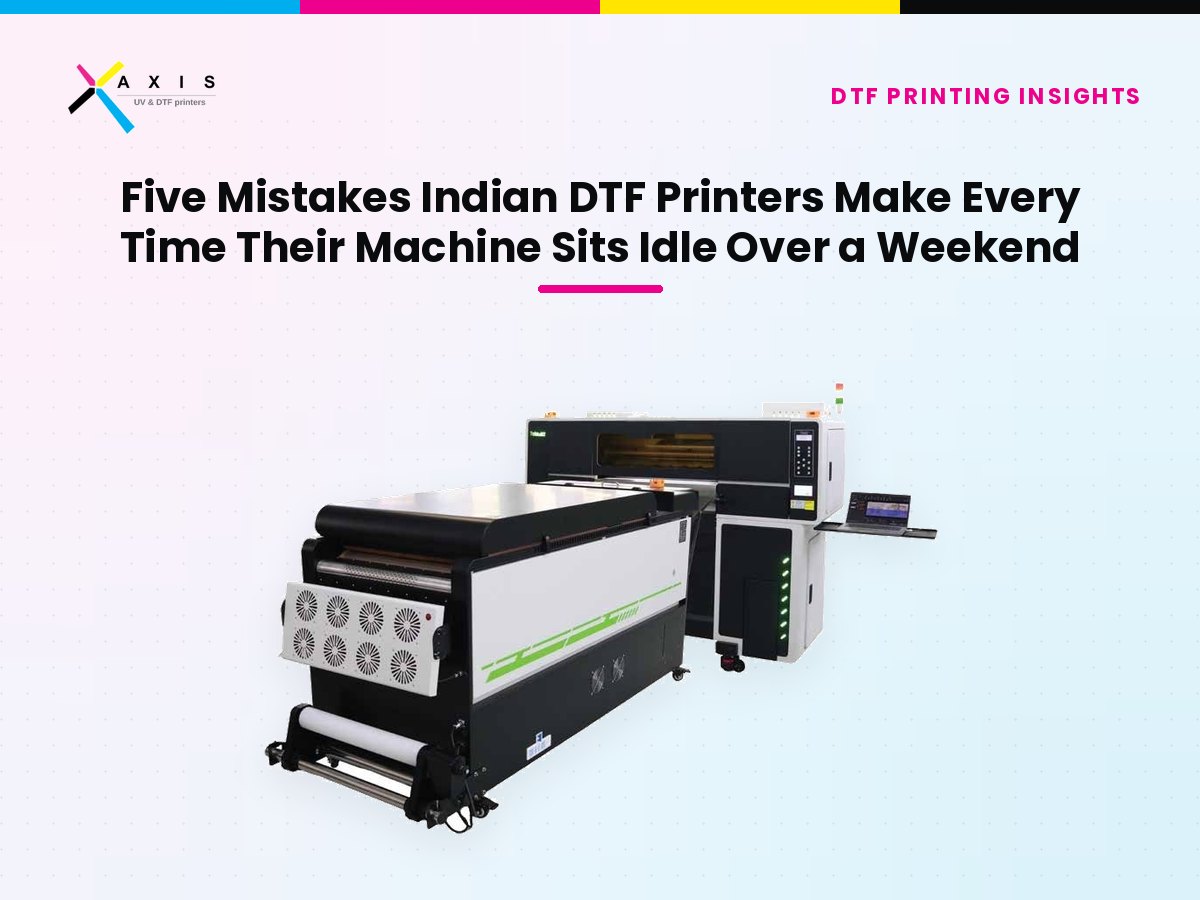
A correct idle-machine protocol for a DTF (direct-to-film) printer means running a short white-ink circulation and nozzle-check routine before shutdown, keeping the print head capped and the machine in a stable, dust-free environment, and running the same routine again before the first job after the break. Most Indian printers only think about maintenance when a machine is running. The bigger risk sits in the gaps: the Sunday it stands still, the three-day Holi weekend, the five-day Diwali closure. White ink settles fastest exactly when nobody is watching it, and a machine that prints perfectly on Friday can misfire, streak, or produce a completely blocked nozzle test on the next working day.
Why does an idle DTF machine matter more than people think?
It matters because Indian printers lose far more working days to planned closures than most owners realise. The Ministry of Personnel's 2026 circular lists 19 gazetted public holidays for India in 2026, and most small printing businesses add several more restricted or state-specific holidays on top of that. Every one of those closures is a separate idle-machine event, not a single annual inconvenience.
Add the standard weekly off day, and a typical small DTF shop can be looking at 70 to 90 non-production days a year. Each one is a window where heat press plates cool, humidity drifts, and white ink inside the lines and dampers is left undisturbed. None of that is dramatic on its own. Repeated often enough, it becomes the single biggest predictable cause of Monday-morning and post-festival breakdowns.
How much does unplanned machine downtime actually cost a small business?
It costs more than the repair bill, because it stops paying customers from getting their orders on time. A widely cited manufacturing study by Vanson Bourne, commissioned by ServiceMax (2017), found that 82 percent of manufacturers experienced at least one unplanned downtime outage over a three-year period, and that human error accounts for 23 percent of manufacturing downtime, compared with 9 percent in other sectors.
The same study found that more than 70 percent of companies do not have full visibility into when their equipment actually needs maintenance. That gap between "the machine looks fine" and "the machine is about to fail" is exactly where a missing idle protocol does its damage. As Mark Homer, Vice President of Global Customer Transformation at ServiceMax, put it in the same study: "It's perhaps not surprising that the manufacturing sector has higher levels of human error given the breadth of machinery and equipment that requires maintenance."
What five mistakes happen when a DTF machine is left idle without a protocol?
The five mistakes are switching the machine off without circulating ink, skipping the pre-shutdown nozzle check, leaving the print head uncapped, ignoring the room environment during the break, and restarting production without a warm-up test. Each one is small by itself. Together, they are the most common reason a machine that ran perfectly on Friday needs an emergency service call the following Tuesday.
- Switching off without circulating ink. White ink is pigment-heavy and settles under gravity within hours of being still. A machine powered down mid-cycle lets that settling begin inside the dampers and lines, not just the bottle.
- Skipping the pre-shutdown nozzle check. Printing one test pattern before closing tells you whether the machine was healthy going into the break. Without it, you cannot tell whether a Monday failure started on Friday or over the weekend.
- Leaving the print head uncapped. An uncapped head dries out faster and collects dust, especially in workspaces that also handle powder application nearby.
- Ignoring the room environment during the break. Textile printing equipment is sensitive to humidity and temperature swings. A room that overheats or turns humid over a long festival closure changes how ink behaves the moment production restarts.
- Restarting without a warm-up and test print. Going straight into a paying customer's job after days of downtime is how a printer discovers a blocked nozzle in the middle of a delivery deadline instead of before it.
Why does this problem keep growing as more people enter DTF printing?
It is growing because the number of machines running in India, and the pressure to keep them profitable, is rising fast. According to Grand View Research’s India DTF Printing Market Outlook (2025), India's direct-to-film printing market was valued at USD 243.9 million in 2025 and is projected to reach USD 380.3 million by 2030, growing at a compound annual rate of 9.3 percent.
Globally, Grand View Research’s global DTF market report puts the market at USD 2.72 billion in 2024, rising toward USD 3.9 billion by 2030. More machines entering service each year means more owners learning idle-machine discipline for the first time, usually the hard way, after their first blocked-nozzle Monday.
The deeper reason this keeps catching new owners off guard is that textile printing equipment behaves differently from office equipment. A desktop printer left off for a week just needs a cleaning cycle. A DTF machine's white-ink circuit is a living system: pigment particles are heavier than the carrier liquid, and without movement they separate. Preventive maintenance built around this reality, not a generic printer-care checklist, is what actually protects the investment.
How long can a DTF machine sit idle before the risk changes?
The risk rises step by step with idle duration, not all at once. An overnight gap needs almost no special handling, while a multi-week festival shutdown needs active intervention partway through, not just at the start and end. The table below shows how the required response scales with how long the machine will be off.
| Idle duration | Typical trigger | Minimum protocol action |
|---|---|---|
| Overnight (8 to 16 hours) | Daily closing | Cap the print head; no circulation needed |
| Weekend (2 to 3 days) | Sunday plus one holiday | Nozzle check before shutdown, circulate white ink once, cap head |
| Festival block (4 to 7 days) | Diwali, Holi, Eid closures | Circulate ink every 2 to 3 days if anyone can visit; full nozzle test and cleaning cycle on return |
| Extended shutdown (1 to 4 weeks) | Combined holidays, relocation, off-season pause | Scheduled visits to circulate and check ink; consider draining and properly storing white ink per manufacturer guidance |
What should a smart buyer look for before deciding how to handle idle periods?
A smart buyer should judge a machine and a supplier on how well they support the business during the 70 to 90 non-printing days a year, not only on print speed during the busy ones. Five buying criteria matter here.
- A documented shutdown and restart procedure that came with the machine, not one the owner has to invent after the first failure.
- Local, responsive after-sales support that can talk an operator through an unusual restart issue on a holiday, rather than a call centre that opens the day after everyone needed help.
- Transparent job costing that already accounts for the maintenance time a protocol takes, so it never feels like a shortcut worth skipping under deadline pressure.
- Genuine operator training that covers idle-machine care specifically, not just day-to-day operation.
- Consistent consumable quality, because white ink that separates or oxidises faster than it should makes every idle period riskier than it needs to be.
What should be on a checklist before choosing who to buy a DTF machine from?
The checklist should test whether a supplier actually prepares buyers for the idle periods, not just the print runs. Look for a supplier who:
- Provides a written idle-machine and holiday-shutdown protocol as part of installation, not as an afterthought.
- Offers operator training that includes a live demonstration of the shutdown and restart routine, not just a manual.
- Keeps critical spare parts such as dampers, caps and filters in local stock, since a delayed part can turn a one-day fault into a week of lost orders.
- Publishes a clear response-time commitment for support calls, including around festival periods when problems are most likely to surface.
- Is willing to show the protocol working on a real machine before you commit to buying, rather than only describing it in a brochure.
This is exactly the gap Axis Enterprises was built to close for Indian DTF printers. Axis Enterprises supplies DTF printing machines, heat presses and consumables alongside installation, operator training and after-sales support designed around how Indian printing businesses actually run, including the long weekends and festival closures that catch new owners off guard. If your current setup does not include a written idle-machine protocol, you can book a free live DTF machine demonstration to see how the routine works on an actual production floor before you decide anything.
Owners who are still comparing machines can also talk to the Axis Enterprises team about operator training that covers shutdown and restart procedures, and printers already running a machine that regularly misbehaves after a break can check Axis Enterprises’ after-sales service and spare-parts support for white-ink system issues. Either way, the fastest way to find out whether your current protocol is actually protecting your machine is to see a live demonstration at axisdtf.com and compare it against what you are doing today.
If your machine has ever needed an unscheduled service call the day after a long weekend or festival break, that is worth investigating before the next one arrives. Book a free live demonstration at axisdtf.com, bring your questions about your specific machine and shutdown routine, and walk away with a clear, written idle-machine protocol you can start using immediately, whether or not you buy anything.
Frequently asked questions
How long can a DTF machine sit idle before white ink becomes a problem?
Meaningful settling can begin within hours, which is why even a weekend needs a circulation step, not just an overnight one. By the fourth or fifth day of a festival closure, an uncirculated machine is at real risk of a blocked nozzle test on restart.
Should I run the machine before leaving for a holiday, or wait until I return?
Both matter, but they do different jobs. A pre-shutdown nozzle check confirms the machine was healthy going into the break, while a post-return check and warm-up print confirms it is safe before you accept a paying customer's job.
Does switching the machine off completely damage it, or is idle mode acceptable?
Powering off is fine for most idle periods as long as the print head is capped and, for anything longer than a weekend, the white ink has been circulated first. The damage comes from an uncapped head and unmoved white ink, not from the power switch itself.
Is an idle-machine protocol something the supplier should provide, or is it on the printer to figure out?
A supplier who sells DTF machines to Indian businesses should hand over a written protocol and demonstrate it during installation and training, given how many holidays and weekly closures every Indian printer works around. If your supplier never mentioned one, that is worth asking about directly.
Can one operator manage the full shutdown and restart routine, or does it need more than one person?
One trained operator can usually manage it for a single machine, provided they follow a written checklist rather than memory. Businesses running multiple machines or multiple shifts benefit from cross-training at least two people so the routine does not depend on one person's availability.
What is the biggest difference between handling a normal weekend and a major festival closure?
Duration and the number of check-ins required. A weekend usually needs one circulation cycle before shutdown and one check on return, while a five-to-seven-day festival closure needs at least one mid-break visit to circulate ink if the business can arrange it.
Sources
- India Briefing, "Public Holidays in India 2026 and Key HR Considerations"
- Grand View Research, "India Direct To Film Printing Market Size & Outlook, 2030"
- Grand View Research, "Direct To Film Printing Market Size | Industry Report, 2030"
- Cutting Tool Engineering, "Report: Most common cause of manufacturing downtime is human error," citing Vanson Bourne / ServiceMax (2017)
Founder, Axis Enterprises. Selling and servicing digital printing machines across India since 2011. Author of "Increase Your Profit by 270% with UV Printing Technology". More about the author