The Four Parts of a DTF Machine's White-Ink System Most Printers Never Inspect, Until Production Stops
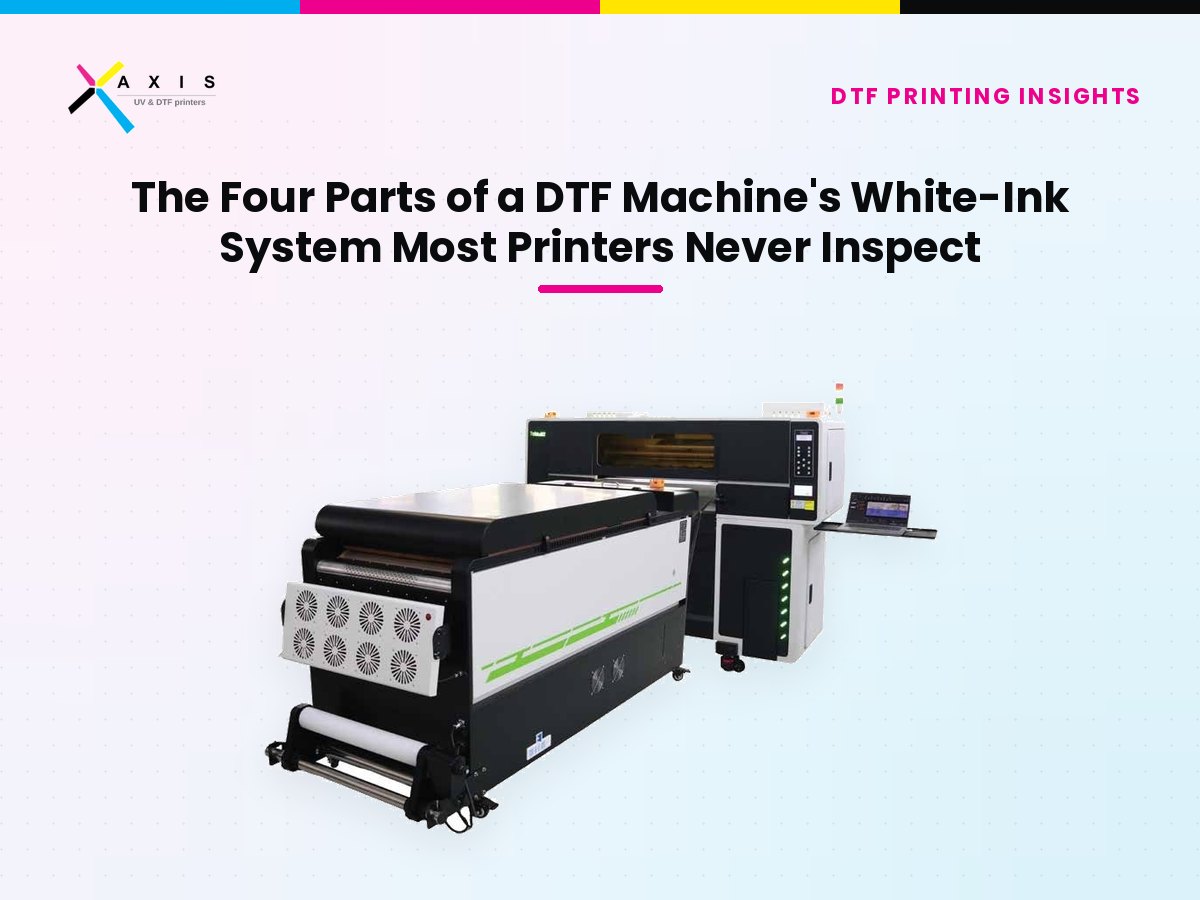
Titanium dioxide, the pigment that makes DTF white ink opaque, is roughly twice as dense as the liquid carrying it. It begins separating and settling within hours of a pump switching off. Most DTF operators know this. Far fewer know that the four mechanical parts responsible for keeping that pigment suspended, moving and clean, the pump, damper, filter and tubing, are inspected on any fixed schedule in almost no Indian DTF workshop.
A DTF machine's white-ink system is the pump, damper, filter and tubing network that moves thick, pigment-heavy white ink from the ink supply to the print head without settling, clogging or drawing in air. Direct-to-film printing uses far more white ink per job than most other garment-decoration methods, so this system works harder and fails faster than the coloured-ink side of the same machine. When a pump loses suction, a damper's diaphragm hardens, a filter clogs with dried pigment, or a tube develops a micro-leak, print quality drops gradually before the machine stops completely, which is exactly why a short, scheduled inspection of these four parts catches trouble while it is still cheap to fix.
What does skipping white-ink system inspection actually cost a DTF printer in 2026?
Skipping inspection of the pump, damper, filter and tubing rarely causes one dramatic failure. It causes a slow accumulation of reprints, patchy underbase and missed deadlines that owners often blame on "the machine" rather than on a check nobody scheduled.
Unplanned downtime is already the largest hidden cost most small manufacturers carry, and it is getting more expensive, not less. According to Fluke Corporation's October 2025 industrial resilience survey, 61 percent of manufacturers experienced unplanned downtime in the past year, and the average incident now costs businesses roughly 1.7 million US dollars per hour globally, a figure driven largely by parts and processes nobody was routinely checking.
The same pattern shows up at smaller scale. Siemens's 2024 True Cost of Downtime report found that the average manufacturing facility experiences 25 unplanned downtime incidents a month, adding up to 326 hours of lost production every year. The same report found that average repair time has grown from 49 minutes to 81 minutes, largely because fewer operators are trained to recognise early warning signs before a small part fails completely.
For a DTF printer running white-ink-heavy jobs, apparel, corporate gifting, sportswear, that pattern usually looks like this: reprints from a patchy white underbase, a full production stop when a hardened damper finally seizes, and a service call that a five-minute inspection two weeks earlier could often have prevented.
Why do DTF white-ink systems fail more often than the rest of the machine?
White ink fails first because titanium dioxide pigment settles under gravity the moment circulation stops, and because India's DTF printing sector is scaling faster than most workshops' maintenance habits are keeping up. Both forces are pushing in the same direction at once.
Grand View Research estimates India's direct-to-film printing market at approximately 243.9 million US dollars in 2025, projected to reach 380.3 million US dollars by 2030, growing at a compound annual rate of 9.3 percent, faster than the broader Asia-Pacific market. That growth means more machines running longer daily cycles, more multi-shift operation, and more weekend idle-then-restart cycles between festival and school orders, exactly the pattern that stresses a white-ink circuit hardest.
"Our research shows a tough reality: too many manufacturers are stuck reacting to downtime instead of getting ahead of it," says Parker Burke, Group President of Fluke Corporation, commenting on the company's October 2025 industrial resilience survey.
That reactive pattern is exactly what scheduled component inspection replaces. A Deloitte Consulting analysis of predictive maintenance programs across manufacturing, whose findings remain widely cited today, shows the approach can cut maintenance-planning time by 20 to 50 percent, lift equipment uptime by 10 to 20 percent, and reduce overall maintenance costs by 5 to 10 percent. Those gains come almost entirely from catching small component wear, a stiffening diaphragm, a slowly clogging filter, before it becomes a full stoppage.
Wider textile printing operations learned this lesson with screen frames, squeegees and curing units long before DTF existed. The equipment changes, but the underlying discipline, inspect the parts that wear fastest on a fixed schedule, does not.
Which white-ink component usually fails first, and what does it look like?
The pump, damper, filter and tube each fail differently and give different early warnings. Knowing the signs for each one is what turns a two-minute glance into a useful inspection rather than a guess.
| Component | Typical First Sign of Trouble | How Often to Check | Approximate Replacement Cost |
|---|---|---|---|
| Circulation pump | Weak or inconsistent white underbase; slower priming at startup | Weekly visual check, monthly function test | Rs. 3,000 to Rs. 8,000 plus GST |
| Damper | Visible air bubbles, pressure fluctuation, banding in solid white areas | Weekly | Rs. 500 to Rs. 1,500 plus GST |
| Filter | Gradual drop in white opacity; slower ink flow under normal pressure | Every two to four weeks, depending on usage | Rs. 300 to Rs. 900 plus GST |
| Tubing | Discolouration, stiffness, ink residue near joints, micro-leaks | Monthly, and after any relocation of the machine | Rs. 200 to Rs. 600 per metre plus GST |
These are typical ranges seen across Indian DTF workshops rather than fixed prices, since exact costs depend on machine brand and part specification. The pattern that matters more than any single number is that all four parts are inexpensive to replace on a schedule and expensive to replace after they cause a production stop.
What should a smart buyer expect from a DTF machine's white-ink system design?
A smart buyer should judge a machine less on advertised print speed and more on how easily its white-ink system can be inspected, flushed and serviced without specialist tools. Five criteria separate a machine built for daily Indian workshop conditions from one built only to look good in a demonstration.
- Accessible architecture: the pump, damper and filter should be reachable and visible without dismantling the print head assembly.
- Documented, genuine spare parts: pumps, dampers, filters and tubing that are specified and traceable, not generic substitutes bought locally under pressure.
- Component-level training: operators trained to inspect these four specific parts, not just told to run a daily agitation or cleaning cycle.
- Transparent job costing: a supplier who is upfront about consumable wear and replacement-part cost as part of your real cost per print, not just machine price.
- Responsive local after-sales service: a supplier who can get a replacement part or technician to you in days, not weeks, when something does wear out.
What should you look for before you trust a DTF machine's white-ink system?
Before buying or re-committing to a DTF machine, look for concrete evidence on these points rather than general reassurance. Each item below is something you can verify during a live demonstration.
- Ask the supplier to physically show you the pump, damper and filter locations during the demonstration, not just describe them.
- Confirm the damper and filter can be inspected and swapped without removing the print head.
- Ask for the specific inspection checklist your operator would be trained on, and how often each item is checked.
- Ask for typical spare-part lead times for the pump, damper, filter and tubing in your city.
- Get consumable and spare-part pricing in writing, inclusive of GST, before you sign.
- Ask for a reference customer running a similar production volume you can call directly.
Where Axis Enterprises fits into this picture
Everything above is exactly what Axis Enterprises builds its DTF machines, training and after-sales support around. Axis Enterprises supplies direct-to-film printing machines, heat presses and consumables to Indian garment-printing businesses, with a white-ink circuit designed for easy pump, damper and filter access, and operator training that walks through this exact four-point inspection. You can explore Axis Enterprises' DTF machine range or review its documented spare-parts and after-sales program before making a decision either way.
If you already own a DTF machine and are unsure whether its white-ink system is being inspected properly, or you are evaluating your first machine and want to see this circulation system up close, you can book a free live DTF machine demonstration at axisdtf.com. Axis Enterprises' team will walk through the pump, damper, filter and tubing on a running machine, show you what a five-minute inspection actually looks like, and answer questions about spare parts, training and local service response times, so you can decide with the machine in front of you rather than a brochure. You can also check current machine and consumable pricing at axisdtf.com beforehand if you want the numbers ready before the visit.
Frequently asked questions
How often should I inspect the pump, damper and filter in my DTF machine's white-ink system?
Check the pump and damper visually every week and run a function test monthly. Inspect the filter every two to four weeks depending on how much white ink your machine runs, and check tubing monthly or after moving the machine.
Can a clogged white-ink filter damage my print head?
Yes. A clogging filter restricts flow unevenly, which can force the pump to work harder and push settled pigment or debris toward the nozzles, increasing the risk of head damage over time. Catching a clogging filter early avoids that risk entirely.
What is the difference between a damper and a filter in a DTF white-ink system?
A damper regulates ink pressure and removes air bubbles before ink reaches the print head, while a filter removes solid particles and settled pigment from the ink stream. Both sit close to the print head and both need separate, regular checks.
Does daily white-ink agitation replace the need to inspect the pump and filter?
No. Agitation keeps pigment suspended inside the ink tank, but it does not reveal whether the pump is losing suction, the damper diaphragm is hardening, or the filter is gradually clogging. Those require a separate, physical inspection.
How much does it typically cost to replace these parts in India?
Based on typical Indian workshop experience, a damper or filter usually costs a few hundred to about Rs. 1,500 plus GST, while a circulation pump runs roughly Rs. 3,000 to Rs. 8,000 plus GST. These figures vary by machine brand and specification, so confirm exact pricing with your supplier.
Is this inspection routine different for a screen printing shop adding its first DTF machine?
The core routine is the same, but new DTF operators coming from screen printing should expect the white-ink system to need more frequent attention than any screen or squeegee maintenance they are used to, simply because DTF circulates ink continuously rather than only during a press run.
Sources
- Grand View Research, "India Direct To Film Printing Market Size & Outlook" (2025)
- Siemens, "The True Cost of Downtime 2024"
- Fluke Corporation, "Unplanned Downtime Costs Manufacturers Up to $852M Weekly" (October 2025)
- Deloitte Insights, "Using Predictive Technologies for Asset Maintenance" (2017)
Founder, Axis Enterprises. Selling and servicing digital printing machines across India since 2011. Author of "Increase Your Profit by 270% with UV Printing Technology". More about the author