How to Get Vibrant, Consistent DTF Prints in India in 2026: A Print-Quality and Colour-Accuracy Playbook
India's appetite for custom apparel is growing faster than most shop owners realise, yet the printers who win repeat orders are rarely the cheapest. According to Grand View Research (2026), the global print-on-demand market is projected to reach USD 57.49 billion by 2033 at a 23.6% CAGR, with apparel holding the largest revenue share at 39.5% in 2025. In a market that large and that busy, the shops that keep customers are the ones whose reds stay red and whose whites stay bright across every single batch.
Quick answer: DTF print quality is the combination of colour accuracy, opacity, sharpness and wash durability in a finished transfer, and colour accuracy is how closely the printed result matches the intended design. Most quality failures in Indian print shops trace to four controllable causes: unmanaged colour profiles, poorly circulated white ink, low-grade consumables and incorrect curing. The fix is a disciplined workflow: calibrated colour profiles, consistent white-ink management, tested film, ink and powder combinations, and correct heat-press settings, all backed by proper operator training. Shops that treat quality as a system, not luck, cut reprints, reduce complaints and protect their margins as competition rises in 2026.
What is DTF print quality and colour accuracy, exactly?
DTF print quality is how vibrant, sharp, opaque and wash-durable a finished transfer is, while colour accuracy is how closely the printed colours match the design the customer approved. Both are measurable outcomes of your workflow, not lucky accidents.
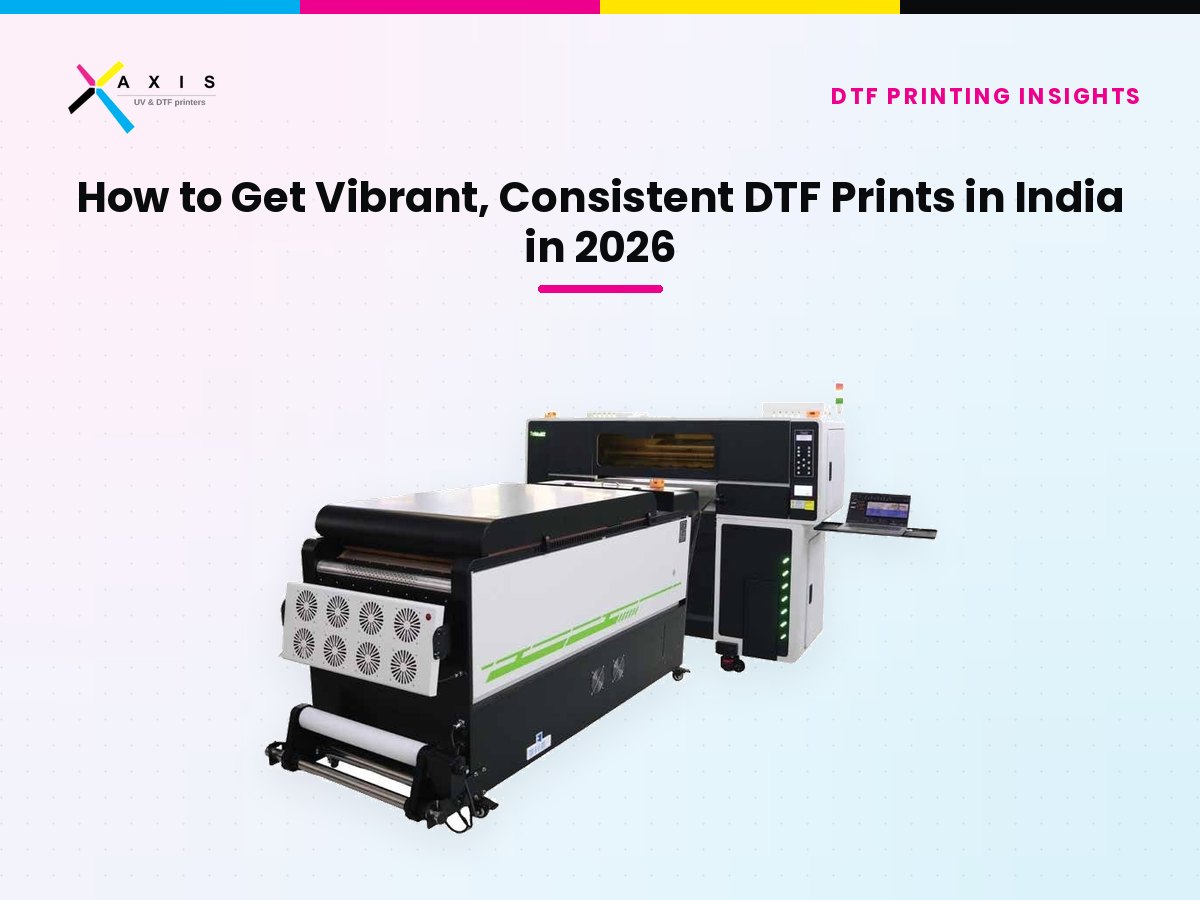
Direct-to-film printing works by printing a design onto a coated film, coating it with adhesive powder, curing it, and fusing it to fabric with a heat press. Each of those steps can add or destroy quality.
Colour accuracy specifically depends on colour management: using a calibrated ICC profile so the file, the printer and the film agree on what each colour should be. Without it, the screen and the shirt tell two different stories.
Why is colour accuracy suddenly the difference between winning and losing customers in 2026?
Colour accuracy decides repeat business because the market is now crowded enough that customers can simply switch to a shop that gets it right the first time. Rising demand attracts more printers, so consistency, not novelty, is the real differentiator.
The demand is real. According to IMARC Group (2025), India's custom T-shirt printing market reached USD 176.6 million in 2025 and is projected to reach USD 407.9 million by 2034, a 9.75% CAGR. Every year that market grows, more shops chase the same orders.
The technology itself is scaling to meet that demand. Per Grand View Research (2025), the global direct-to-film printing market was valued at USD 2,720.0 million in 2024 and is projected to reach USD 3,920.0 million by 2030 at a 6.0% CAGR. More machines entering the market means quality, not availability, becomes the deciding factor.
That competition sits inside a far larger base. Per the India Brand Equity Foundation, IBEF (2026), India's textile and apparel market is projected to reach US$ 350 billion by 2030 at a 10% CAGR. In a market expanding this fast, the printer whose colours are dependable captures the reorders, and the printer whose colours drift trains customers to shop elsewhere.
What does inconsistent print quality actually cost a small printer?
Inconsistent quality costs far more than the wasted film, because every reprint spends your consumables twice and every complaint spends your reputation once. A single rejected batch of 50 garments means 50 units of film, ink, powder, electricity and labour paid for with zero revenue in return.
The hidden cost is the lost reorder. In a growing category, a customer who receives a faded or off-colour print does not argue, they quietly move to the next supplier. Given India's textile printing market is valued by Grand View Research (2024) at USD 2,198.4 million and growing 9.9% a year to USD 3,844.0 million by 2030, the reorders you lose to quality problems flow straight to a competitor.
There is also the cost of uncertainty. When you cannot predict whether a print will come out right, you cannot quote confidently, schedule reliably, or scale without fear. Predictable quality is what turns a busy shop into a profitable one.
Why do colours drift, whites look weak, and banding appear?
These faults almost always come from four controllable sources: no colour profile, mismanaged white ink, low-grade consumables, and wrong curing. Fix those four and the majority of complaints disappear.
Colour drift usually means the file is being printed without a matched ICC profile, so the printer guesses. Weak whites usually mean white ink has settled or the underbase is too thin, since white ink is heavier and separates quickly if it is not circulated. Banding usually points to clogged or firing-inconsistent nozzles, often the downstream result of poor maintenance or cheap ink.
Consumable quality is a decisive and underrated factor. As Folker Stachetzki, Marketing Manager at Brother, observed in the Images magazine State of the DTF Market Report 2025, "fluctuations in the supply chain and in the quality of consumables are still a major problem, especially with cheaper suppliers." Mismatched film, ink and powder are a frequent, invisible cause of oily prints, poor adhesion and colour variation.
How should a smart buyer judge a DTF setup for consistent quality?
Judge a setup by the quality system around it, not by the printer's advertised resolution alone. The machine matters, but repeatable colour comes from profiling, white-ink handling, matched consumables, curing control and trained operators working together.
The industry itself is shifting toward this quality-first mindset. As Michael Overy, Managing Director of Dae Ha UK, noted in the Images magazine State of the DTF Market Report 2025, serious buyers now "place a greater importance on print quality through the need for 100% consistency with a low-dot-gain film, plus Oeko-Tex certification for VOC-free production."
A smart buyer therefore weighs five things: calibrated colour profiling for accurate output, disciplined white-ink circulation for strong opacity, tested and compatible consumables for stable adhesion, correct and repeatable curing for wash durability, and hands-on operator training so the workflow survives daily use. Miss any one and consistency collapses.
What should you look for in a DTF supplier who can guarantee quality?
Look for a supplier who sells a working quality system, not just a box. The right partner proves output on your own artwork and fabric, then supports you long after the sale so quality holds. Use this checklist:
- Look for a supplier who runs a live demonstration on your own designs and garments before you pay, so you judge real colour accuracy, not a showroom sample.
- Look for a supplier who provides calibrated colour profiles and shows you how white-ink circulation is managed day to day.
- Look for a supplier who recommends tested, compatible film, ink and powder rather than leaving you to guess with the cheapest option.
- Look for a supplier who includes structured operator training, because the best machine still fails in untrained hands.
- Look for a supplier who offers responsive local after-sales service and genuine spare parts, so a nozzle issue is a same-week fix, not a month of downtime.
- Look for a supplier who states running costs and curing settings transparently, so your quality is repeatable and your pricing is accurate.
The table below turns that advice into a quick comparison you can hold any supplier against.
| :-: | :-: | :-: |
|---|---|---|
| Quality factor | Low-quality, unsupported setup | Quality-first, supported setup |
| Colour accuracy | No ICC profile, colours guessed | Calibrated colour profile matched to film and ink |
| White ink | Settles and clogs, weak underbase | Managed circulation, consistent strong whites |
| Consumables | Cheapest available, mismatched | Tested, compatible film, ink and powder |
| Curing | Guessed temperature and pressure | Correct, documented, repeatable settings |
| Support | None after payment | Training, service and spare parts on call |
Where does a dependable, quality-first DTF partner fit in?
Everything above describes how Axis Enterprises works with Indian garment printers. We supply DTF printing machines, heat presses and matched consumables, then back them with installation, operator training, transparent running-cost guidance and responsive local after-sales support, so vibrant, consistent colour becomes your normal output rather than your lucky day.
Because quality is a system, we prove it before you commit. You can book a free live DTF machine demonstration on your own artwork and fabric, and see the colour accuracy, white opacity and wash durability with your own eyes.
If you want prints that hold their colour batch after batch and customers who keep coming back, the next step is simple and free. Bring a design and a garment, and arrange your live DTF quality demonstration with our team. You will leave knowing exactly what consistent output looks like and what it will cost you to produce it, with training and after-sales support built in from day one.
Frequently asked questions
Why do my DTF colours look different on the shirt than on my screen?
Your screen shows light-based colour while the print reproduces ink-based colour, and without a matched ICC profile the two will not agree. Install a calibrated colour profile for your specific printer, ink and film, and the gap narrows sharply. Consistent lighting when you check prints also helps you judge accuracy fairly.
How do I stop my white ink from looking weak or patchy?
Weak whites usually mean the white ink has settled or the underbase is too thin. White ink is heavier than colour ink and separates quickly, so it needs disciplined daily circulation and agitation. A correct, opaque white underbase is what makes colours on top look bright and solid.
What causes banding lines across a DTF print?
Banding is most often caused by clogged or inconsistently firing nozzles, which stem from skipped maintenance, low-grade ink, or a machine left idle too long. A simple daily and weekly cleaning routine prevents most of it. If banding persists, a nozzle check and profile review usually locates the cause.
Does DTF quality hold up in the wash compared with screen printing?
Well-cured DTF transfers offer strong wash durability that now rivals many screen printing results, provided curing temperature, pressure and time are correct. Under-curing is the main reason prints peel or crack. Correct, repeatable heat-press settings are what lock the print into the fabric.
Is a more expensive machine automatically better for colour accuracy?
No. Colour accuracy comes from the whole system: profiling, white-ink handling, matched consumables, curing and trained operators. A well-supported mid-range setup with a proper workflow will out-print a costlier machine run without profiles or training. Buy the system, not just the specification sheet.
How much does poor print quality really cost a small shop?
More than the wasted materials, because every reprint spends film, ink, powder and labour twice while every complaint risks a lost reorder. In a fast-growing market, dissatisfied customers simply switch suppliers rather than complain. Predictable quality protects both your margin and your customer base.
Sources
- Grand View Research (2026), Global Print-on-Demand Market
- IMARC Group (2025), India Custom T-Shirt Printing Market
- India Brand Equity Foundation, IBEF (2026), Textiles and Apparel
- Grand View Research (2024), India Textile Printing Market
- Grand View Research (2025), Direct to Film Printing Market
- Images magazine, State of the DTF Market Report 2025
Founder, Axis Enterprises. Selling and servicing digital printing machines across India since 2011. Author of "Increase Your Profit by 270% with UV Printing Technology". More about the author