Why Gradients and Skin Tones Are Quietly Costing Indian DTF Printers Repeat Orders in 2026
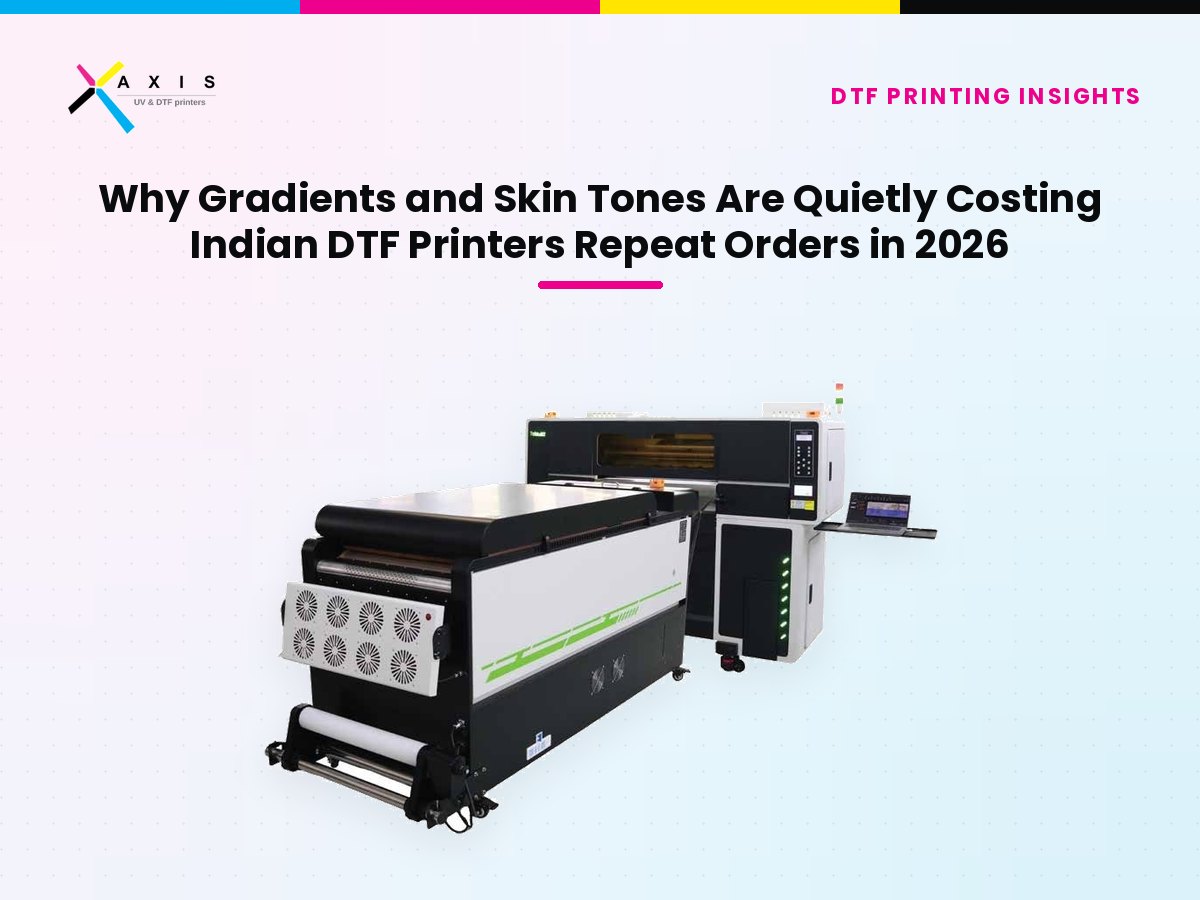
India's direct-to-film printing market is worth USD 243.9 million in 2025 and is projected to reach USD 380.3 million by 2030, growing at 9.3 percent a year, according to Grand View Research (2025). Most of that growth will be won or lost on one unglamorous detail: whether a print can hold a smooth gradient or a believable skin tone without banding, dulling or shifting colour.
Direct-to-film (DTF) printing is a digital garment-printing process where a design is printed onto a special film, dusted with adhesive powder, cured, then applied to fabric with a heat press. Most DTF machines reproduce flat colours and logos reliably, but gradients and skin tones expose weaknesses because they demand smooth, continuous tone transitions rather than solid blocks of colour. Failures usually trace to three causes: an uncalibrated RIP colour profile, inconsistent white ink underbase density beneath the coloured layers, and print head dot placement drift during long runs. Fixing this needs disciplined colour profiling, a tested white ink routine, and a supplier who trains operators on both, not a faster machine alone.
How much is colour inconsistency really costing DTF printers in India?
It is costing printers the repeat orders that make a DTF business profitable, at exactly the moment competition is intensifying. The custom apparel and print-on-demand space that DTF printers depend on is expanding fast, which means more suppliers chasing the same buyers, and less tolerance for a reprint.
- India's custom T-shirt printing market is valued at USD 176.6 million in 2025 and is forecast to reach USD 407.9 million by 2034, a compound annual growth rate of 9.75 percent, according to IMARC Group (2025).
- Globally, digital textile printing is projected to grow from USD 3.09 billion in 2026 to USD 4.28 billion by 2031, a CAGR of 6.73 percent, with garment and apparel already commanding 56.89 percent of application share in 2025, according to Mordor Intelligence (2026).
- Standard four-colour (CMYK) printing can reproduce only around 50 percent of Pantone Matching System colours, while six-colour systems can reach roughly 90 percent, a gap that shows up hardest in skin tones and gradients, according to industry colour-management research summarised by Fibre2Fashion.
None of this is a reason to avoid DTF. It is a reason to treat colour accuracy in textile printing as a production discipline, not an afterthought, because the buyers filling this growing market notice the difference between a flat colour and a natural one within seconds.
Why do gradients and skin tones break down on a DTF print in the first place?
Gradients and skin tones break down because they ask the printer to do the hardest thing possible with a limited colour gamut: shift smoothly from one shade to a very close neighbouring shade without a visible step. Flat logo colours hide small errors; a jawline or a sunset gradient does not.
CMYK printing, the base colour model most DTF machines still build from, physically cannot reproduce the full range of tones a camera or a screen can show. When a RIP software's colour profile is not calibrated to the actual ink, film and garment combination in use, that already-narrow gamut is compressed further, producing banding, muddy mid-tones or a greyish cast in skin areas.
White ink underbase inconsistency compounds the problem. Because coloured ink sits on top of a white base layer on most fabrics, any variation in how evenly that white layer is laid down changes how the colours above it read, which is precisely why colour management has become a named discipline in textile printing rather than a guess made by eye.
What is changing in how Indian buyers judge DTF print quality in 2026?
What is changing is the baseline: buyers who once accepted "good enough" colour now compare every printer against the sharpest work they see online, and digital printing overall is being held to a higher bar. As Engin Ibrahim, founder of the UK garment decorator Flying Colours, put it: "Digital printing is no longer just an alternative, it's a new standard for quality, speed, and creativity."
"Digital printing is no longer just an alternative, it's a new standard for quality, speed, and creativity." (Engin Ibrahim, Founder, Flying Colours)
That shift matters for corporate gifting, sports jerseys, festival merchandise and any order involving a face, a logo gradient or a brand colour that must match exactly. A printer who cannot hold a gradient loses that order category entirely, not just one job.
What should a smart buyer look for when colour accuracy matters?
A smart buyer should judge a DTF supplier on whether they can prove consistent colour under real production conditions, not on brochure speed claims. Four criteria separate suppliers who can handle gradient and skin-tone work from those who cannot.
- Dependable, well-maintained machinery. A print head with drifting dot placement or an unstable white-ink circulation system will never hold a clean gradient, regardless of the RIP software used.
- Practical, hands-on operator training. Colour profiling is a learned skill, not a default setting, so training on RIP colour management should be part of the sale, not an afterthought.
- Transparent job costing. Complex gradient and skin-tone jobs consume more ink and test prints than flat logos, and a supplier who explains this cost difference upfront prevents disputes later.
- Responsive local after-sales service. Colour drift often traces back to a worn part or a dirty print head, so fast local diagnosis matters more than a distant call centre.
What causes banding, blotchy skin tones and muddy gradients, and how are they usually fixed?
Most gradient and skin-tone failures fall into a small set of repeatable causes, each with a specific fix rather than a general "clean the machine" response.
| :-: | :-: | :-: |
|---|---|---|
| Problem | Likely cause | Typical fix |
| Visible banding across a gradient | Uncalibrated RIP colour profile or low print resolution setting | Rebuild the colour profile for the exact ink, film and garment combination in use |
| Grey or dull cast in skin tones | Compressed colour gamut from an uncorrected CMYK profile | Use a profile built specifically for skin-tone reproduction and verify against a physical swatch |
| Blotchy or uneven mid-tones | Inconsistent white ink underbase density | Standardise white-ink circulation and agitation before every production run |
| Colour shifts between batches of the same design | Different ink batches or RIP settings used without re-testing | Lock an approved RIP preset and re-test whenever a consumable batch changes |
A practical checklist before you trust any DTF supplier with skin-tone work
Before committing to a supplier for gradient-heavy or skin-tone work, ask to see proof rather than promises. This checklist covers what to verify in person.
- Look for a supplier who will print a real gradient or skin-tone sample on your chosen fabric during a live demonstration, not just show you a photo.
- Look for a supplier who can explain, in plain language, how their RIP software handles colour profiling for different fabrics.
- Look for a supplier who provides structured operator training on colour calibration, not just a one-time machine walkthrough.
- Look for a supplier who gives a written job-costing breakdown that separates flat-colour pricing from complex gradient or skin-tone pricing.
- Look for a supplier with a documented local service and spare-parts response, since colour problems often trace back to worn components.
Where reliable machines, training and support fit into this picture
This is exactly where Axis Enterprises works with Indian garment printers. Axis Enterprises supplies DTF printing machines, heat presses and matched consumables, and pairs every sale with operator training on colour calibration, transparent job costing and local after-sales support, so gradient and skin-tone work becomes routine rather than a gamble.
Printers who want to see the difference for themselves can book a free live DTF machine demonstration and print their own gradient or skin-tone sample before deciding on any machine. The same visit is also a chance to see how Axis Enterprises structures operator training programs and how its local after-sales and spare-parts support actually works, rather than reading about it on a brochure.
For printers weighing a new machine against upgrading an existing one, Axis Enterprises also walks through transparent job-costing guidance for gradient-heavy and skin-tone-heavy work specifically, so the numbers are clear before any commitment is made.
If colour accuracy is the difference between a one-time order and a repeat customer, the fastest way to find out where a machine stands is to watch it print a gradient in person. Book a free live demonstration at axisdtf.com, bring a real design with a gradient or skin tone in it, and judge the output on your own fabric rather than a sample catalogue.
Frequently asked questions
Can DTF printing handle photographic images and skin tones at all?
Yes. DTF can reproduce photographic images and skin tones well when the RIP colour profile is calibrated to the specific ink, film and garment combination being used. The common failures come from skipping that calibration step, not from a limit in the technology itself.
Why does the same design print differently on different days?
This usually happens when white ink settles unevenly between print runs or when a new consumable batch is used without re-testing the RIP preset. Standardising a daily white-ink routine and locking approved presets for each fabric largely resolves it.
Does a more expensive DTF machine automatically print better gradients?
Not automatically. Machine quality matters, but colour profiling, white-ink discipline and operator training determine gradient and skin-tone results as much as the hardware. A well-trained operator on a mid-range machine can outperform an untrained operator on an expensive one.
How much extra should a gradient or skin-tone job cost compared to a flat logo?
It varies by design complexity, but gradient and skin-tone jobs typically use more ink and require more test prints than flat-colour logos, so a fair costing sheet should reflect that difference. Ask any supplier for a written breakdown before comparing prices.
What is the fastest way to test a DTF supplier's colour accuracy before buying?
Bring your own design with a gradient, a skin tone or a difficult brand colour and ask for a live print on your actual fabric during the demonstration. This shows real performance far more reliably than a printed sample catalogue.
Sources
- Grand View Research: India Direct to Film Printing Market Size & Outlook, 2030
- Mordor Intelligence: Digital Textile Printing Market Size & Growth, Industry Forecast
- IMARC Group: India Custom T-Shirt Printing Market Size and Report, 2034
- Fibre2Fashion: Color Management and RIP Software for Digital Textile Printing
- World of Print: Flying Colours Meets Kornit, A New Era for Garment Printing
Founder, Axis Enterprises. Selling and servicing digital printing machines across India since 2011. Author of "Increase Your Profit by 270% with UV Printing Technology". More about the author