How Indian DTF Printers Can Complete More Orders Per Day in 2026 Without Sacrificing Quality
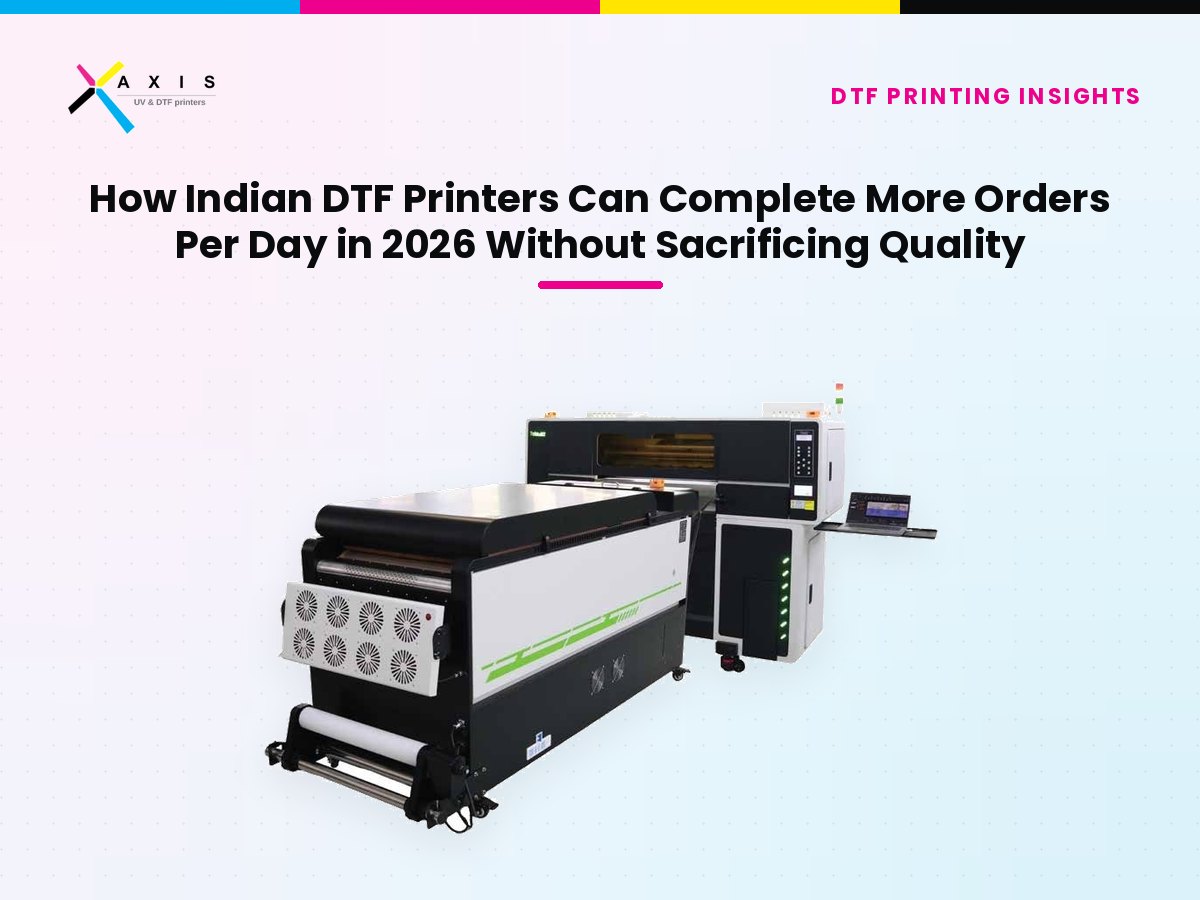
Quick answer: How can a DTF printing business complete more orders per day without losing quality?
The fastest way to complete more DTF orders per day is to remove workflow bottlenecks, not simply to print faster. Most delays happen before and after printing: slow file preparation, unoptimised RIP settings, manual powder handling, and inconsistent curing.
Standardise your artwork, batch similar jobs, use dependable RIP software, and keep a fixed pre-flight and maintenance routine so the machine rarely stops mid-run. Reliable equipment, trained operators, and fast local service prevent the downtime that quietly caps daily output. Printers who treat throughput as a measured system, stage by stage, ship more orders at the same quality and protect their margins.
How fast is demand for custom printing actually growing in 2026?
Demand is rising much faster than most small printers realise, which is exactly why daily output now decides who wins the extra orders. According to Grand View Research (2026), the global print-on-demand market was valued at USD 10.8 billion in 2025 and is projected to reach USD 57.5 billion by 2033, a compound annual growth rate of 23.6 percent.
India is riding the same wave. Per Straits Research (2026), the India print-on-demand market was valued at USD 864 million in 2025 and is forecast to grow to USD 3.63 billion by 2034 at a 17.9 percent CAGR.
DTF production speed is the number of finished, sellable transfers a shop can print, powder, cure, and press in a working day at consistent quality. A DTF workflow is the full chain of steps from receiving artwork to a packed order: file preparation, raster image processing, printing, powder application, curing, and heat pressing.
What is a slow DTF workflow really costing your shop?
A slow workflow costs you the orders you turn away and the margin you burn on rework. When each job takes longer than it should, your fixed costs of rent, electricity, staff wages, and GST-inclusive overheads are spread across fewer sellable prints.
The pressure is structural, not seasonal. Grand View Research (2026) estimates the global direct-to-film printing market at USD 2,720.0 million in 2024, rising to USD 3,920.0 million by 2030, which means more shops are buying machines and competing for the same local jobs every year.
Consider a simple example. If a shop clears 25 transfers a day and a better workflow lifts that to 40 at the same quality, that is 15 extra sellable prints daily, or roughly 390 more per month on a 26-day schedule. Even a modest profit per transfer turns that gap into real money left on the table by a slow line.
- Reprints from wrong colours or weak whites consume film, ink, powder, and machine time twice.
- Machine downtime from clogged nozzles or missing spare parts stops the whole line, not one job.
- Manual, undocumented steps mean output collapses the moment your most experienced operator is absent.
Why do most DTF shops hit a daily output ceiling?
Most shops hit a ceiling because the printer is rarely the real bottleneck. The delays cluster in the steps around printing: preparing files, waiting on the RIP, shaking powder by hand, and curing unevenly.
The wider market is moving toward smaller, faster, more frequent runs, which punishes any slow step. As Doug Mitchell, Chief Growth Officer at PCNA, put it in Print & Promo Marketing, "Today's buyers don't just want products, they want relevance. Print on demand makes it possible to match artwork or personalization to a moment, an event or even an individual without the slow, inventory-heavy processes of traditional decoration."
Speed has become the competitive edge itself. Steven Farag, CEO and Cofounder of Campus Ink and The NIL Store, told ASI Central (2026) simply, "For us, speed is everything."
This shift is part of a longer move from analog to digital decoration. Fortune Business Insights reported the global digital textile printing market growing from USD 147.4 million in 2020 toward USD 311.7 million by 2028 at a 10.1 percent CAGR, as short-run digital methods keep taking share from long-run analog printing.
Where is the time actually lost in a DTF workflow?
The time is lost in the setup, handling, and curing stages far more than in the print pass itself. Mapping each stage against its common bottleneck shows where a day's output really leaks away.
| :-: | :-: | :-: |
|---|---|---|
| Workflow stage | Common bottleneck | Faster, quality-safe approach |
| Artwork and file prep | Resizing and fixing files one by one | Standard templates and a fixed pre-flight checklist |
| RIP processing | Re-entering settings for every job | Saved profiles in dependable RIP software |
| Printing | Stopping mid-run for clogged nozzles | Daily maintenance and stable white-ink circulation |
| Powder and curing | Manual shaking and uneven curing | Consistent application and calibrated cure settings |
| Heat pressing | Guessing time, temperature, and pressure | Documented press settings per fabric type |
Notice that none of these fixes ask you to run the machine faster. Each removes a stop, a redo, or a hesitation, which is how throughput rises while quality holds.
How should a smart buyer judge DTF production speed in 2026?
A smart buyer judges speed by sustained daily output at consistent quality, not by the headline print-speed number on a brochure. A machine that prints quickly but stalls twice a day, or needs a specialist to recover, delivers fewer finished orders than a steadier one.
The India custom apparel opportunity rewards this discipline. IMARC Group (2026) valued the India custom T-shirt printing market at USD 176.6 million in 2025 and projects USD 407.9 million by 2034 at a 9.75 percent CAGR, so the shops that ship reliably every day will capture a growing share.
Use these criteria when you assess any setup for real-world speed:
- Sustained throughput: how many finished transfers per hour the machine holds across a full shift, not a one-minute burst.
- Uptime and recovery: how rarely it stops, and how quickly a trained operator can get it running again.
- Operator readiness: whether staff are trained to run the line without depending on one irreplaceable person.
- Consumable stability: whether the film, ink, and powder behave predictably so you are not re-tuning all day.
- Local support and spares: whether service and parts reach you in hours, not weeks, when something fails.
What should you look for in a DTF supplier if speed matters?
Look for a supplier who sells you sustained daily output, not just a machine. The right partner protects your throughput long after the sale, because that is where your profit actually lives.
- Look for a supplier who demonstrates real production speed on a live machine, with your kind of jobs, before you buy.
- Look for one who provides hands-on operator direct-to-film printing training, so your team hits full output quickly.
- Look for transparent guidance on cost per print and realistic daily capacity, without vague speed claims.
- Look for responsive local after-sales service and spare-part availability, so a fault costs you hours, not days.
- Look for compatible consumables and correct heat press settings support, so quality stays stable as volume rises.
- Look for a partner who treats your growth as the goal, not a one-time transaction.
How does Axis Enterprises help you print more per day?
Given everything above, this is exactly the gap Axis Enterprises was built to close. Axis Enterprises supplies dependable DTF printing machines, heat presses, and consumables, backed by installation, practical operator training, transparent job costing, and responsive local after-sales service and spare parts for Indian garment-printing businesses. You can book a free live DTF machine demonstration to see sustained daily output on real jobs before you invest.
The aim is simple: a line that keeps running, a team that can run it without you, and dependable machinery and local support that turns rising demand into completed orders instead of missed ones.
What is the easiest next step?
The easiest next step is to watch a machine run at real speed with your own kind of artwork, then compare its finished daily output against what you produce today. That single demonstration tells you more about true throughput than any brochure. Visit axisdtf.com to arrange a live DTF demonstration and get honest, practical guidance on capacity, costing, and training for your shop.
Frequently asked questions
How many DTF transfers can a shop realistically print in a day?
It depends on machine width, artwork size, and how smoothly the surrounding steps run. In practice, daily output is decided less by the printer's top speed and more by how rarely the line stops for file fixes, clogs, or curing problems. A well-run workflow with trained operators completes far more finished orders than a faster machine that keeps stalling.
Does printing faster reduce DTF print quality?
Not if you raise output by removing bottlenecks rather than rushing the print pass. Standardised files, saved RIP profiles, stable white-ink circulation, and calibrated curing let you finish more jobs at the same quality. Quality drops when operators cut corners on maintenance or curing to save minutes, not when the workflow itself is well organised.
What is the biggest bottleneck in most DTF workflows?
For most small shops it is the manual, undocumented steps around printing: preparing each file from scratch, re-entering RIP settings, and inconsistent powder and curing. These stages quietly consume more time than the actual printing. Documenting them and training staff to follow a fixed routine usually lifts daily output the fastest.
Does RIP software really affect production speed?
Yes. A raster image processor that lets you save and reuse colour and ink profiles removes repeated setup for every job. Good RIP settings also protect white-ink density and colour accuracy, which cuts reprints. Reliable software plus saved profiles is one of the cheapest ways to gain speed without touching the machine.
How does daily output affect profit for a DTF business in India?
Higher daily output spreads fixed costs like rent, wages, electricity, and GST-inclusive overheads across more sellable prints, so each transfer carries more margin. It also lets you accept larger and more urgent orders that slower shops must decline. In a fast-growing market, consistent throughput is what turns rising demand into actual revenue, which is why you can arrange a free live DTF demonstration to benchmark real daily output before investing.
Sources
- Grand View Research, Print On Demand Market Size And Share Report, 2026-2033
- Straits Research, India Print on Demand Market Size, Share and Growth Forecast
- Grand View Research, Direct To Film Printing Market Size, Industry Report, 2030
- IMARC Group, India Custom T-Shirt Printing Market Size and Report
- Fortune Business Insights, Digital Textile Printing Market Size, Share Report
- Print & Promo Marketing, Print on Demand Is the New Standard
- ASI Central, Print On Demand Conference 2026: The Opportunities Are Limitless
Founder, Axis Enterprises. Selling and servicing digital printing machines across India since 2011. Author of "Increase Your Profit by 270% with UV Printing Technology". More about the author