Why India's Small Fashion Brands Are Ditching Bulk Manufacturing in 2026
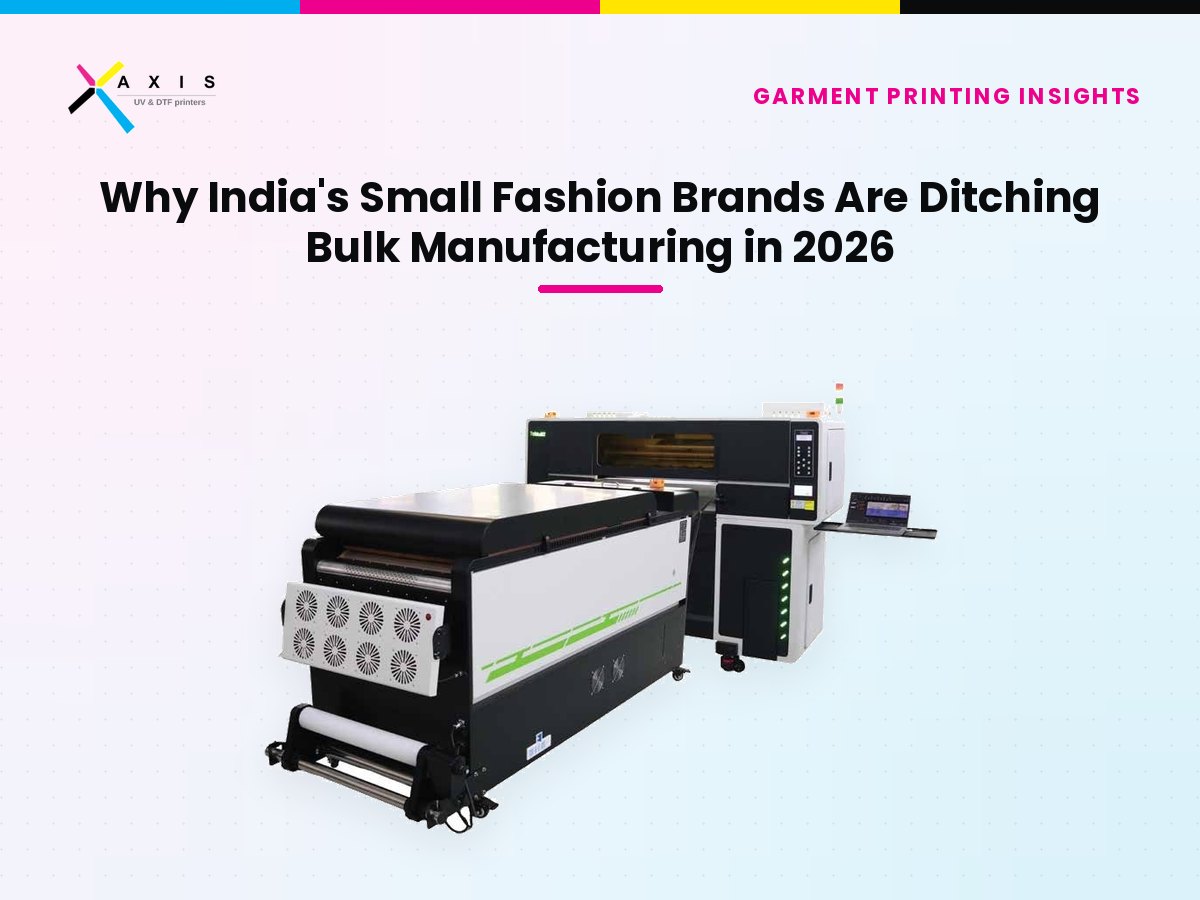
Quick answer: Small fashion brands in India no longer need to place bulk orders of 200 to 500 pieces per style to launch a new design. Direct-to-film (DTF) printing lets a label produce as few as one to twenty finished garments per design, test real demand, and reorder only what actually sells. This removes the two biggest risks of traditional garment manufacturing: capital locked in unsold stock, and long production lead times before a design ever reaches a customer. Brands using this approach report faster design-to-shelf timelines and lower upfront investment, letting them launch more collections per year without the working-capital strain of conventional minimum order quantities.
What do the numbers say about India's shift toward on-demand fashion?
India's direct-to-consumer fashion market is growing far faster than traditional retail, and that growth is quietly changing how small brands choose to manufacture. According to Redseer Strategy Consultants (2023), India's D2C market is projected to reach a gross merchandise value of USD 30 billion to USD 35 billion by 2027, growing at roughly 40% CAGR between 2022 and 2027, nearly three times faster than the broader retail market.
That growth is a double-edged sword. More small brands are launching every month, but most still plan production the way large manufacturers do: by committing to bulk minimum order quantities before they know which designs will sell.
Why are minimum order quantities such a costly problem for small brands?
Minimum order quantities force small brands to pay for guesses, not orders. A new label typically has to commit to 50 to 200 T-shirts, 100 to 300 hoodies, or 200 to 500 units of jeans per style before a single customer has confirmed they want it, tying up cash in stock that may never sell through at full price.
India's formal apparel manufacturing base is also not expanding fast enough to make small, flexible runs the default. Government data from the Ministry of Textiles / Press Information Bureau (2025) shows India had 12,820 registered wearing-apparel manufacturing units in 2023-24, but only 9,758 of them were actually operational, meaning a meaningful share of registered capacity sits idle or underused rather than available for short, flexible batches.
The result: a new brand either overcommits to bulk stock it cannot yet sell, or underinvests and misses the launch window entirely. Neither choice is really a business decision. Both are a bet made with incomplete information.
Why is on-demand garment printing suddenly viable for small labels?
The short answer: the print technology finally caught up to the business need. Short runs have always been desirable for small brands; what changed recently is that the quality and economics of producing them stopped being a compromise.
Ryan Baise, Founder and CEO of Youth Inc., told ASI Central's Print On Demand Conference coverage (February 2026) that the shift is recent, not old news.
"The print technology wasn't really there at a scale and quality that we felt great about, and I think that has evolved a lot in three years." (Ryan Baise, Founder and CEO, Youth Inc.)
Rob Watson, CEO of Vantage Apparel, made a similar point about how early this shift still is, in the same coverage: "I still think there's so much opportunity to grab market share. We're right at the beginning of the curve."
The market data backs up that "early curve" framing. India's print-on-demand market was estimated at roughly USD 1,061.6 million in 2026 and is projected to reach USD 5,419.0 million by 2033, a CAGR of about 26.2%, according to Grand View Research (2026). India's dedicated direct-to-film printing market alone was valued at USD 243.9 million in 2025 and is projected to reach USD 380.3 million by 2030 at roughly a 9.3% CAGR, according to Grand View Research's separate India DTF printing market outlook (2025), with India already accounting for about 8.3% of the global DTF printing market.
What is driving this shift is simple: textile printing methods that can produce a single finished transfer as cheaply, relatively speaking, as producing a hundred, remove the economic reason to over-order. A brand can print one hoodie, ten hoodies, or a hundred hoodies from the same file, at a marginal cost that barely changes per piece beyond the garment and consumable cost.
How should a smart brand rethink its production criteria for small batches?
The old buying criteria (lowest price per piece, single supplier, biggest possible order to earn a discount) actively punish small and growing brands. A different set of criteria fits how fashion actually sells today.
- Production flexibility: the ability to print one unit or one thousand from the same setup, without re-tooling or re-negotiating a minimum order.
- Equipment reliability: machinery and consumables that do not create nozzle clogs, colour drift, or downtime in the middle of a time-sensitive launch window.
- Transparent job costing: a clear, itemized understanding of what each garment actually costs to produce, including ink, film, powder, labour and wastage, not a vague flat per-piece quote.
- Trained, capable operators: people who can move between many small, different designs in a single day without quality slipping between the first piece and the fiftieth.
- Responsive local support: a production partner (in-house or vendor) who can be reached quickly when something goes wrong, with spare parts available locally rather than shipped from abroad.
What should you look for in a DTF printing setup before you commit to it?
The checklist below turns those criteria into practical, observable signals you can actually verify before you invest time or money.
- Look for a machine or vendor that can demonstrate a live, timed print run from file upload to finished, cured transfer, not just a sample piece made in advance.
- Look for documented, itemized cost-per-print data (ink, film, powder, garment, labour, wastage) rather than a single bundled number that hides where your margin actually goes.
- Look for operator training that is structured and repeatable, not dependent on one person who happens to know how the machine behaves.
- Look for a written service-response commitment: how fast a technician responds, what parts are stocked locally, and what a breakdown actually costs to fix.
- Look for evidence that the same setup has handled both a 5-piece test run and a 500-piece reorder without a change in process.
- Look for a supplier willing to let you speak to existing customers about real uptime, real turnaround time, and real after-sales response, not just a brochure.
Where does Axis Enterprises fit into this picture?
This is exactly the gap Axis Enterprises was built to close. Axis Enterprises supplies DTF printing machines, heat presses, and consumables to Indian garment-printing businesses, alongside installation, operator training, transparent job-costing guidance, and local after-sales support and spare parts. For a small fashion brand trying to launch without committing to bulk minimum order quantities, that combination, dependable machinery plus practical training plus responsive local service, is the difference between a short run that works and one that stalls halfway through a launch.
Printers and brand owners evaluating whether to bring DTF production in-house can see the full process end to end, from file preparation to finished, cured transfer, by arranging a live DTF machine demonstration at axisdtf.com, rather than relying on a sample piece prepared in advance.
What does a low-friction next step look like?
If minimum order quantities have been holding back how often you can launch, the practical next step is to see the actual production process, not another brochure. Axis Enterprises offers a free, live demonstration of its DTF printing machines, run on real garments with real timing, so you can judge output, quality and turnaround for yourself before committing to any equipment. You can also use the visit to walk through transparent job-costing details and after-sales support terms with the Axis Enterprises team directly, so the numbers in this article become numbers specific to your own product line.
How does DTF printing compare with other small-batch production methods?
| :-: | :-: | :-: | :-: |
|---|---|---|---|
| Method | Typical minimum order | Cost per single unit | Best fit for |
| Bulk cut-and-sew manufacturing | 200 to 1,000+ pieces per style | Low per piece only at full bulk volume | Proven, repeat-selling designs with confirmed demand |
| \Screen printing\ | 25 to 50 pieces per design (screen setup cost) | Low at volume, high for single pieces | Single-colour designs printed in moderate to large quantities |
| Direct-to-film (DTF) printing | As low as 1 piece per design | Consistent per piece regardless of quantity | Testing new designs, mixed small batches, personalization |
The comparison above is about production method, not brand. A brand can mix approaches: DTF for testing and small reorders, screen printing or bulk manufacturing once a design proves it can sell in volume.
Frequently asked questions
Can a small fashion brand really launch with fewer than 20 pieces per design?
Yes. DTF printing produces a finished, ready-to-press transfer for a single garment at close to the same relative cost structure as producing many, so a brand can print a small test batch, gauge real demand, and reorder only the designs that sell.
Is DTF printing suitable for multiple fabric types, not just cotton T-shirts?
DTF transfers can be applied to a wide range of fabric types used in textile printing, including blends, since the design is printed onto film first and then heat-pressed onto the garment, rather than printed directly onto the fabric. This makes it more forgiving across mixed-fabric small batches than methods that print directly onto the garment surface.
How does DTF printing compare with print on demand services used by global brands?
Print on demand as a global model already proves that producing only what is ordered reduces unsold inventory risk. DTF printing brings that same on-demand principle in-house for Indian garment businesses, instead of outsourcing production to a third-party platform.
What equipment does a small brand need to start printing in small batches in-house?
At minimum, a brand needs a DTF printer, a curing or shaker unit for the powder, and a heat press to apply the finished transfer to the garment. Training on RIP software, film handling and curing settings is equally important to avoid early quality problems.
Does switching to small-batch DTF production mean giving up on larger bulk orders later?
No. A brand can use DTF printing to validate a design in small numbers, then move that same design to screen printing or bulk manufacturing once demand is confirmed, using each method for what it does best.
What is the realistic risk in shifting from bulk orders to on-demand small-batch printing?
The main risk is choosing unreliable equipment or an inexperienced supplier, since a breakdown during a live launch window has no bulk-stock buffer to fall back on. This is why service response time and local spare-parts availability matter as much as the machine's print quality.
Sources
- Business Standard, "Indian D2C market is projected to grow to $35 billion GMV: Redseer" (2023)
- Grand View Research, India Direct-to-Film Printing Market Outlook (2025)
- Grand View Research, India Print-On-Demand Market Outlook (2026)
- Press Information Bureau, Ministry of Textiles, "Status of Textile and Apparel Manufacturing Units" (2025)
- ASI Central, "Print On Demand Conference 2026: The Opportunities Are Limitless" (2026)
Founder, Axis Enterprises. Selling and servicing digital printing machines across India since 2011. Author of "Increase Your Profit by 270% with UV Printing Technology". More about the author