How to Know a DTF Machine Will Still Pay Off if Your First Six Months Go Wrong
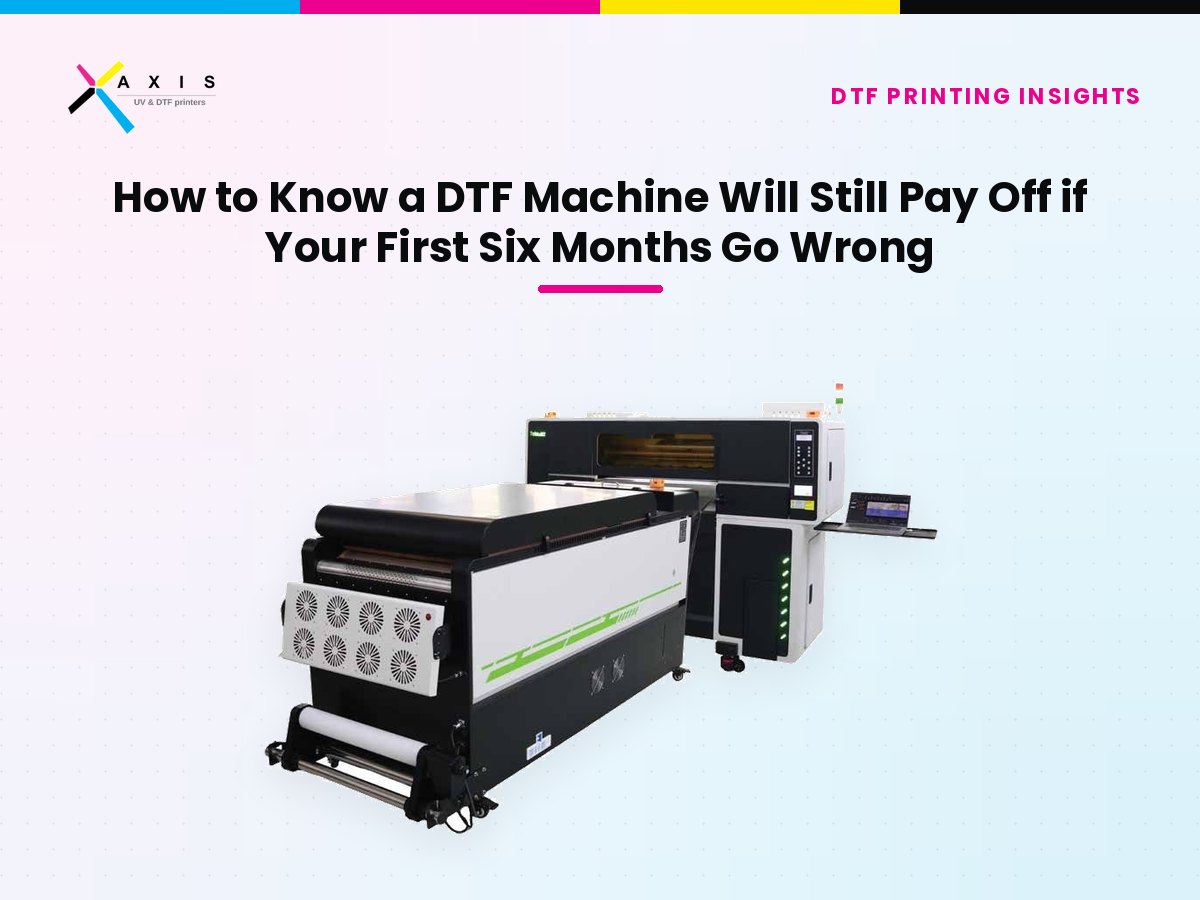
Quick answer: A DTF machine can still pay for itself even after a slow start, but only if you plan the return before you buy, not after. Smart buyers build three numbers: a base case for a normal month, a conservative case for a slower ramp, and a downside case that assumes lower order volume, higher wastage, and unexpected maintenance in the first six months. If the machine still recovers its cost in the downside case within a period you can fund, the purchase is sound. If it only works in the best case the plan is fragile, and scenario planning is what turns a hopeful guess into a decision you can defend.
How big is the custom-print opportunity in 2026, and why does that not guarantee your payback?
The opportunity is large and growing fast, yet market size tells you nothing about your own first six months. According to Grand View Research (2025), the global print-on-demand market was valued at USD 10.8 billion in 2025 and is projected to reach USD 57.5 billion by 2033, a compound growth rate of 23.6 percent.
Direct-to-film sits inside this wave. The global direct-to-film printing market was estimated at USD 2,720 million in 2024 and is projected to reach USD 3,920 million by 2030, per Grand View Research (2024).
Here is the counterintuitive part. A rising market lifts demand across a country, not evenly across every new machine in its first months. Your payback depends on your orders, your prices, and your wastage, not on the size of the category.
What really happens to DTF cash flow in the first six months?
In most new setups, orders arrive slower than planned, wastage runs higher than expected, and small repairs appear before the machine settles. That combination stretches the payback period well beyond the demo-day estimate.
Demand for the end product is real. The India custom T-shirt printing market reached USD 176.6 million in 2025 and is forecast to grow at 9.75 percent a year to USD 407.9 million by 2034, according to IMARC Group (2025). A growing market still leaves a new shop climbing a learning curve for its first two quarters.
The wider small-business picture explains why cash discipline matters. The Press Information Bureau (2025) reported that India's MSME sector contributes 30.1 percent of national GDP and 45.73 percent of exports, which means most apparel-printing businesses are small units where a single slow quarter directly threatens working capital. Planning for the break-even point under stress is not pessimism; it is how small operators stay solvent.
What is DTF ROI scenario planning, and why does it matter now?
DTF ROI scenario planning is the practice of estimating the return on a machine investment across several demand and cost outcomes, rather than a single optimistic forecast. It replaces one hopeful number with a range you can actually manage.
The reason it matters is that payback is driven by contribution margin, not headline revenue. Contribution margin is the selling price of an order minus its true variable costs: ink, film, powder, the garment, labour, electricity, packaging, and a reserve for wastage. Two shops with identical sales can have very different returns on investment if one ignores these costs.
Utilisation matters more than advertised speed. A machine rated for high hourly output still earns only on the jobs it actually completes, and early months rarely run at full capacity. The DTF printer market itself was valued at USD 2.68 billion in 2025 and is projected to reach USD 4.25 billion by 2032, a 6.77 percent growth rate, per 360iResearch (2025), which signals steady long-term demand for equipment even as any single owner ramps slowly.
Industry practitioners frame the same point in plain terms. As Rob Super, CEO and Founder of American Print Supply, told ASI Central (2025): "If I'm making two to three times that revenue in decorated apparel while purchasing outsourced transfers, that's a good indicator that now I'm leaving money on the table." The lesson works both ways: the economics reward owners who model their numbers honestly before committing capital.
How do base, conservative and downside ROI scenarios compare?
The three scenarios use the same machine and the same investment, and vary only the assumptions about orders, wastage, and early maintenance. The table below is an illustrative planning example, not a promise of results, built on a total setup cost of Rs. 6,50,000 covering the machine, heat press, installation, training, and opening consumables.
| :-: | :-: | :-: | :-: |
|---|---|---|---|
| Assumption | Base case | Conservative case | Downside case |
| Orders per month | 400 | 280 | 180 |
| Contribution per order (Rs.) | 180 | 165 | 150 |
| Rejection and wastage | 5% | 8% | 15% |
| Extra maintenance, first 6 months (Rs.) | 0 | 5,000 | 12,000 |
| Approx. monthly contribution (Rs.) | 72,000 | 46,000 | 27,000 |
| Approx. payback period | \\\~9 months | \\\~14 months | \\\~24 months |
Read the downside column first, not the base column. If a roughly 24-month payback under a genuinely bad start is still fundable from your working capital, the investment is resilient. If only the 9-month base case keeps you afloat, the plan needs stronger pricing, a lower entry cost, or committed orders before purchase.
Note that these figures exclude GST, finance cost, and owner salary. Add those for a complete view, because a machine that pays back on paper can still strain cash if the loan EMI and GST outflow are ignored.
How should a smart buyer judge a DTF machine investment?
Judge the investment by how it performs in a bad month, not a perfect one. A buyer who only asks about top speed and price is measuring the wrong things.
Use these criteria when weighing any machine and supplier:
- Dependable output at real utilisation: the machine should hold quality at 60 to 70 percent daily use, which is where early months actually run.
- Predictable running cost: ink, film, and powder consumption should be stable and known, so your contribution margin does not drift.
- Fast local service and spare parts: a two-day repair in month three can erase a month of contribution, so response time is a financial number, not a convenience.
- Practical operator training: trained operators cut the wastage that destroys the downside case.
- Transparent job costing help: a supplier who helps you price by print area and complexity protects your margins from day one.
What should you look for in a DTF machine supplier before you buy?
Look for a supplier who behaves like a long-term partner in your payback, not a one-time seller of hardware. The checklist below separates the two.
- Look for a supplier who lets you see a live demonstration on your own artwork and fabric, so the numbers you plan with are real.
- Look for a supplier who states service response time, technician charges, and spare-parts dispatch in writing before payment.
- Look for a supplier who provides structured operator training, not a single handover, so wastage falls quickly.
- Look for a supplier who supplies compatible ink, film, and powder as a tested system, protecting print quality and cost.
- Look for a supplier who helps you build a costing and break-even sheet for your own market.
- Look for a supplier who is reachable locally for maintenance, because textile printing downtime is lost revenue you cannot recover.
Where does this leave you, and how can Axis Enterprises help?
Everything above points to one conclusion: the safest DTF investment is one backed by dependable machinery, real training, honest job costing, and responsive local service. That is exactly what Axis Enterprises is built to provide for garment printers and first-time apparel-printing businesses across India. We supply DTF printing machines, heat presses, and consumables, and we stay involved through installation, operator training, maintenance, and after-sales support.
If you are running your base, conservative, and downside numbers, the most useful next step is to test them against a real machine: you can book a free live DTF machine demonstration and bring your own designs and fabric, so the contribution and payback figures you plan with come from your actual work rather than a spec sheet. You can also talk to the Axis Enterprises team about service response times and spare-parts availability in your region, and review the machines and consumables Axis Enterprises supplies before you commit any capital. There is no pressure to buy: the goal is a decision your cash flow can defend.
Frequently asked questions
How many monthly orders are required to recover a DTF machine investment?
Divide your total fixed setup cost by your contribution per order to find monthly orders needed at break-even. For example, a Rs. 6,50,000 setup recovered over 12 months at Rs. 180 contribution per order needs roughly 300 orders a month. Always test this against a downside case with fewer orders and higher wastage.
What happens to break-even if my rejection rate rises from 5 percent to 15 percent?
Higher rejection raises your true cost per sellable print and lowers contribution per order, so break-even orders climb. In the illustrative table above, moving from 5 percent to 15 percent wastage, alongside lower volume, stretched payback from about 9 months to about 24 months. Wastage control is one of the fastest ways to protect ROI.
Should I include owner salary and loan EMI in my payback calculation?
Yes. A payback figure that ignores owner salary, GST, and loan EMI can look healthy while the business runs short of cash. Include these as fixed monthly costs in your conservative and downside cases so the plan reflects real outflows.
Is cash flow the same as profit for a new DTF business?
No. Profit is what remains after costs on paper, while cash flow is the actual money moving in and out each month. A new shop can show a profit yet still run out of cash if payments are delayed or stock is bought ahead, which is why downside planning focuses on cash, not only profit.
How do I plan a downside case realistically?
Assume lower order volume, higher wastage, and some unexpected maintenance in the first six months, then check whether the machine still recovers its cost in a period you can fund. If the downside payback is affordable, the investment is resilient. If only the best case works, strengthen pricing or secure orders before buying.
Sources
- Grand View Research, Print On Demand Market Size And Share Report (2025)
- Grand View Research, Direct To Film Printing Market Size, Industry Report (2024)
- IMARC Group, India Custom T-Shirt Printing Market Size and Report (2025)
- 360iResearch, DTF Printer Market Size and Share 2026-2032 (2025)
- Press Information Bureau, Government of India, MSME contribution to GDP and exports (2025)
- ASI Central, PRINTING United Expo 2025: The Present and Future of Direct-to-Film Printing (2025)
Founder, Axis Enterprises. Selling and servicing digital printing machines across India since 2011. Author of "Increase Your Profit by 270% with UV Printing Technology". More about the author