Why Many New DTF Print Shops Run Short of Cash in Their First 90 Days
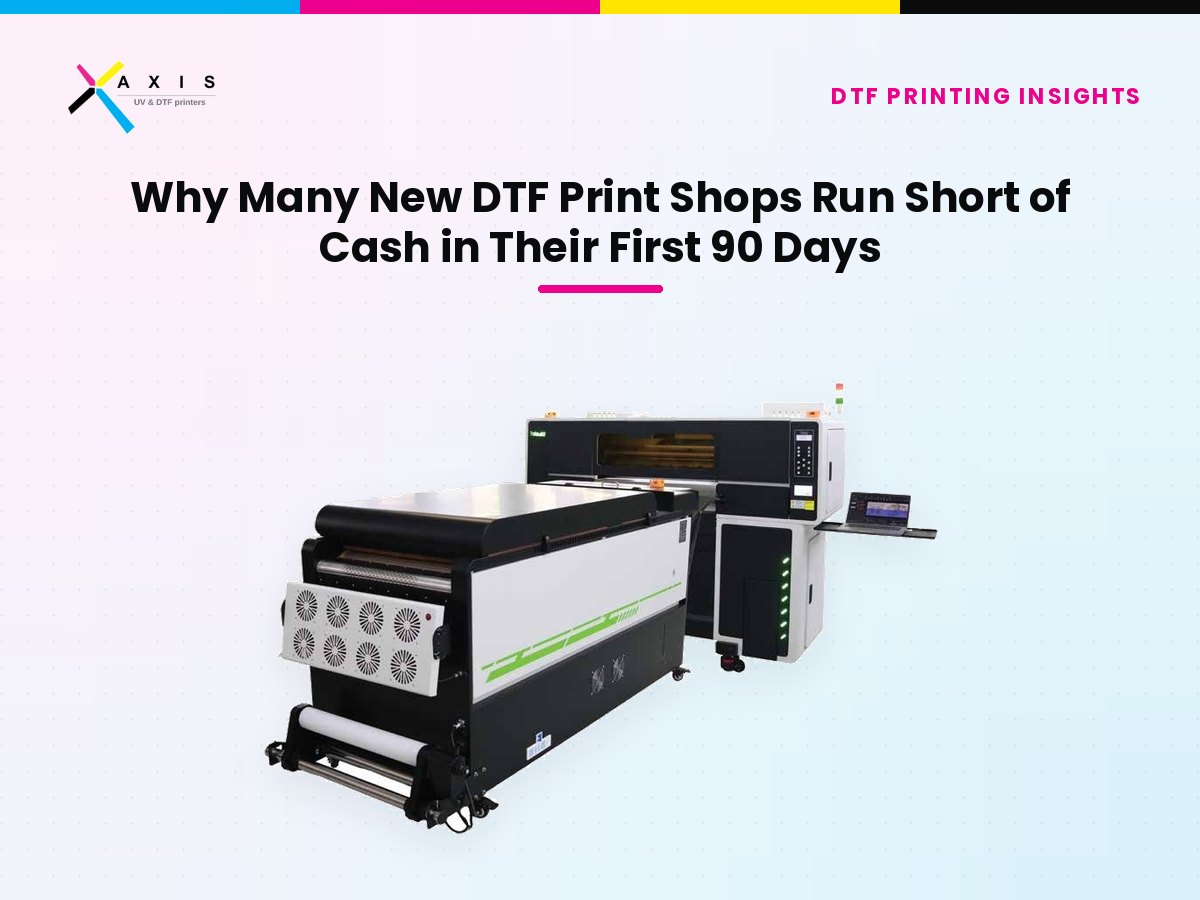
Quick answer: Most new DTF print businesses do not stall because the machine is bad. They stall because the owner spends the entire budget on equipment and keeps too little working capital, the cash needed to buy film, ink, powder and garments, run samples, market the shop and cover early repairs. A safer plan puts a fixed share into the machine and reserves three to six months of operating cash before the first order arrives. Working capital is the money that keeps daily production moving while customer payments land weeks later. Protect it, and a young shop can accept orders instead of turning them away.
Does a new business fail because of the product, or because of the money behind it?
Most young businesses close because they run out of cash, not because the product was wrong. The empty bank account, not the machine, is what usually ends a printing business.
According to CB Insights (2025), which analysed 431 venture-backed startups that shut down since 2023, 70% of the failures had run out of capital. That figure sits far ahead of the 43% linked to poor product-market fit.
Read that again before you sign for a machine. The equipment rarely kills the business. Running out of money to operate it does.
How often does slow payment drain a young business in India?
Running out of cash is the most common ending for a failed business, and slow customer payments make it worse in India. A shop can be profitable on paper and still run dry while it waits months to be paid.
According to Recordent's 2026 report on Indian SME receivables, which studied about 110,000 MSMEs, the average invoice now takes 73 days to be paid and average overdue receivables have crossed Rs. 3.83 crore. Winny Patro, Founder and CEO of Recordent, put the problem plainly:
"MSMEs form the backbone of India's economy, yet delayed payments continue to quietly erode their growth potential."
For a new DTF shop, that gap is deadly. You pay for film, ink, powder and garments today, but corporate and reseller customers may pay you after two months.
Why do new DTF businesses feel starved of cash even when orders arrive?
New DTF shops feel starved of cash because production spends money every day while payments arrive weeks later. The orders are real, but the cash timing is against you.
First, a definition. Working capital is the operating cash a business has available to run day to day, and direct-to-film printing is a process that prints a design onto a coated film, bonds it with adhesive powder, cures it, and presses it onto fabric with a heat press.
The category is also getting more crowded. According to Grand View Research (2025), India's direct-to-film printing market was worth USD 243.9 million in 2025 and is projected to reach USD 380.3 million by 2030 at a 9.3% CAGR. The same firm, Grand View Research (2024), valued the global DTF market at USD 2,720.0 million in 2024, rising to USD 3,920.0 million by 2030.
Growth pulls in more shops, and every one of them buys the same consumables every week. Those consumables are paid for now, while customer payments land later, which is why cash flow, not profit, decides whether a young shop survives its first months.
Demand is climbing on the customer side too. According to IMARC Group (2025), India's custom T-shirt printing market reached USD 176.6 million in 2025 and is forecast to hit USD 407.9 million by 2034, and much of that demand flows through print-on-demand and small-batch orders you must fund before you are paid.
How should a smart buyer budget for a DTF setup?
Budget the whole business, not only the machine. Split your capital so equipment, consumables, samples, marketing and a repair reserve are all funded before day one.
A smart buyer plans against five criteria that protect cash:
- Dependable machinery: fewer surprise breakdowns mean fewer cash shocks in the first year.
- Practical operator training: trained operators reach saleable output sooner, so revenue starts earlier.
- Transparent job costing: knowing your true cost per print keeps pricing and cash predictable.
- Responsive local service and spare parts: fast repairs stop downtime from draining your cash.
- A real working-capital reserve: three to six months of operating cash set aside before the first order.
The table below shows one illustrative way to split a first setup. Adjust the shares to your own plan, and remember to account for GST on both the machine and consumables.
| :-: | :-: | :-: |
|---|---|---|
| Budget category | Illustrative share of total | Why it matters |
| Machine, installation and setup | 50 to 60% | The productive core, but not the whole plan. |
| Consumables (film, ink, powder) | 10 to 15% | Consumed weekly and paid for before you are paid. |
| Blank garments and samples | 8 to 12% | Needed to win orders and prove quality. |
| Marketing and customer acquisition | 5 to 10% | Builds the order pipeline that feeds the machine. |
| Repair and spare-parts reserve | 5 to 10% | Covers a print head or electronic part without borrowing. |
| Working-capital buffer | 10 to 15% | Bridges the weeks between production and payment. |
What should you look for in a DTF supplier to protect your cash?
Look for a supplier whose product and support reduce the two biggest cash killers for a new shop: downtime and guesswork. The right supplier lowers your risk before you ever place an order.
- Look for a supplier who runs a live, timed demonstration so you see real output from file to finished transfer before you buy.
- Look for a supplier who trains your operators, so the business is not dependent on a single technician.
- Look for a supplier who keeps spare parts and offers fast local service, so one fault does not freeze production for days.
- Look for a supplier who is honest about running costs and cost per print, so your pricing protects your margin.
- Look for a supplier who helps you plan capacity and a working-capital reserve, not one who only sells hardware.
Where does Axis Enterprises fit into this?
This is exactly the approach behind Axis Enterprises. We supply DTF printing machines built for Indian production conditions, together with installation, practical operator training and responsive local after-sales support, so your team reaches saleable output quickly and stays there. Our aim is simple: help you protect the working capital that keeps a new shop alive while the machine earns its keep.
What is the easiest next step?
The lowest-risk first step is to watch the machine work before you commit a single rupee. You can book a free live DTF machine demonstration at axisdtf.com, bring a sample design, and see real output from file to finished transfer. Use that visit to sanity-check your cost per print and your cash plan, then decide with numbers rather than promises, and if it helps, the team can walk you through a realistic first-year budget for your expected volume.
Frequently asked questions
How much working capital should I keep after purchasing the complete setup?
Aim to hold three to six months of operating cash after the machine is paid for. That reserve covers film, ink, powder, garments, salaries, electricity and marketing while early customers pay you on 30 to 73 day cycles. Without it, a run of large but slow-paying orders can leave you unable to buy the consumables to fulfil them.
How much of my startup budget should go to the machine itself?
A common working range is 50 to 60% of the total budget on the machine, installation and setup, leaving the rest for consumables, samples, marketing, repairs and a cash buffer. Spending 90% or more on equipment is the classic mistake, because it leaves nothing to actually run the business. Treat the machine as the engine, not the entire vehicle.
How much emergency reserve should I keep for a print head or electronic part failure?
Set aside 5 to 10% of your setup budget as a dedicated repair and spare-parts reserve. A print head or main board can fail without warning, and a supplier with local stock and fast service turns a potential shutdown into a short pause. This reserve is separate from your general working capital.
What budget warning signs suggest I am spending too much on equipment and too little on operations?
The clearest warning sign is having almost no cash left the day the machine is installed. Others include no budget for samples or marketing, no repair reserve, and relying on the first orders to buy your first consumables. If your plan only works when customers pay immediately, it is too tight.
Which hidden expenses are commonly missing from DTF startup quotations?
Quotations often show only the machine and skip GST, freight, electrical stabilisation, ventilation, spare parts, initial consumables, blank garments for samples, and RIP software. They also rarely include the working capital to operate for the first few months. Ask any supplier for the full cost to first sale, not just the price of the printer.
Sources
- CB Insights, The Top Reasons Startups Fail (2025)
- Recordent SME Receivables Report, via SMEStreet (2026)
- Grand View Research, India Direct-to-Film Printing Market Outlook (2025)
- Grand View Research, Direct-to-Film Printing Market Size Report (2024)
- IMARC Group, India Custom T-Shirt Printing Market (2025)
Founder, Axis Enterprises. Selling and servicing digital printing machines across India since 2011. Author of "Increase Your Profit by 270% with UV Printing Technology". More about the author