How Much DTF Printing Capacity Does Your Business Actually Need in 2026?
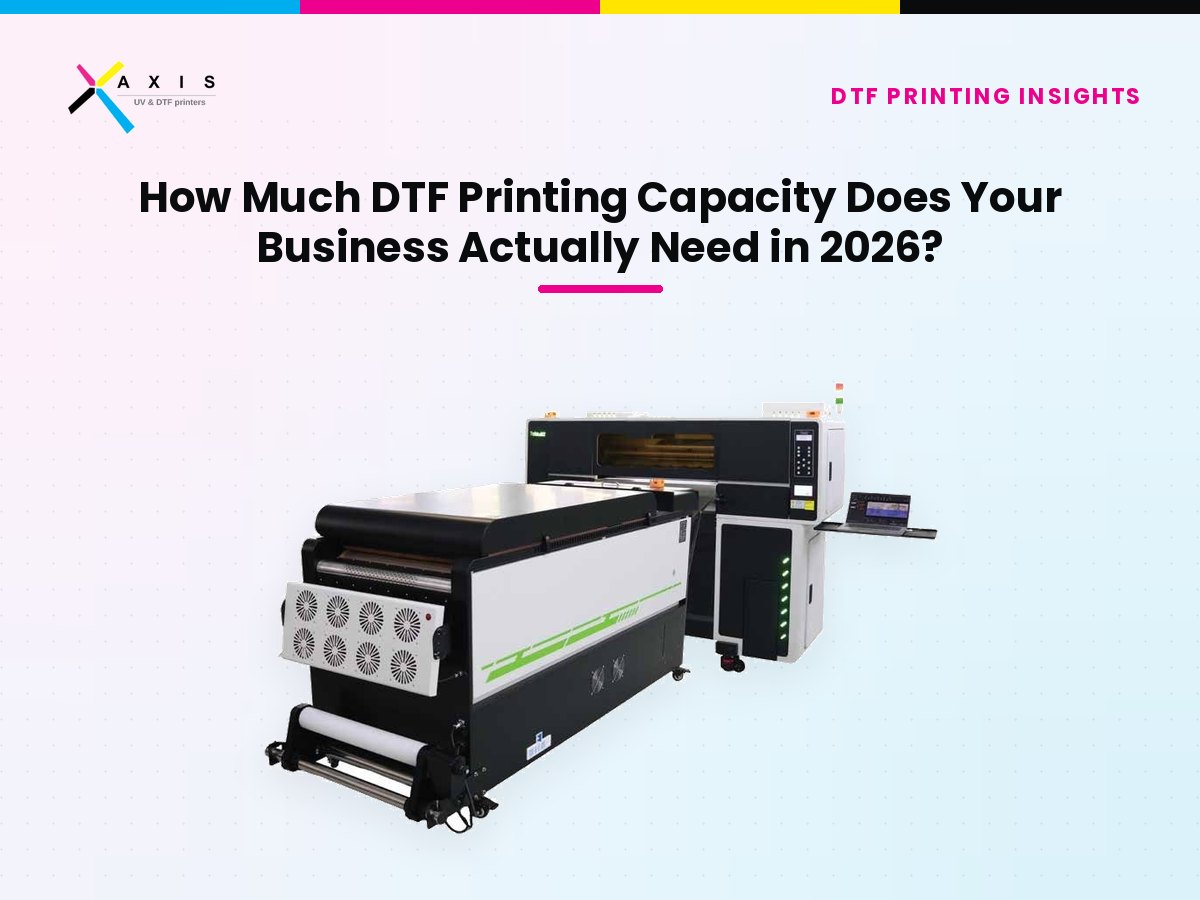
Demand for custom apparel is growing far faster than most small printers expect. The global print-on-demand market is projected to jump from USD 13.1 billion in 2026 to USD 57.5 billion by 2033, a 23.6% compound annual growth rate, according to Grand View Research (2026). Yet the quiet limit on a printing business is rarely demand. It is capacity: how many finished pieces you can actually ship in a day.
Quick answer: DTF printing capacity is the number of finished, sellable transfers your setup can produce in a normal working day, not the speed printed on the brochure. For most small Indian garment businesses in 2026, the right first machine comfortably clears today's orders and leaves room for 18 to 24 months of growth. Size it to your real daily order volume: a shop finishing 40 to 60 transfers a day needs a different setup from one pushing 150 or more. Match print width, shift length, curing and white-ink discipline to that number, then confirm every speed claim with a live demonstration before you pay.
What is DTF printing capacity, and why does it decide your profit?
DTF printing capacity is the realistic count of finished, sellable transfers your whole setup produces in a working day, after printing, powdering, curing, peeling and reprints. It is not the raw print speed on the specification sheet.
Direct-to-film printing moves a design onto a film, coats it with adhesive powder, cures it, and then bonds it to fabric with a heat press. Every one of those steps has its own throughput. Your true capacity is set by the slowest step in the chain, not the fastest.
This matters because capacity, not machine price, is what caps monthly revenue. A machine that cannot keep up with your busy season costs you orders you already won.
How many prints per day should a small DTF business plan for?
Most small Indian DTF shops in 2026 plan for 40 to 150 finished A3-size transfers in an eight-hour shift, depending on print width, artwork size and operator skill. The single most useful planning number is the 50-transfer-per-day threshold that separates a desktop setup from a production one.
Mike Davis, an Application Specialist at Roland DGA, frames the decision as a single question in Screen Printing magazine (2025):
"Are you expecting to produce more than an average of 50 standard-size transfers in an eight-hour day? If your shop typically makes 50 transfers or less a day, I'd suggest looking at a desktop device. If you are consistently producing more than 50 transfers a day, you may want to consider adding a second desktop device or moving to a production-level machine." (Mike Davis, Application Specialist, Roland DGA)
Use the table below as a starting frame, then adjust for your own artwork sizes and ganging. Actual output always depends on how well jobs are batched and how disciplined the operator is.
| :-: | :-: | :-: | :-: |
|---|---|---|---|
| Print width class | Typical finished output per 8-hour shift | Best fit for | Monthly volume it supports comfortably |
| Desktop, about 30 cm (12 inch) | 30 to 60 transfers | New or home-based business testing demand | Up to about 1,000 pieces |
| Single-head, 60 cm (24 inch) | 80 to 150 transfers | Growing shop with steady B2B and retail orders | About 1,500 to 3,500 pieces |
| Dual-head production, 60 cm (24 inch) | 150 to 300 or more transfers | Established shop with bulk, uniform and event contracts | 4,000 pieces and above |
Why do so many new buyers size their machine to the wrong number?
Most buyers size to the orders they have this month, not the orders arriving over the next two years, and the market is moving too fast for that to hold. The global custom t-shirt printing market is forecast to grow from USD 5.16 billion in 2024 to USD 9.82 billion by 2030, an 11.5% compound annual growth rate, with Asia Pacific already holding over 39.4% of global revenue in 2024, per Grand View Research (2026).
Undersizing is the more common and more expensive mistake. When festival, school or corporate orders arrive together, a machine that maxes out at 50 transfers a day forces you to refuse work or miss deadlines.
Oversizing has a cost too. A large machine left half-idle ties up capital, and standing white ink can settle and clog when volume is thin. The goal is a match, not a maximum.
What is changing in the Indian custom-apparel market that affects capacity planning?
India's apparel demand base is expanding quickly, which shortens the time a first machine stays big enough. The Indian textile and apparel market is projected to grow from USD 248.70 billion in 2025 to USD 656.31 billion by 2034, an 11.38% compound annual growth rate, according to the IMARC Group (2026).
At the same time, print on demand and small-batch textile printing are pulling orders away from large minimum-quantity screen runs toward fast, varied, low-quantity jobs. That shift rewards machines that change over quickly and run reliably all day.
The broader DTF equipment market reflects the same pull. Grand View Research (2026) values the direct-to-film printing market at USD 2,720.0 million in 2024, rising to USD 3,920.0 million by 2030 at a 6.0% compound annual growth rate. More entrants means more competition, so uptime and turnaround, both functions of capacity, decide who keeps the repeat customer.
How should a smart buyer actually think about capacity?
Judge capacity by finished, sellable output over a full shift, not by the headline speed. A machine that prints fast but stalls on curing, peeling or nozzle cleaning delivers less than a slower machine that runs without interruption.
Five criteria separate a machine that will serve you from one that will frustrate you:
- Real sellable output: ask for output measured after curing and peeling, across a normal shift, not a one-minute burst.
- Print width and ganging: a wider bed lets you place designs side by side and lift throughput without buying a second machine.
- Growth headroom: the setup should absorb 18 to 24 months of order growth before it becomes the bottleneck.
- Uptime and consumable discipline: reliable white-ink circulation and stable running matter more than peak speed, because downtime erases capacity.
- Local service and spare parts: capacity you cannot restore quickly after a fault is capacity you do not really own.
What should you look for in a DTF machine and supplier before you buy?
Look for a supplier who proves capacity in front of you and stands behind the machine after the sale, not one who only quotes the lowest price. Use this checklist when you compare options:
- Look for a supplier who runs a full live demonstration at your real artwork size and lets you count finished pieces per hour yourself.
- Look for a machine at least 60 cm (24 inch) wide if you expect steady volume, so you can print side by side and raise throughput.
- Look for a supplier who explains job costing openly: ink, film, powder and electricity per print, so your capacity plan connects to profit.
- Look for structured operator training, because an untrained operator can cut a machine's real capacity by half.
- Look for responsive local after-sales service and stocked spare parts, so a single fault does not halt production for days.
- Look for installation and setup support, so the machine hits its rated output from the first week, not after months of trial and error.
How does Axis Enterprises help you match capacity to real demand?
Everything above points to one need: a machine sized to your real daily orders, backed by people who keep it running. That is the gap Axis Enterprises is built to close, supplying DTF printing machines, heat presses and consumables to Indian garment businesses, along with installation, practical operator training and responsive local after-sales support and spare parts. The aim is simple: help you buy the right capacity once, then protect it with dependable service so your machine keeps earning through every busy season.
What is the easiest next step to get your capacity plan right?
The lowest-risk way to size a machine is to watch one run your own jobs before you commit a rupee. You can book a free live DTF machine demonstration and see real finished output, at your artwork sizes, measured over a full working session rather than a brochure minute. Bring your busiest week's order numbers, and the team will help you map the right capacity to your real demand before you decide.
Frequently asked questions
How many prints per day should I expect from a 13-inch, 24-inch or 30-inch DTF machine?
As a planning guide, a desktop-class machine around 30 cm finishes roughly 30 to 60 A3 transfers per shift, a 60 cm single-head machine 80 to 150, and a dual-head production machine 150 or more. Real output depends on artwork size, ganging, curing time and operator skill, so always confirm the figure with a live demonstration on your own designs.
Should I choose machine capacity based on current orders or expected future growth?
Size to comfortably clear today's orders and add headroom for 18 to 24 months of growth. With Indian apparel demand rising at double-digit rates, a machine matched only to this month's volume often becomes a bottleneck within a year, forcing an early and costly upgrade.
How can I verify a seller's advertised printing speed before purchasing?
Ask for a live demonstration using your own artwork, and count finished, peeled transfers over a set period rather than trusting a per-minute figure. A trustworthy supplier will let you time the full cycle, including curing and peeling, and will not object to you measuring the output yourself.
Does a wider DTF printer always mean more profit?
Not automatically. A wider bed raises throughput only when you fill it by ganging designs side by side and keep the machine running reliably. Width helps most for shops with steady volume; a home business testing demand may profit more from a well-run desktop setup with lower running costs.
How much should I budget beyond the machine when planning capacity?
Plan for consumables (ink, film and powder), a suitable heat press, stable power, workspace and applicable GST on the equipment and supplies. Capacity is only real when the whole line, including curing and pressing, can keep pace, so budget for the supporting setup rather than the printer alone.
Sources
- Grand View Research, Print On Demand Market Size And Share Report, 2026-2033
- Grand View Research, Custom T-shirt Printing Market Size, Industry Report, 2030
- Grand View Research, Direct To Film Printing Market Size, Industry Report, 2030
- IMARC Group, Indian Textile and Apparel Market Size and Trends, 2026-2034
- Screen Printing magazine, What Every Screen Printer Needs to Know About DTF Production (2025)
- Wikipedia, Direct-to-film printing
- Wikipedia, Heat press
- Wikipedia, Print on demand
- Wikipedia, Textile printing
Founder, Axis Enterprises. Selling and servicing digital printing machines across India since 2011. Author of "Increase Your Profit by 270% with UV Printing Technology". More about the author