New or Used DTF Machine: What a Second-Hand Printer Really Costs You in the First Year (2026)
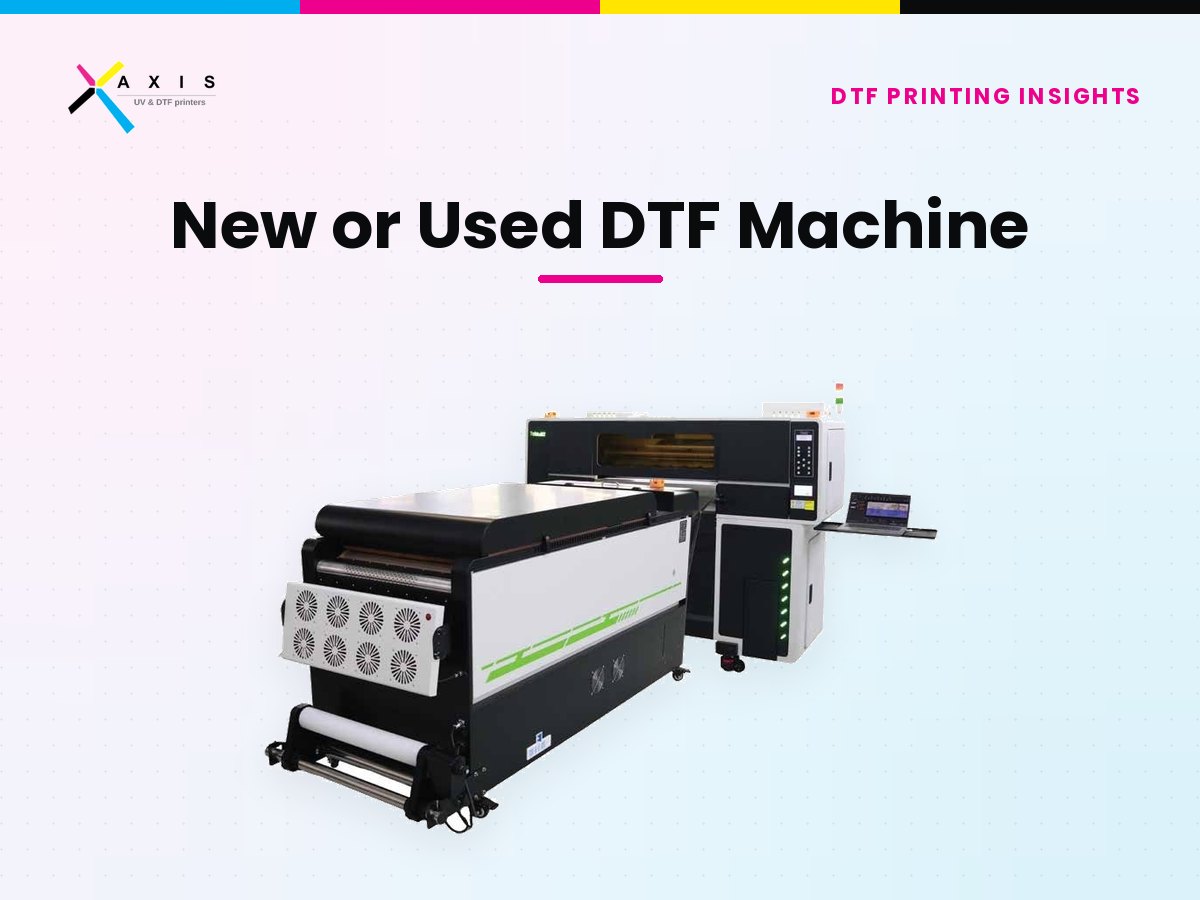
Here is a figure most sellers of second-hand equipment will not volunteer: the print head, the single costliest wearing part in a DTF printer, can be more than halfway through its working life before a used machine ever reaches your floor. The Digiprint USA technical team (2026) reports that an Epson XP600 print head lasts only 3 to 5 months in daily DTF service, with replacement running about USD 398 (roughly Rs. 33,000) every four months. A used printer can look spotless and still arrive with its most expensive component nearly spent.
Quick answer: Whether to buy a new or used DTF machine depends on total cost of ownership, not the sticker price. A used machine lowers your day-one cost but often carries a worn print head, out-of-warranty parts, no training and uncertain service, which can erase the saving within the first year through downtime and wastage. A new machine from a supplier who installs it, trains your operator and stocks local spare parts usually delivers a lower, more predictable cost per sellable print. Buy used only when you can inspect the head, verify service history and confirm parts support. Otherwise, a well-backed new machine is the safer path to steady output.
What is a DTF machine, and what does "used" really mean here?
A DTF machine is a printer that lays a design onto coated film, coats it with adhesive powder, cures it, and then transfers it onto fabric with heat and pressure. A "used" one is that same setup after months or years of production, which means its wearing parts are already partly consumed.
Direct-to-film printing spread quickly through Indian shops because it works on cotton, polyester and blends without pre-treatment, and because it pairs a printer with a heat press rather than the screens and setup of older methods. The print head, capping station, dampers, pump and white-ink circulation are the parts that wear, and on a used machine they carry an invisible history.
The honest way to compare any two machines, new or used, is total cost of ownership: the purchase price plus consumables, maintenance, spare parts and the value of orders lost to downtime, divided across every good print you actually sell.
Why do the savings on a used DTF machine often disappear within the first year?
The savings disappear because the largest costs of a DTF machine are not printed on the invoice. They are the wearing parts and the downtime, and a used machine starts with both working against you.
Consider the head alone. If a second-hand printer arrives with two of its three to five productive months already used, you may be weeks from a replacement that costs around USD 398 for an XP600 head, or nearer USD 997 (roughly Rs. 83,000) for an i3200 class head, before a single order has paid for the machine.
Then add the quieter costs. A used machine usually comes with no operator training, no active warranty and no guarantee that dampers, wipers or a pump will be available locally when they fail. Every hour spent sourcing a part or clearing a clog is an hour of orders you cannot bill.
What is changing in India's DTF market that makes machine reliability matter more in 2026?
Reliability matters more because demand is rising and competition is tightening, so idle capacity is now pure cost. A machine that stops is not just an inconvenience, it is lost ground in a market others are winning.
The category is growing steadily. According to Grand View Research (2024), the global direct-to-film printing market was valued at USD 2,720.0 million in 2024 and is projected to reach USD 3,920.0 million by 2030, a compound annual growth rate of 6.0 percent.
India is moving faster than the global average. IMARC Group (2025) reports the India custom T-shirt printing market reached USD 176.6 million in 2025 and is forecast to hit USD 407.9 million by 2034, a CAGR of 9.75 percent, driven by short-run, personalised, print-on-demand orders.
The equipment market itself is broad and still maturing. 360iResearch (2026) valued the DTF printer market at USD 2.68 billion in 2025, projected to reach USD 4.25 billion by 2032 at a 6.77 percent CAGR, which means buyers face very different machines, new and used, at similar prices.
Capacity is the trap. Mike Davis, Application Specialist at Roland DGA, notes in Screen Printing magazine:
"If you are consistently producing more than 50 transfers a day, you may want to consider adding a second desktop device or moving to a production-level machine."
A cheap used entry machine can hit that ceiling within a season, which is how a bargain quietly becomes a bottleneck against faster, more flexible methods than screen printing.
How should a smart buyer judge a new or used DTF machine?
Judge either machine on lifetime economics and dependability, not on the lowest quotation. The right question is not "what does it cost today" but "what will it cost me per good print, every day, for the next three years".
Five criteria separate a sound decision from an expensive one:
- Cost per sellable print: compare the full cost, including ink, film, powder, wastage and downtime, not the sticker price. A cheap used machine can carry a higher lifetime cost.
- Verifiable condition: for a used machine, insist on print-head hours or age, service records and a live print test. For a new machine, insist on a timed, full-workflow demonstration.
- Warranty and parts support: confirm what is covered and whether dampers, caps, wipers and a pump are held in local stock, because a fault should cost hours, not weeks.
- Operator training: untrained operators cause most clogs, wastage and reprints, so hands-on training is part of the purchase, not an extra.
- Transparent job costing: a fair seller helps you calculate cost per print, with GST accounted for, before you pay a rupee.
The table below shows how the two paths usually compare over a realistic three-year horizon.
| :-: | :-: | :-: |
|---|---|---|
| Cost factor | Used machine, unknown history | New machine, full support |
| Day-one price | Lowest | Higher, justified by condition and support |
| Print head | Partly consumed, replacement may be near | Fresh, full working life ahead |
| Warranty | Usually expired or void | Active, with defined coverage |
| Spare parts and service | Uncertain, sometimes unavailable | Local stock and defined response |
| Operator training | Rarely included | Structured, hands-on |
| Three-year cost per sellable print | Higher and unpredictable | Lower and predictable |
What should you inspect before buying any DTF machine?
Inspect the parts that cost the most to replace and the support that keeps them running. Whether the machine is new or used, this checklist protects your money.
- Look for a seller who shows a live, timed run from artwork to finished transfer, not a burst of print speed.
- Look for documented print-head age or hours on a used unit, and a fresh head with clear warranty on a new one.
- Look for a white-ink system that circulates cleanly, since neglected white ink is the fastest route to blocked nozzles.
- Look for local spare-parts stock and a stated service response time in writing.
- Look for structured operator training included with the machine.
- Look for a transparent per-print cost sheet, GST included, before any payment.
Where can Indian printers buy a DTF machine they will not regret?
This is exactly the gap Axis Enterprises was built to close for Indian garment printers. Axis Enterprises supplies dependable DTF printing machines, heat presses and consumables, and pairs every machine with installation, hands-on operator training, maintenance and responsive local after-sales support with spare parts, so the number that matters, your cost per sellable print, stays low and predictable. You can review the full range of DTF printers, heat presses and consumables and compare configurations against a real production plan rather than a demo-day speed.
The lowest-risk way to test everything above is to watch a machine work with your own artwork before you spend a rupee. You can book a free live DTF machine demonstration and bring a design you actually sell, so you leave with an honest cost per print and a clear view of real daily output, printing, powdering, curing and pressing, instead of a promise. If you are weighing a used unit against a new one, the same visit lets you see exactly what a fresh, fully supported setup delivers.
Frequently asked questions
Is a used DTF machine ever the right choice?
Only when its full three-year running cost is genuinely lower, which is rare without a verified history. A used machine can suit a buyer who can inspect the print head, confirm service records and secure local parts support. Without those, the day-one saving is often erased by downtime and an early head replacement.
How can I tell how much life is left in a used DTF print head?
Ask for the head's age or run hours and a recent nozzle-check print, then run a live test on your own artwork. An XP600 head typically lasts only 3 to 5 months in daily DTF use, so even a few months of prior service matters. If the seller cannot show its condition, price in a near-term replacement.
What running costs should I check before buying either machine?
Check the cost of ink, film and powder per print, plus expected wastage, cleaning consumption and maintenance. Combine these into a cost per sellable print and add GST. That single figure, not the machine price, tells you whether a job is profitable.
Why does after-sales service change the maths on a used machine?
Because a DTF machine only earns money when it is running, and a used unit often comes without warranty or guaranteed parts. Local service and in-stock spares turn a fault into a short pause instead of days of lost revenue. Treat that support as part of the price, not an afterthought.
Does DTF only work for T-shirts?
No. DTF transfers apply to cotton, polyester and blends, which opens up hoodies, uniforms, bags, caps and corporate merchandise. That range is a large part of why short-run, print-on-demand style orders keep growing.
Sources
- Digiprint USA, DTF Print Head Lifespan by Model (2026)
- Grand View Research, Direct To Film Printing Market Size and Report (2024)
- IMARC Group, India Custom T-Shirt Printing Market (2025)
- 360iResearch, DTF Printer Market, Global Forecast 2026-2032
- Screen Printing magazine, What Every Screen Printer Needs to Know About DTF Production
Founder, Axis Enterprises. Selling and servicing digital printing machines across India since 2011. Author of "Increase Your Profit by 270% with UV Printing Technology". More about the author