Why One Focused DTF Offer Will Outsell Chasing Every Print Job in 2026
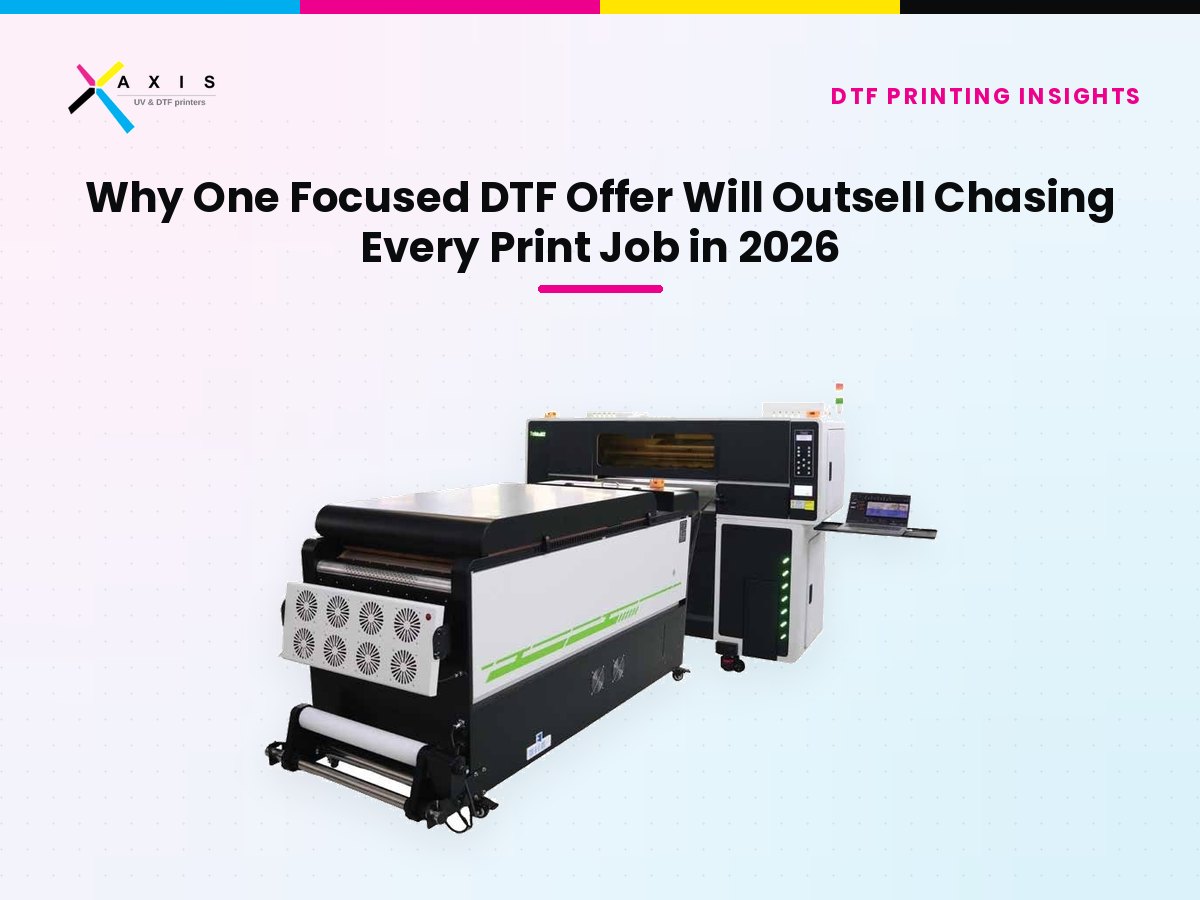
Should a new DTF business specialize or take every order?
Specialize. A new DTF business earns faster by launching one repeatable offer for one defined customer segment, such as small-batch uniforms for local schools, rather than accepting every possible print job.
A focused offer is easier to price, produce and market, so quality stays consistent, costs stay predictable, and you avoid price wars on commodity bulk printing. Choose one product and one buyer type you can serve better than anyone nearby, prove it, then expand from a position of strength.
How crowded is the DTF printing market becoming in India?
DTF is one of the easiest garment-decoration businesses to enter, which means new generalist shops are multiplying fast. Direct-to-film printing is a process that prints a design onto a coated film, bonds it with adhesive powder, cures it, and heat-presses it onto fabric.
According to Grand View Research (2025), India's direct-to-film printing market was valued at USD 243.9 million in 2025 and is projected to reach USD 380.3 million by 2030 at a 9.3% CAGR. The same firm, Grand View Research (2024), sized the global direct-to-film market at USD 2,720.0 million in 2024, rising to USD 3,920.0 million by 2030.
A growing market attracts more sellers, not fewer. When everyone offers the same general printing, price becomes the only difference, and price competition destroys margins.
Why do generalist DTF print shops struggle to make money?
Generalists lose money because they spread thin across too many job types, none done well enough to command a premium. Every new order style means new artwork, new settings and new mistakes, which raises wastage and slows delivery.
The risk is measurable. According to CB Insights (2026), in an analysis of 431 companies that shut down, 43% failed from poor product-market fit and 70% ran out of capital.
A repeatable offer is a single, standardized product and service you can sell and produce the same way every time. Without one, a DTF shop reinvents its workflow on every job and never builds the efficiency that creates profit.
What is changing in how custom apparel buyers choose a printer?
Buyers increasingly reward specialists who solve one need brilliantly, especially for short runs and personalization. The low minimum-order advantage of DTF makes names, numbers and small batches profitable in ways bulk screen printing cannot match.
The demand is real and specific. IMARC Group (2025) valued India's custom T-shirt printing market at USD 176.6 million in 2025, projecting USD 407.9 million by 2034 at a 9.75% CAGR, while Grand View Research (2026) expects the global print-on-demand market to reach USD 57.49 billion by 2033 at a 23.6% CAGR.
Winners in textile printing now sell around a clear use, such as team kits, corporate onboarding or event merchandise, not around the printer. As Michael Porter, professor at Harvard Business School, wrote in "What Is Strategy?" (Harvard Business Review, 1996), "The essence of strategy is choosing what not to do."
"The aim of marketing is to know and understand the customer so well the product or service fits him and sells itself." Peter Drucker, management scholar.
How should you choose what to sell first with a DTF machine?
Choose one repeatable offer for one defined segment, then build everything around producing it profitably. Depth in one lane beats shallow coverage of many.
Apply these criteria when you pick your first offer:
- One defined segment: a specific buyer type you understand, such as schools, uniform dealers, sports clubs or event agencies.
- One repeatable product: a standardized job, for example small-batch uniforms with names and numbers, that you can produce the same way every time.
- Right-sized capacity: a machine matched to that offer's realistic volume at roughly 60% to 70% utilisation, not to a peak-speed demo.
- Transparent job costing: a clear cost per print covering ink, film, powder, garment, labour, wastage, electricity and GST, so every quote protects your margin.
- Consistent output: equipment and training that reproduce the same colour and adhesion on every run, because repeat buyers expect identical results.
What should you look for before you commit to a DTF setup?
Look for a supplier who helps you build one profitable, repeatable offer, not just one who sells you a machine. The comparison below shows why focus outperforms taking everything.
| :-: | :-: | :-: |
|---|---|---|
| Factor | Generalist launch | Focused launch |
| Offer | Accept every print job | One repeatable product for one segment |
| Pricing power | Low: competes on price | Higher: rewarded for expertise |
| Wastage and rework | High: new settings every job | Low: same workflow repeated |
| Marketing | Vague message to everyone | Sharp message to one buyer type |
| Path to profit | Slow and unpredictable | Faster, built on repeat orders |
Practical checklist for choosing where to buy:
- A supplier who helps you identify a profitable niche and the machine size it needs.
- Honest output figures for your specific job type, including artwork prep, powdering and heat press curing, not just top speed.
- Structured operator training so your repeatable product comes out identical every time.
- Local after-sales service and genuine spare parts within reach, not routed overseas.
- Transparent, itemised pricing with no hidden freight, installation or consumable costs.
- Guidance on cost per print and break-even orders for your chosen offer.
Where does Axis Enterprises fit in?
Everything above points to the same need: a partner who helps you pick one profitable offer, size the machine for it, and keep output consistent as repeat orders grow. Axis Enterprises supplies DTF printing machines, heat presses and consumables to Indian garment printers, and backs them with installation, operator training, maintenance and local after-sales support. You can book a free live DTF machine demonstration and test the exact job you plan to sell before you invest.
What is the low-risk first step?
Pick the one offer you want to own, then prove it on a real machine before committing capital. Bring the exact product you plan to sell, such as a batch of named uniforms, and watch a DTF printer run your own artwork so you can judge quality, speed and cost per print for yourself.
The same session covers practical operator training and honest job costing, and you can raise the after-sales and spare-parts questions that decide whether a machine stays profitable. When you are ready, arrange your free demonstration at axisdtf.com and build your business around one offer you can win.
Frequently asked questions
Why should a new DTF business focus on one offer instead of many?
A single repeatable offer lets you standardize artwork, settings and pricing, which cuts wastage and speeds delivery. Focus also sharpens your marketing, so one buyer type hears a message made for them. You can always add products later, once the first offer is profitable and stable.
How do I choose a profitable DTF niche in India?
Start with a buyer type you can reach easily and serve repeatedly, such as schools, uniform dealers, sports clubs or event agencies. Pick a job they order again and again, then price it to protect margin after ink, film, powder, garment, labour and GST. Demand that repeats is worth more than demand that is large but one-off.
Does specializing limit how much I can grow?
No. Specializing builds the efficiency, reputation and cash flow that fund expansion. India's custom T-shirt printing market is projected by IMARC Group to reach USD 407.9 million by 2034, leaving ample room to add adjacent offers once your first one is solid.
Is DTF better than screen printing for a focused, short-run offer?
For personalization and small batches, DTF usually wins because it has no screen setup cost and handles full-colour designs easily. Screen printing still suits very large identical runs. A focused DTF offer around names, numbers and short runs faces less price competition than bulk logo work.
What machine size should I buy for one repeatable offer?
Size the machine to your offer's realistic daily volume at about 60% to 70% utilisation, not to a showroom peak-speed figure. Anchoring the purchase to one known product makes sizing far more accurate. This keeps cost per print low and the machine busy from the start.
Sources
- Grand View Research, India Direct-to-Film Printing Market Outlook (2025)
- Grand View Research, Global Direct-to-Film Printing Market Report (2024)
- IMARC Group, India Custom T-Shirt Printing Market (2025)
- Grand View Research, Global Print-on-Demand Market (2026)
- CB Insights, Why Startups Fail (2026)
- Michael Porter, What Is Strategy? (Harvard Business Review, 1996)
- Peter Drucker, on the aim of marketing
Founder, Axis Enterprises. Selling and servicing digital printing machines across India since 2011. Author of "Increase Your Profit by 270% with UV Printing Technology". More about the author