The Pre-Dispatch Checklist That Can Save DTF Printers Up to One-Fifth of Their Revenue in 2026
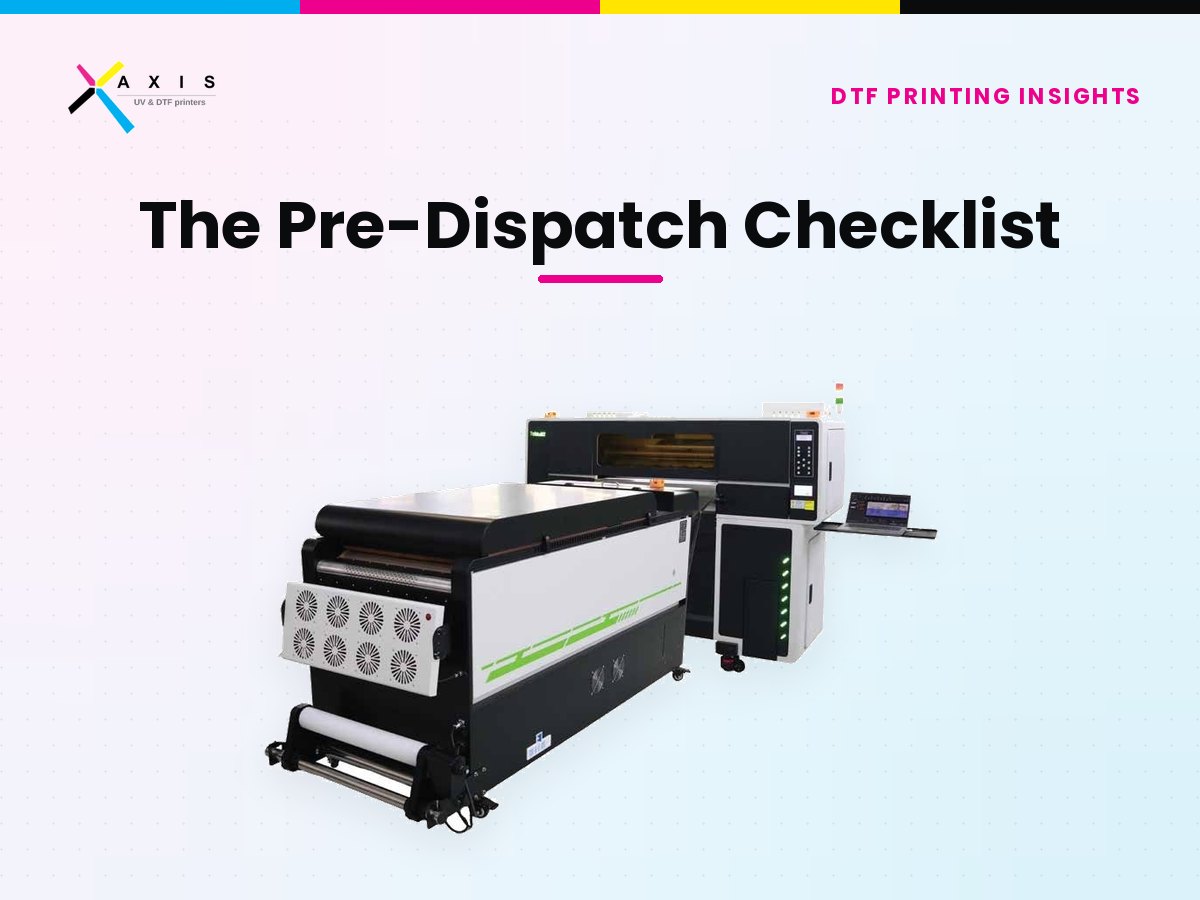
A pre-dispatch quality checklist is a short, structured inspection every printed garment passes through before it leaves the workshop, covering colour match, adhesion, artwork accuracy and packing. It is the last point where a printer can catch a mistake before it becomes a customer's problem. For a small or growing Indian direct-to-film (DTF) printing business, a five-minute checklist run on every batch catches the errors that cause reprints, refunds and lost repeat customers, without slowing production down. The sections below explain what to check, why it matters more in 2026 than before, and how to build one.
How much revenue do DTF printers actually lose to quality mistakes?
Many manufacturers lose 15 to 20 percent of total sales revenue to quality-related costs such as rework, returns and scrap, according to the American Society for Quality, as cited in a 2026 Fabrico industry guide on the cost of poor quality. For a printing business already working on thin per-garment margins, that is not a rounding error. It is the difference between a profitable month and a break-even one.
The apparel industry's own inspection standard makes the scale of the problem clearer. Garment quality control commonly uses an acceptable quality limit (AQL) of 2.5 for major defects, meaning a batch can still "pass" inspection while carrying a defined number of functional failures such as poor adhesion, wrong colour or incorrect sizing, as explained in a 2026 apparel quality control guide from LeeLine Apparel. Most small DTF shops never apply any formal standard at all, so their real defect rate goes unmeasured and is usually higher than they assume.
The stakes are rising because the market is growing fast. India's DTF printing market generated USD 243.9 million in revenue in 2025 and is projected to reach USD 380.3 million by 2030, growing at a 9.3 percent compound annual rate, according to Grand View Research's 2026 India market outlook. More printers chasing the same buyers means a single bad batch is now more likely to cost a customer permanently, not just one order.
Why are pre-dispatch mistakes becoming more expensive for DTF printers in 2026?
Pre-dispatch mistakes cost more today because order volumes and buyer expectations are rising faster than most small printing shops' quality habits. Two market shifts explain most of this pressure.
First, the barrier to entry keeps falling. The global DTF printing market was valued at USD 2.72 billion in 2024 and is projected to reach USD 3.9 billion by 2030, expanding at a 6.0 percent compound annual rate, according to Grand View Research's global market report. More machines in more hands means buyers have more places to take their business the moment quality slips.
Second, India's print-on-demand segment is growing even faster than the equipment market itself. India's print-on-demand market generated USD 857.9 million in 2025 and is forecast to grow at a 26.2 percent compound annual rate through 2033, according to Grand View Research's India print-on-demand outlook. Print-on-demand orders tend to arrive in small, varied batches, individual names, individual sizes, individual colours, which makes consistent quality genuinely harder to hold than long single-design runs.
The underlying craft has not changed even though the pressure to move fast has. Textile printing has always depended on controlled inks, controlled heat and controlled pressure. A heat press running two or three degrees off its set temperature, or a curing cycle shortened to clear a backlog, will not show up as a visible fault until the customer washes or stretches the garment, and by then the reprint is already unavoidable.
What should a smart buyer look for to protect quality as they scale?
A smart buyer looks past machine specifications and asks how quality gets protected once the machine is running at full speed under real order pressure. Five buying criteria matter more than any single feature on a spec sheet.
- Print and colour consistency built into the machine itself. A printer that holds its colour profile and white-ink density steady across a long run reduces how often a batch needs a mid-run correction.
- Practical, hands-on training that includes quality checks, not just operation. An operator who can run a nozzle test and read it correctly prevents far more rejects than one who only knows how to press start.
- Transparent job costing that already accounts for wastage and rework. A buyer who knows the real cost of a reject can justify the two minutes it takes to inspect a batch before dispatch.
- Responsive local after-sales service and genuine spare-parts availability. A worn damper or a clogged nozzle that cannot be fixed within a day is what usually forces an owner to skip inspection just to keep shipping.
- A supplier willing to show quality under pressure, not just under ideal demo conditions. Ask to see a difficult design, gradients, small text, large solid white areas, printed live rather than a pre-made sample.
What should go on a pre-dispatch DTF quality checklist?
A workable pre-dispatch checklist has six checks that together take under five minutes per batch and catch the majority of avoidable rejects. Run them in this order, before the first garment of a batch is packed, not after the last one.
- Start with a nozzle test and a colour-control print. Compare it against yesterday's approved sample before running a single customer job.
- Match against a physical reference swatch, not a screen. Screens and phone cameras render colour inconsistently; fabric samples under the same lighting do not.
- Run a light stretch and rub test on one sample piece. Poor adhesion or cracking usually shows up in seconds under gentle stretching, well before a customer notices it after one wash.
- Check the design against a simple artwork checklist. Confirm resolution, transparent background, correct dimensions and minimum line thickness before printing, not after.
- Sort every rejected piece into a defect category. Artwork, nozzle, colour, powder, curing or operator error, so the same mistake is not repeated on the next batch.
- Log the batch before it is packed. Record consumable batch numbers, settings and the operator's initials, since this single habit turns a future complaint into a five-minute diagnosis instead of a guessing game.
Because not every defect deserves the same response, it helps to classify what you find using the same major-defect logic described earlier.
| Defect class | What it means | Typical DTF example | What to do |
|---|---|---|---|
| Critical | Zero tolerance; a safety or compliance failure | Toxic or unapproved ink residue, sharp embellishment edges | Reject the piece and the batch; investigate the cause immediately |
| Major | A functional failure a customer would return | Wrong colour, poor adhesion, visible banding, cracked print after light stretch | Reject the piece; re-inspect surrounding units from the same run |
| Minor | A cosmetic issue unlikely to trigger a return | Slight edge fuzz, minor powder residue, small placement variance | Note it, clean or trim if quick, and monitor the trend |
This does not need to be complicated to be effective. It needs to be applied the same way, every single batch.
Where a reliable DTF setup makes this checklist effortless
A checklist only works if the machine, training and support behind it make it easy to follow under real order pressure, and that is exactly the gap Axis Enterprises was built to close. Axis Enterprises supplies DTF printing machines built for consistent colour and white-ink output across long production runs, backed by hands-on operator training that covers quality checks, not just button-pressing. Every machine comes with transparent job costing support and a local after-sales and spare-parts network, so a worn part never becomes the reason a batch skips inspection.
Consistent output, trained operators, honest costing and fast local support are easier to build into a daily habit when the equipment and the people behind it are already set up for it. That is the practical difference between a checklist that gets followed and one that quietly gets skipped during a busy week.
If you want to see how a machine holds colour and adhesion across a real production run before committing to one, the fastest way is to watch it happen. You can book a free live DTF machine demonstration at axisdtf.com and bring your own difficult design, gradients, fine text or large white areas included, to see exactly how it performs under the same conditions your dispatch checklist will need to catch.
Frequently asked questions
What is a pre-dispatch quality check in DTF printing?
It is a short inspection run on a sample of every printed batch before packing, checking colour match, adhesion, artwork accuracy and finishing. It typically takes under five minutes and is meant to catch defects before they reach the customer, not after.
How many garments should I inspect per batch?
For most small DTF operations, checking one control print at the start of the batch plus a light stretch and rub test on a sample piece is enough to catch the majority of issues. Larger or higher-value batches benefit from sampling a few pieces spread across the run, not just the first and last.
Does AQL apply to a small DTF printing business?
The full acceptable quality limit sampling tables are built for larger production runs, but the underlying logic, classifying defects as critical, major or minor and deciding in advance what to do with each, works at any scale and is worth adopting even for small batches.
What are the most common DTF print defects caught before dispatch?
The most frequent issues are colour mismatch against the approved sample, banding, weak or oversaturated white underbase, poor adhesion revealed by a stretch test, and artwork errors such as low resolution or incorrect print dimensions.
Does a pre-dispatch checklist slow down production?
A well-designed checklist adds only a few minutes per batch, far less time than reprinting a rejected order or handling a customer complaint after delivery. The businesses that skip it usually spend more time on avoidable reruns than they saved by not checking.
How do I know if my print head or heat press settings are causing quality drift?
Compare today's colour-control print and stretch test against a dated reference sample kept from a known good batch. If adhesion, colour or white density has drifted, check heat press temperature accuracy, ink batch consistency and nozzle health before adjusting artwork or RIP settings.
Sources
- Grand View Research, India Direct To Film Printing Market Size & Outlook (2026)
- Grand View Research, Direct To Film Printing Market Size & Trends Report (2026)
- Grand View Research, India Print On Demand Market Size & Outlook (2026)
- Fabrico, The Cost of Poor Quality (COPQ) in Manufacturing: 2026 Guide
- LeeLine Apparel, AQL 2.5 Explained: Apparel Quality Control Guide 2026
Founder, Axis Enterprises. Selling and servicing digital printing machines across India since 2011. Author of "Increase Your Profit by 270% with UV Printing Technology". More about the author