How to Protect Your DTF Print Head and Avoid Costly Replacements in 2026
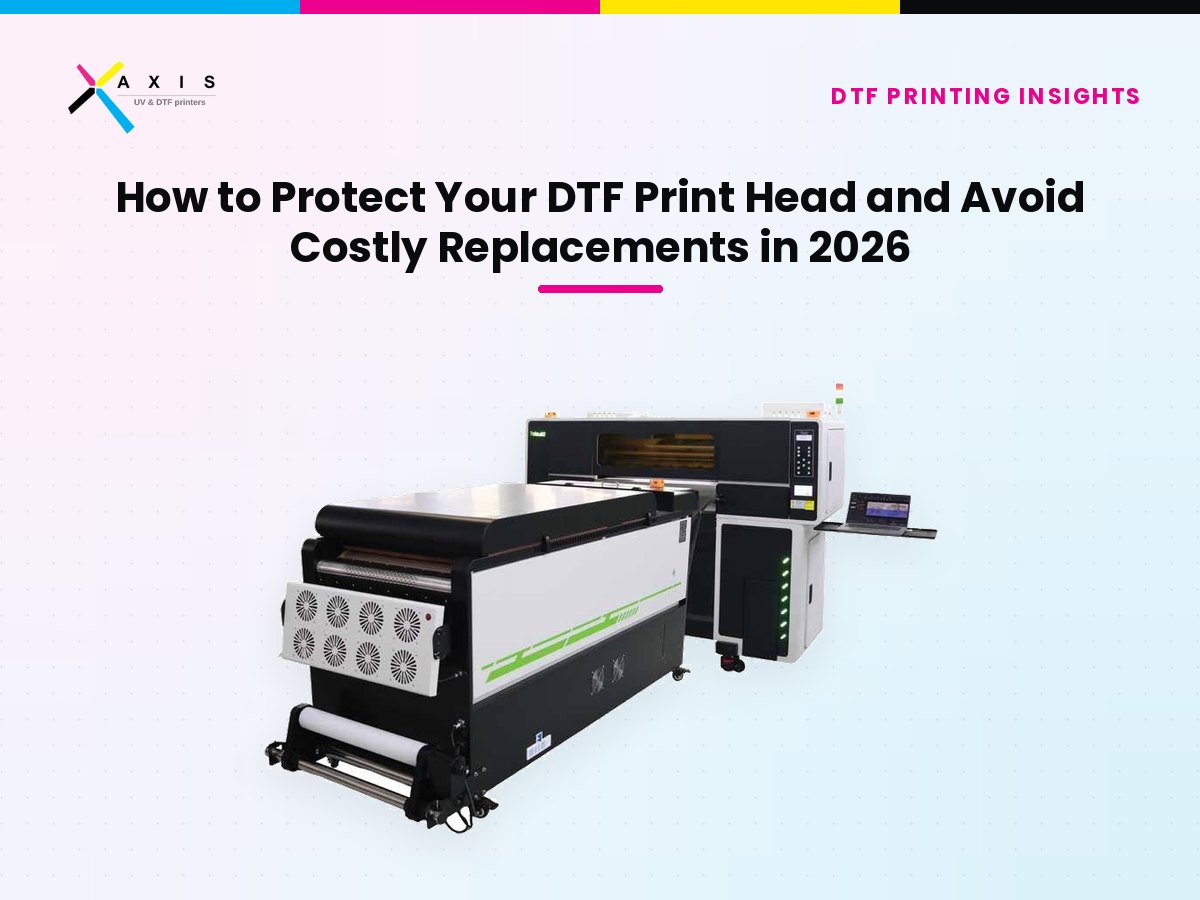
Quick answer: To protect a DTF print head and avoid an expensive replacement, keep white ink circulating every day, never leave the machine fully idle for more than a day or two, use only compatible manufacturer-approved ink and cleaning fluid, run a nozzle test before production instead of reflex deep-cleaning, and protect the machine with a stabiliser against voltage swings. A print head is the single most costly wear part on a DTF printer, so disciplined daily care and a stable power and consumable supply are what decide whether it lasts many months or fails in weeks.
What does a failed DTF print head actually cost your business?
A single failed print head can wipe out a month of profit. The technical team at Digiprint USA (2026) reports that the Epson i3200 head, the workhorse inside most DTF machines sold today, lasts only four to six months under daily commercial production and costs around USD 997 (close to Rs. 85,000) to replace.
Spread across a shop running 25 days a month, that is roughly Rs. 300 in silent head-wear cost every single working day. Most first-time owners never budget for it, so the bill lands as a shock rather than a planned expense.
The wider market is expanding fast, which means more operators are meeting this cost for the first time. According to Grand View Research (2024), the global direct-to-film printing market was worth USD 2,720 million in 2024 and is forecast to reach USD 3,920 million by 2030 at a 6.0% CAGR, even as India's own textile and apparel market is projected to grow at a 10% CAGR to reach USD 350 billion by 2030.
Why do so many DTF print heads fail years before they should?
Most heads do not wear out, they are damaged early by avoidable mistakes. Digiprint USA (2026) attributes the majority of premature DTF print-head failures to white ink settling, because the titanium dioxide pigment is about twice as dense as its carrier fluid and sinks within hours when circulation stops.
The second common killer is over-cleaning. Operators panic at a few missing nozzles and run repeated deep cleans that flush costly ink and stress the head. A print head is defined as the component that fires microscopic ink droplets through hundreds of nozzles, so every unnecessary purge shortens its working life.
Deana Iribe, Training and Marketing Content Manager at Printer Biz and owner of The Print Bakery, put the waste plainly at the 2025 PRINTING United Expo:
"Every time you do an auto-clean, you're literally throwing money down the drain because the ink is going down your tubes." (Deana Iribe, reported by ASI Central, October 2025)
Two more culprits round out the list: incompatible or low-quality ink that corrodes the nozzle plate, and unstable electricity. In many Indian workshops voltage swings and poor earthing damage the delicate electronics behind the head long before the nozzles themselves give out.
What is really changing in DTF printing right now?
Demand for short-run, personalised apparel is pushing more small shops toward DTF than ever before. Direct-to-film printing is a process where a design is printed onto a coated film, dusted with adhesive powder, cured, and then bonded to fabric with a heat press.
Unlike screen printing, DTF needs no screens or minimum order quantities, so it suits the small-batch, made-to-order economy. That shift is enormous: Grand View Research (2026) projects the global print-on-demand market will reach USD 57.49 billion by 2033 at a 23.6% CAGR.
Here is the insight most sellers skip: in DTF, the print head is not a spare part, it is the engine. The economics of the business depend on keeping that engine alive, yet many buyers choose a machine on sticker price alone and ignore the running reality.
Rob Super, CEO and Founder of American Print Supply, framed the hidden operator cost this way at the same 2025 expo:
"If I'm a sole entrepreneur, if I'm spending time running the printer, doing maintenance on the printer, I'm losing sight of my sales." (Rob Super, reported by ASI Central, October 2025)
How should a smart buyer judge a DTF setup for print-head life?
Judge the setup by how long it keeps a head alive, not by the day-one price. The right lens turns a purchase decision into a total-cost-of-ownership decision, and it naturally points to a few criteria.
- Consumable discipline built in: a white-ink circulation system and a supplier who provides compatible, tested ink, film, and powder rather than random refills.
- Training that reduces panic cleaning: operators who are taught to read a nozzle test are the biggest single defence against wasted ink and damaged heads.
- Transparent running costs: a seller who shows you the real cost per print, including head-wear and maintenance, not just the machine quote.
- Power protection guidance: a partner who insists on a stabiliser and proper earthing suited to Indian conditions.
- Fast local support and genuine spares: because a head or damper failure with no nearby help means days of lost orders.
What should you look for in a DTF machine supplier?
Look for a supplier who behaves like a long-term production partner, not a one-time seller. Use this checklist when you evaluate any option.
- Look for a supplier who runs a live demonstration on your own artwork before you pay, so you see real print quality and head behaviour.
- Look for a supplier who trains your operators on daily, weekly, and monthly maintenance, including correct nozzle-test reading.
- Look for a supplier who supplies matched, quality-tested ink, film, and powder rather than leaving you to gamble on cheap consumables.
- Look for a supplier who explains warranty terms clearly, especially whether the print head is covered or treated as a consumable.
- Look for a supplier who keeps genuine spare parts and offers responsive local after-sales service in India.
- Look for a supplier who talks openly about total running cost, not only the purchase price.
Which factors damage a print head, and how do you prevent each one?
The direct answer: nearly every early failure traces to five avoidable factors, and each has a simple daily countermeasure. The table below maps the risk to the fix.
| :-: | :-: | :-: |
|---|---|---|
| Risk factor | What it does to the head | How to prevent it |
| White ink settling | Pigment sinks and clogs nozzles and dampers within hours | Keep circulation on daily; agitate and circulate before every shift |
| Long idle time | Ink dries in nozzles, causing permanent blockages | Run a short daily nozzle test; cap the head correctly on weekends |
| Over-cleaning | Wastes ink and stresses the nozzle plate | Read the nozzle test first; clean only the channel that needs it |
| Low-quality or incompatible ink | Corrodes the nozzle plate and leaves sediment | Use only manufacturer-approved, filtered ink |
| Voltage fluctuation | Damages head electronics and the mainboard | Fit a servo stabiliser and ensure proper earthing |
Where can Indian printers get machines, training, and support built for this?
Everything above points to one practical need: a DTF partner who supplies dependable machines and then keeps them running. This is exactly the role Axis Enterprises plays for garment printers across India, combining DTF machines, heat presses, and matched consumables with installation, operator training, and responsive after-sales support.
Rather than selling a box and disappearing, the focus is on protecting your investment through practical operator training and maintenance guidance and genuine spare parts with local service, so your print head lasts and your production stays profitable.
What is the easiest next step to see this for yourself?
The lowest-risk way to judge any DTF machine is to watch it print your own design and see how the head is maintained in real time. You can book a free live DTF machine demonstration and bring your own artwork, ask about running costs and head warranty, and see the maintenance routine before you commit a single rupee. It is a no-pressure way to turn everything you have just read into a decision you can trust.
Frequently asked questions
What is the average life of a DTF print head under normal Indian working conditions?
Under daily commercial use, industry data from Digiprint USA (2026) puts the popular Epson i3200 head at roughly four to six months. With disciplined circulation, correct cleaning, and stable power, many operators comfortably reach the upper end of that range or beyond. Neglect and voltage problems can cut it to weeks.
What happens if a DTF printer remains idle for two or three days?
White ink settles and pigment can dry inside the nozzles and dampers, leading to blockages. Before a planned break, circulate the ink, cap the head properly, and run a nozzle test on return. For longer idle periods, a short daily power-on and nozzle check prevents most damage.
Can low-quality or incompatible ink permanently damage a DTF print head?
Yes. Cheap or mismatched ink can corrode the nozzle plate coating, leave sediment, and cause repeat clogging that no cleaning fully clears. Using only manufacturer-approved, properly filtered ink is one of the cheapest forms of head insurance you can buy.
How do voltage fluctuations and poor earthing affect the print head?
Sudden voltage swings can damage the electronics that drive the head, along with the mainboard and carriage system, sometimes before the nozzles ever fail. A quality servo stabiliser and correct earthing protect these components. This is essential in areas with an unstable supply.
Can unnecessary deep cleaning shorten print-head life?
Yes. Repeated auto-cleans and deep purges waste expensive ink and place mechanical and thermal stress on the head. Always read a nozzle test first and clean only the specific channel that is failing rather than purging the whole head by reflex.
Does the warranty usually cover the print head, or is it treated as a consumable?
It varies by supplier, and this is a critical question to settle before buying. Some warranties cover the head for a defined period, while others treat it as a consumable excluded from cover. Always ask for the warranty terms and replacement cost in writing.
Sources
- Grand View Research, Direct-to-Film Printing Market Size and Industry Report (2024)
- Grand View Research, Print-On-Demand Market Press Release (2026)
- Digiprint USA, Printhead Lifespan by Model (2026)
- ASI Central, PRINTING United Expo 2025: The Present and Future of Direct-to-Film Printing (October 2025)
- Wikipedia, Direct-to-film printing
- Wikipedia, Heat press
- Wikipedia, Screen printing
- Wikipedia, Print on demand
Founder, Axis Enterprises. Selling and servicing digital printing machines across India since 2011. Author of "Increase Your Profit by 270% with UV Printing Technology". More about the author