The Real Cost of Starting a DTF Printing Business in India: A Complete 2026 Startup Budget
Most people who shut a business down did not lose because the idea was weak. They lost because the money ran out first. In an analysis of 431 companies that closed since 2023, CB Insights (2025) found that 70 percent ran out of capital before the business could stand on its own.
For a new DTF printing business, that pattern usually starts on day one, with a single decision: spending almost the entire budget on the printer and treating everything else as an afterthought.
How much does it really cost to start a DTF printing business in India in 2026?
Quick answer: A realistic DTF printing startup in India in 2026 costs roughly Rs. 7,00,000 to Rs. 18,00,000 in total, and the printer is only part of it. That total should cover the printer and shaker, a heat press, a computer with RIP software, starter consumables, workspace and electrical setup, operator training, about three months of working capital, and a small spare-parts contingency, all before GST. Owners who budget only for the machine and skip the operating buffer are the ones who stall within months.
What is startup investment, and why is it more than the machine price?
Startup investment is the total money required to open a business and keep it running until it can pay for itself, not only the price of the main equipment. For a printing unit, the visible cost is the machine; the invisible costs are consumables, setup, training, and the cash that keeps orders moving.
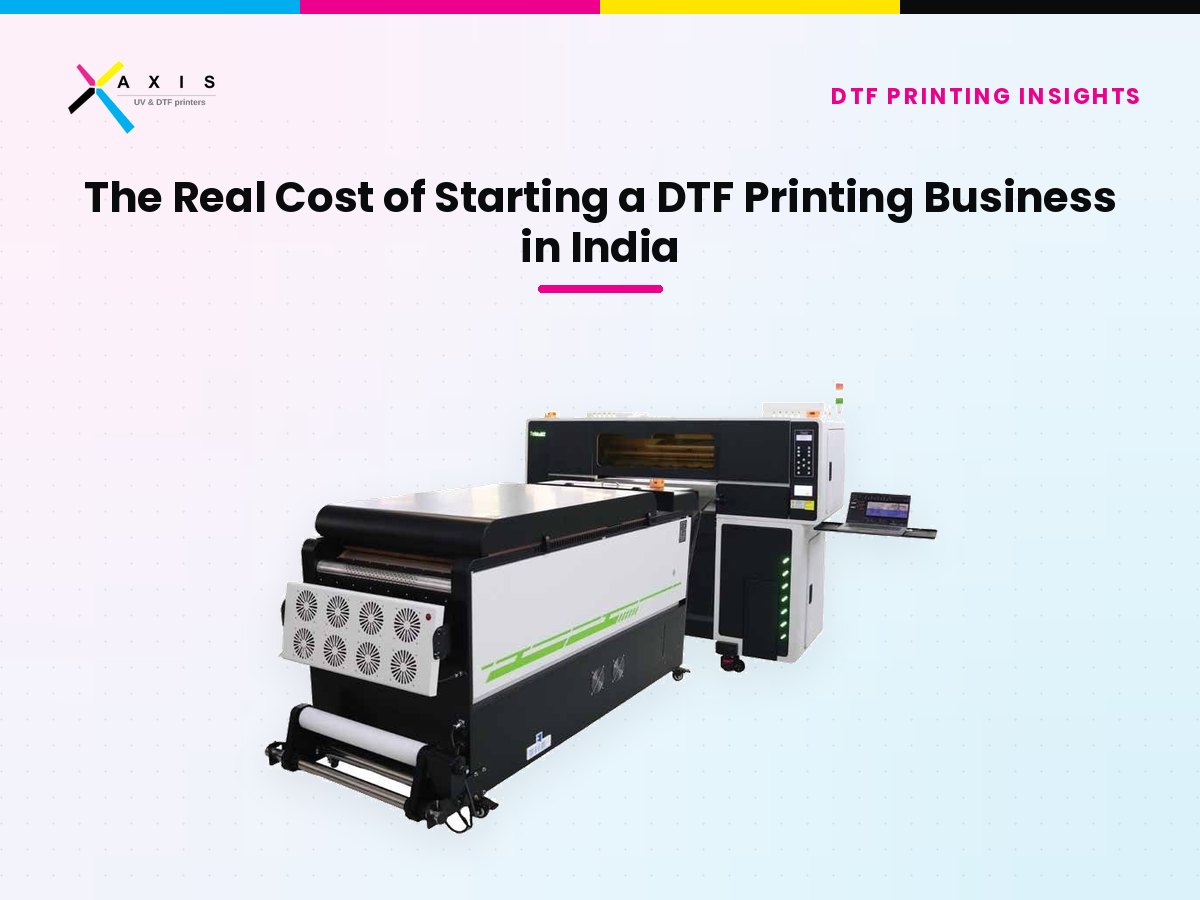
Direct-to-film printing is a process of printing a design onto a special film, coating it with adhesive powder, curing it, and then transferring it onto fabric with a heat press. That means the printer alone cannot produce a single sellable transfer. Every stage after the print needs its own equipment, stock, and skill.
Why do so many new printing businesses run out of money?
They run out of money because they confuse the equipment cost with the business cost. The machine is a one-time purchase; the business is a monthly obligation of ink, film, powder, garments, electricity, and salaries.
The same CB Insights (2025) analysis found that beyond the 70 percent who ran out of capital, 43 percent failed on poor product-market fit, meaning they could not sell enough at a profit before the cash was gone. A printer bought without a matching operating budget simply speeds up that clock.
The temptation is real because the market is genuinely growing. According to Grand View Research (2025), India's direct-to-film printing market was valued at USD 243.9 million in 2025 and is projected to reach USD 380.3 million by 2030, a compound annual growth rate of 9.3 percent. Growth invites entrants; it does not fund them.
Is demand for custom apparel actually strong enough to justify the spend?
Yes, the demand signal is strong, which is exactly why the budgeting has to be disciplined rather than optimistic. Rising demand rewards businesses that can deliver consistently, not those that open underfunded.
India's custom T-shirt printing market reached USD 176.6 million in 2025 and is projected to hit USD 407.9 million by 2034 at a 9.75 percent CAGR, according to the IMARC Group (2025). The wider shift toward made-to-order production is even sharper: Grand View Research (2025) valued the global print on demand market at USD 10.8 billion in 2025, projected to reach USD 57.5 billion by 2033 at a 23.6 percent CAGR.
DTF sits at the center of this shift in textile printing because it decorates cotton, blends, and synthetics without separate setups per fabric. As Bob Stone, Vice President of Sales at Barudan America, told Impressions Magazine (2025):
"Direct-to-film has had a huge impact on the decorated apparel industry."
Impact draws crowds. The businesses that last are the ones that entered with a full budget, not just a machine.
How should a smart buyer budget for a DTF setup?
A smart buyer budgets for the whole system and the first three months of operation, not for the printer in isolation. The goal is to reach the point where customer payments cover running costs before the starting capital is exhausted.
Five criteria separate a fundable plan from a fragile one:
- Total cost of a sellable print, not machine price. Judge every option by realistic cost per finished transfer, including wastage, cleaning ink, and downtime, so pricing and margins are known before launch.
- A funded training line. An operator who can run and troubleshoot the machine from week one prevents the expensive early mistakes that eat consumables and confidence.
- Guaranteed access to service and spare parts. Downtime is lost revenue; fast local support and available parts belong in the plan, not in the panic after a breakdown.
- A three-month working capital buffer. Garments, ink, film, powder, salaries, and delivery must be funded while the customer pipeline is still forming.
- Machine reliability over headline speed. A dependable unit at a steady real output earns more than a fast one that stalls, because uptime, not advertised speed, pays the bills.
What should a startup budget for a DTF business actually include?
A complete DTF startup budget in India includes eight line items, and the machine is only the first. The table below shows typical planning ranges to size the full investment; treat them as planning figures to refine with live quotes, and add GST where it applies.
| :-: | :-: | :-: |
|---|---|---|
| Cost component | Typical planning range (Rs., before GST) | Why it belongs in the budget |
| DTF printer and shaker or oven | 3,50,000 to 9,00,000 | The core production unit; cost scales with width and print-head count |
| Heat press | 25,000 to 80,000 | Required to cure and transfer every design onto fabric |
| Computer and RIP software | 40,000 to 90,000 | Drives colour management and file preparation |
| Starter consumables (ink, film, powder) | 40,000 to 1,00,000 | First stock to produce and sample before reorders begin |
| Workspace setup (stabiliser, exhaust, furniture) | 50,000 to 1,50,000 | Stable power and ventilation protect output and equipment |
| Operator training | 0 to 30,000 | Often bundled with a good supplier; builds day-one competence |
| Three months working capital | 1,50,000 to 4,00,000 | Funds garments, salaries, and running costs until orders pay |
| Contingency and spare-parts fund | 50,000 to 1,50,000 | Covers print-head, electrical parts, and unexpected downtime |
What should you look for in a DTF supplier to protect your budget?
Look for a supplier whose offer reduces your total investment risk, not just the sticker price of the machine. The right partner lowers the cost of learning, downtime, and mistakes, which is where underfunded businesses actually bleed.
- Look for a supplier who runs a live, timed demonstration from file to finished transfer, so real output and cost per print are visible before you pay.
- Look for a supplier who includes hands-on operator training, so you are not paying to learn on wasted stock.
- Look for a supplier who commits to local after-sales service and keeps spare parts in stock, so a fault costs hours, not weeks.
- Look for a supplier who explains transparent job costing, so you can price work and protect margins from day one.
- Look for a supplier who helps you plan the full startup budget, including consumables and working capital, rather than selling only the machine.
Where does a well-supported DTF setup come from?
Everything above describes what a dependable DTF partner should do, and it is exactly what Axis Enterprises is built to provide. We supply DTF printing machines, heat presses, and ink, film, and powder consumables, together with installation, practical operator training, maintenance, and responsive local after-sales support for Indian garment-printing businesses.
That means the plan on this page is not left as theory. From machine selection to on-site operator training and spare-parts support, the goal is to help you launch with a complete, funded setup rather than a printer and a gap where the operating budget should be.
If you are costing a DTF business this year, the most useful next step is to see real output and real numbers before you commit. You can book a free live DTF machine demonstration and watch a print run from file to finished transfer, then use it to build a realistic startup budget for your own volume and space. It is a low-pressure way to replace guesswork with figures you can plan around.
Frequently asked questions
Is the printer the biggest cost when starting a DTF business?
The printer is usually the single largest line item, but it is rarely the majority of a well-planned budget. Once you add consumables, workspace, training, and three months of working capital, the machine often accounts for roughly half of the total. Budgeting only for the printer is the most common early mistake.
How much working capital should a new DTF business keep?
Plan for at least three months of running costs, covering garments, ink, film, powder, salaries, electricity, and delivery. This buffer keeps the business fulfilling orders while the customer pipeline is still building. Without it, a slow first quarter can end the business even when demand is rising.
Does GST apply to DTF machines and consumables in India?
Yes, DTF machines, heat presses, and consumables attract GST, and equipment prices are often quoted before tax. Plan for GST on top of the quoted figures so your capital estimate is accurate. Registered businesses may be able to claim input tax credit, so confirm the current treatment with your accountant.
Is now a good time to start a DTF printing business in India?
Demand indicators are positive: India's DTF printing market is growing at a 9.3 percent CAGR through 2030 per Grand View Research (2025), and custom T-shirt printing at 9.75 percent through 2034 per the IMARC Group (2025). A growing market rewards businesses that open fully funded and can deliver consistently. It does not rescue an underfunded launch.
What hidden costs surprise first-time DTF owners most?
The costs most often missed are ongoing consumables, electrical stabilisation and ventilation, spare parts for the print head, and the working capital to survive the first few months. These are predictable, not unlucky, and they belong in the plan from the start.
Sources
- CB Insights, "The Top 12 Reasons Startups Fail" (2025)
- Grand View Research, India Direct-to-Film Printing Market Outlook (2025)
- IMARC Group, India Custom T-Shirt Printing Market (2025)
- Grand View Research, Print On Demand Market Report (2025)
- Impressions Magazine, "The Year in Review: 2025" (2025)
Founder, Axis Enterprises. Selling and servicing digital printing machines across India since 2011. Author of "Increase Your Profit by 270% with UV Printing Technology". More about the author