Why Do Repeat Print Orders Never Quite Match the First Batch?
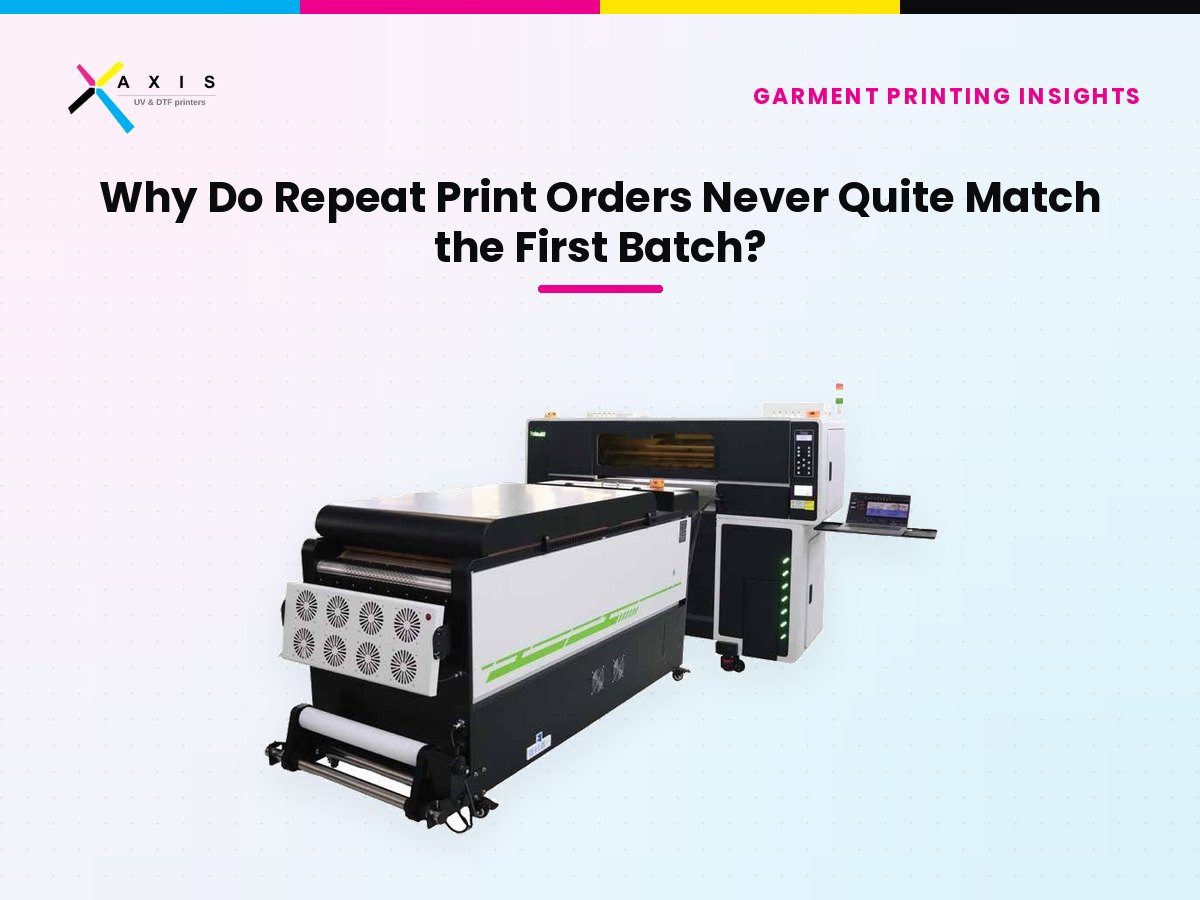
A customer reorders the exact same design three months later, same file, same fabric, same printer, and the T-shirts still come back looking slightly off. It happens across the Indian garment printing industry more often than anyone likes to admit, and it rarely has anything to do with the design file itself.
Colour drifts across repeat orders and multi-batch runs mainly because of four factors: RIP and ICC colour profile settings that get nudged or reset, white ink that settles and thins over time, film and powder batches that vary slightly between manufacturing runs, and curing temperature or press-time creep as machines age or operators change. The fix is standardisation, not luck. Lock and label ICC profiles per substrate, keep a physical swatch library for every repeat client, log white ink density and print mode per job, standardise cure temperature and dwell time, and recalibrate the printer and press on a fixed schedule rather than only when a print looks wrong.
How Much Does Colour Inconsistency Really Cost a Repeat-Order Printing Business?
Colour inconsistency costs more than the price of the reprint. It costs film, ink, powder, machine time, labour, and, most expensive of all, the trust of a repeat buyer who now wonders if every future order needs to be checked shade by shade.
This risk is growing because repeat and bulk orders are becoming the backbone of small apparel businesses in India. Apparel already accounts for 78.5% of all MSME textile sales in the country, and 30.5% of these small apparel businesses report a skilled labour shortage as a top operational challenge, according to a 2025 survey covered by Fibre2Fashion.
When labour is stretched thin and apparel is the dominant product line, colour checking becomes rushed rather than systematic. That is exactly when a bulk order split across two or three production batches starts drifting shade to shade without anyone noticing until the client does.
What Is Colour Consistency in DTF Printing, and What Actually Causes It to Drift?
Colour consistency in DTF printing is the ability to reproduce the same design with the same shade, saturation, and white base across every print run, whether that run happens today or six months from now. Direct-to-film (DTF) printing is a garment decoration process where a design is printed onto a special film with pigment inks and a white ink layer, coated with adhesive powder, cured, and then heat pressed onto fabric.
Colour consistency depends heavily on colour management, the practice of controlling how colour is captured, processed, and reproduced across a workflow, usually anchored by an ICC profile, a standardised file that describes how a specific printer, ink, and film combination should render colour. When any part of that chain shifts, even slightly, the printed colour shifts with it.
Five things typically cause colour to drift between batches and over time:
- RIP or ICC profile drift: an operator nudges a saturation or ink limit setting mid-job, or the RIP software gets updated without reloading the locked profile.
- White ink settling: DTF white ink contains heavy titanium dioxide pigment that settles in the tank or print head if not agitated and shaken on a fixed schedule, thinning the white base over time.
- Ambient humidity and temperature swings: Indian workshops often run without climate control, and both film adhesion and curing behaviour change with the weather.
- Film and powder batch variance: different manufacturing lots of PET film or hot-melt powder can absorb and release colour slightly differently, even from the same supplier.
- Operator variance: a second shift or a new team member pressing at a different temperature, pressure, or dwell time changes the final look without changing the design file at all.
Industry veterans in colour-managed printing describe this as a discipline problem as much as a technical one. As Edward Jansen, Business Unit Vice President, Production Print Solutions Professional Services Group at Canon Solutions America, put it: "The best quality output is always our focus, but it's also about achieving color consistency and repeatable results across the entire print enterprise."
| :-: | :-: | :-: |
|---|---|---|
| Cause of colour drift | Why it happens | How to standardise it |
| RIP/ICC profile drift | Settings changed mid-job or software update overwrites saved profile | Lock and password-protect the ICC profile per substrate; reload before every job |
| White ink settling | Titanium dioxide pigment separates in tank or head over time | Agitate white ink on a fixed daily or shift schedule, not only when print looks pale |
| Humidity/temperature swings | Non-climate-controlled workshops change adhesion and curing behaviour | Track workshop temperature and humidity; adjust cure time within a documented range |
| Film/powder batch variance | Different manufacturing lots absorb and release colour slightly differently | Log film and powder batch numbers per job; test a swatch when a new lot arrives |
| Operator variance | Different shifts or staff press at different temperature, pressure, or dwell time | Standardise press settings in writing and keep a reference swatch for every repeat client |
Why Are Repeat B2B and Bulk Buyers Getting Less Forgiving About Colour Match?
Buyers are less forgiving because print-on-demand and custom apparel have moved from a novelty to a mainstream procurement category, and GST-registered corporate and retail buyers increasingly expect factory-grade uniformity, not craft-shop variation.
India's print-on-demand market was valued at USD 857.9 million in 2025 and is projected to grow at a 26.2% compound annual growth rate through 2033, making India the fastest growing regional market in the Asia Pacific region, according to Grand View Research (2026).
The global direct-to-film printing market itself was valued at USD 2.72 billion in 2024 and is projected to reach USD 3.9 billion by 2030 at a 6.0% CAGR, while the broader textile printing and apparel market across Asia Pacific, India's home market, is expected to grow at a 10% CAGR to USD 350 billion by 2030, according to Grand View Research.
More volume means more repeat orders and more multi-batch runs for the same client, and India's apparel export base, already close to US$40 billion a year and employing more than 45 million people with a government target of US$100 billion by 2030, according to IBEF, means the businesses supplying that pipeline are being held to increasingly professional, brand-consistent standards.
What Should a Smart Buyer Look for in a Colour-Consistent DTF Setup?
A smart buyer should stop evaluating DTF machinery on print speed or upfront price alone and start evaluating it on how repeatable its output is over months, not just on day one. Five criteria matter more than most brochures suggest.
- Mechanical consistency: a printer and heat press built to hold calibration across thousands of prints, not just the first hundred.
- Hands-on operator training: someone actually shows your team how to lock an ICC profile, agitate white ink, and standardise press settings, rather than handing over a manual.
- Transparent job costing: you know exactly what ink, film, and powder a job consumes, so batch variance in cost is visible before it becomes a colour problem.
- Local, responsive after-sales support: a technician or spare part that is days away, not weeks, when a print head or RIP setting needs attention.
- Genuine consumables supply chain: a steady, traceable source of ink, film, and powder so batch-to-batch variance stays within a tight, known range.
What's the Checklist for Choosing a DTF Supplier Who Won't Let Your Colours Drift?
Use this checklist before signing with any DTF machine or consumables supplier, because the sales pitch rarely mentions what happens after month six.
- Look for a supplier who trains your operators on-site, on your own machine, not just through a video call.
- Look for a supplier who documents recommended ICC profiles, ink limits, and cure settings for your specific film and powder combination.
- Look for a supplier who stocks genuine consumables locally, so you are never forced to switch film or powder brands mid-order out of scarcity.
- Look for a supplier who offers a real, reachable after-sales and spares line, not a call centre queue.
- Look for a supplier who can explain, in plain language, why a print might look different from the last batch and how to prevent it.
- Look for a supplier who treats a live machine demonstration as normal, not a rare favour.
Where Does Axis Enterprises Fit Into This Picture?
Axis Enterprises exists for exactly this problem. We sell DTF printing machines, heat presses, and inks, film, and powder consumables to Indian garment printers, and every machine ships with the operator training, standardised setting guidance, and after-sales support that keeps colour consistent from the first print to the five-hundredth.
If your business is scaling into repeat B2B and bulk orders, the machinery, training, and local spares network matter as much as the print quality on day one. You can book a free live DTF machine demonstration and see exactly how batch-to-batch colour control is handled on the shop floor.
Ready to See Consistent Colour, Batch After Batch?
You do not need to take our word for how a DTF machine holds its colour calibration over time. Visit axisdtf.com and book a free live demonstration where our team runs an actual repeat print job in front of you, explains the ICC profile and white ink settings we lock in, and answers questions about training and after-sales support for your specific setup.
It costs nothing to watch, and it is the fastest way to judge whether a supplier's claims about colour consistency hold up outside a brochure. Reach out through Axis Enterprises' support and demonstration team and bring your own design file to the session.
Frequently asked questions
How often should I recalibrate my DTF printer's colour profile?
Most DTF workshops in India benefit from checking calibration weekly and doing a full ICC profile re-verification monthly, or sooner if you change ink, film, or powder brand. Machines used for high-volume repeat orders should be checked more frequently, since drift compounds faster under heavy daily use.
Why does white ink cause more colour problems than CMYK inks in DTF printing?
White ink uses heavier titanium dioxide pigment that settles faster than coloured inks, and it sits underneath the CMYK layer, so any thinning in the white base changes how every colour on top of it appears. Regular agitation on a fixed schedule, not just when a print looks pale, is the main defence.
Can two different film or powder brands produce different colours from the same design file?
Yes. Different PET film coatings and hot-melt powder formulations absorb and release ink slightly differently, even when the design file and printer settings are identical. Testing a swatch whenever you receive a new batch, even from the same supplier, catches this before a full order is affected.
Should I keep physical fabric swatches for every repeat customer?
Yes, a small labelled swatch library is one of the cheapest safeguards against colour complaints. It gives you and the customer a physical reference to compare against, rather than relying on memory or a screen, which does not reproduce colour reliably.
Does room temperature or humidity actually change print colour output?
Yes, in workshops without climate control, humidity affects how film adhesive and powder behave, and temperature affects curing time, both of which influence the final printed colour. Tracking workshop conditions and adjusting cure settings within a documented range reduces this variable significantly.
What is the single biggest mistake small DTF printers make with repeat orders?
Treating every repeat order as a fresh job instead of pulling up the saved settings, ICC profile, and swatch from the original order. Standardising and documenting settings per client, rather than trusting memory, is what actually prevents drift over multiple batches.
Sources
- Grand View Research, India Print On Demand Market Size & Outlook (2026)
- Grand View Research, Direct-to-Film Printing Market Report
- India Brand Equity Foundation (IBEF), Apparel Industry in India
- Fibre2Fashion, Apparel dominates MSME textile sales, accounting for 78.5%: Survey (2025)
- GlobeNewswire, Canon Solutions America Launches Expanded Professional Certification Initiative
- Wikipedia, Direct-to-film printing
- Wikipedia, Color management
- Wikipedia, ICC profile
- Wikipedia, Print on demand
- Wikipedia, Textile printing
Founder, Axis Enterprises. Selling and servicing digital printing machines across India since 2011. Author of "Increase Your Profit by 270% with UV Printing Technology". More about the author