How to Scale a DTF Printing Business in India in 2026 Without Creating Operational Chaos
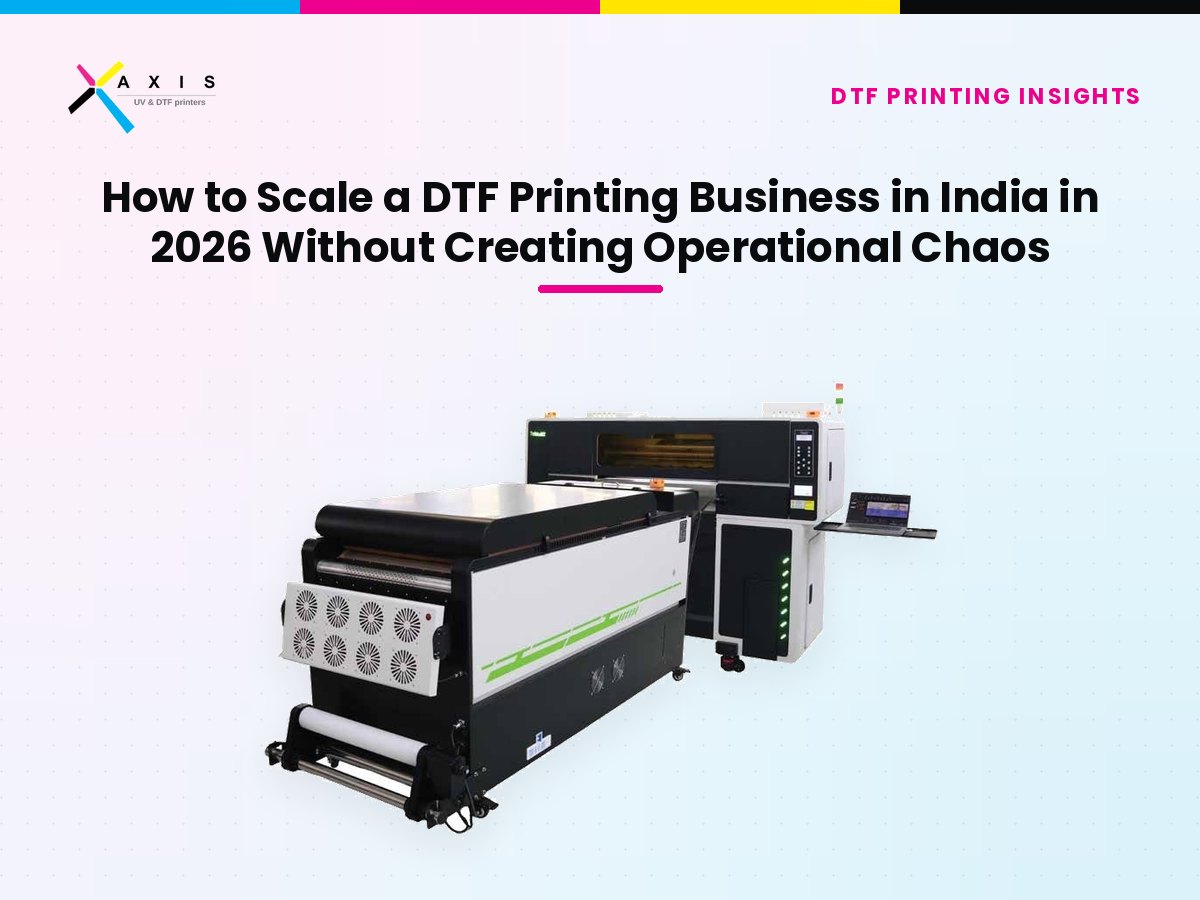
Quick answer: To scale a DTF printing business in India, grow capacity in a controlled sequence rather than by buying machines on impulse. First confirm you have steady, repeatable demand, not one busy month. Next, document your production as written standard operating procedures so quality does not depend on the owner. Then track a few numbers: machine utilisation, rejection rate, on-time delivery and cash reserve. Only when those are stable should you add a second shift or a second machine, backed by a dependable equipment partner and enough working capital in Rs. to absorb the ramp-up. Scaling is an operations decision first and an equipment decision second.
What does it actually mean to scale a DTF printing business?
Scaling a DTF printing business means increasing capacity, revenue and team size while keeping quality, delivery and cash flow under control. It is not the same as simply being busy or buying a bigger machine.
Textile printing is the process of applying colour to fabric in defined patterns, and direct-to-film (DTF) is a transfer method within it: a design is printed onto film, coated with adhesive powder, cured, and then pressed onto the garment. A DTF business scales when each of those steps can run reliably without the owner standing at the machine.
The distinction matters because most stalled shops are busy, not scalable. Busy means orders are coming in. Scalable means you can double those orders next quarter without doubling the mistakes.
Why is demand for DTF printing growing so fast in 2026?
Demand is growing because custom apparel, print-on-demand and DTF adoption are all expanding at the same time, and DTF prints on more fabric types than older methods. This is a rising market, which is exactly why disciplined scaling pays off.
According to Grand View Research, the global direct-to-film printing market was estimated at USD 2,720.0 million in 2024 and is projected to reach USD 3,920.0 million by 2030, growing at a 6.0% CAGR. That is steady global tailwind for anyone printing on film today.
The India picture is stronger. Grand View Research values the India print-on-demand market at USD 857.9 million in 2025, projected to reach USD 5,419.0 million by 2033 at a 26.2% CAGR. The India custom T-shirt printing market reached USD 176.6 million in 2025 and is forecast to hit USD 407.9 million by 2034 at a 9.75% CAGR, per IMARC Group.
The wider base keeps expanding too. The India Brand Equity Foundation (IBEF) reports India's textile and apparel industry reached nearly USD 190 billion in 2025-26 and is projected to grow at a 10% CAGR to USD 350 billion by 2030.
Practitioners see the same shift on the shop floor. As Bob Stone, Vice President of Sales at Barudan America Inc., told Impressions Magazine, "Direct-to-film has had a huge impact on the decorated apparel industry."
What goes wrong when a DTF business tries to grow too fast?
The main thing that goes wrong is cash. Growth consumes working capital faster than owners expect, and running out of it is the most common way businesses stop.
In its 2024 analysis of startups that shut down, CB Insights found that running out of capital was the single most common failure point, cited in 70% of cases. Rapid scaling makes this worse: consumables, salaries and a second machine all demand money before the extra orders are paid for.
The other failures are operational. When volume rises, three problems tend to appear together:
- Production bottlenecks, where the printer, shaker or heat press cannot keep pace with orders.
- Inconsistent quality, as a second operator produces different results from the first.
- Owner dependence, where every decision and every fix still routes through one person.
Each of these turns higher revenue into higher stress instead of higher profit.
Why do most DTF shops stall at one machine and one operator?
Most shops stall because the business lives inside the owner's head, not in written systems. When knowledge is not documented, the owner becomes the ceiling.
Early on, informal training works: the owner shows one person how to run the heat press and manage white ink, and quality holds. As soon as a second machine or a new hire arrives, the gaps show, because there is no reference for correct temperature, pressure, curing time or nozzle checks.
This is where a standard operating procedure changes the outcome. An SOP is a set of step-by-step instructions that lets any trained worker carry out a routine operation the same way every time, which is precisely what higher volume needs.
The market is also getting more competitive, so slack is thinner. Industry surveys show how mainstream DTF has become: at the PRINTING United Expo 2025, reporting by ASI cited State of the Decorated Apparel Industry data showing 65.7% of surveyed decorators now offer DTF transfers, rising to 88.5% among those already using heat-transfer methods. As Cassie Green, Content Director at Apparelist, put it, DTF is "such a defining tech in today's apparel decoration market." When most competitors offer the same service, execution and reliability become the edge.
How should a smart owner decide when to scale a DTF operation?
Decide with numbers, not gut feel. A DTF operation is ready to scale when confirmed demand, documented process, measured performance and a cash buffer are all in place at once.
Use these buying criteria before you add any capacity:
- Repeatable demand: recurring and reseller orders, not a single seasonal spike.
- Documented production: SOPs so a new operator matches your quality.
- Stable core numbers: healthy machine utilisation, low rejection rate and reliable on-time delivery.
- Cash reserve: working capital in Rs. to cover consumables, wages and GST before new revenue lands.
- Dependable equipment and service: machinery and a supplier that will not become your next bottleneck.
The most common real decision is whether to add a shift or add a machine. The table below frames it.
| :-: | :-: | :-: |
|---|---|---|
| Factor | Add a second shift | Buy another machine |
| Upfront cost | Lower: mainly wages and training | Higher: machine plus GST and setup |
| Best when | One machine is under-utilised in a single shift | One machine already runs near full utilisation |
| Main risk | Operator fatigue and quality drift at night | Idle capacity if demand does not hold |
| Speed to add capacity | Fast, within weeks | Slower, needs space, power and install |
| Reversibility | Easy to scale back | Harder to unwind |
What should you look for before adding capacity or a second machine?
Look for the things that keep quality and uptime stable as volume rises, not just the lowest sticker price. The cheapest machine is rarely the cheapest to scale on.
Use this checklist when evaluating any expansion:
- Look for equipment with proven, consistent output at higher volumes, verified in a live demonstration rather than from a spec sheet.
- Look for a supplier who provides structured operator training, so a second or third hire reaches production quality quickly.
- Look for transparent job costing that includes ink, film, powder, labour, electricity, wastage and maintenance, so higher volume does not quietly erode margin.
- Look for local after-sales service and fast access to spare parts, because downtime on a scaled operation costs far more per hour.
- Look for a partner who understands Indian operating conditions: voltage stability, dust, humidity and realistic ROI in Rs.
- Look for honesty about print speed, measuring actual sellable output rather than advertised peak numbers.
These criteria describe an operation built to grow, and they are also a fair test of any vendor you are considering.
Where does the right equipment partner fit into scaling?
Once your demand, process and numbers are ready, the equipment partner is what turns a plan into stable extra capacity. This is exactly the role Axis Enterprises is built for. Axis supplies DTF printing machines, heat presses and consumables, along with installation, practical operator training and after-sales support for garment-printing businesses across India.
The aim is to remove the two risks that stall growth: unreliable machinery and slow service. With dependable equipment, transparent job costing and responsive local support for spare parts, a second shift or second machine adds output instead of adding chaos. It lets you scale print-on-demand and bulk orders without becoming the bottleneck yourself, whether you are moving up from screen printing or expanding an existing DTF line.
What is a low-risk first step to scale with confidence?
The simplest next step is to see the machinery running your kind of work before you commit any capital. You can book a free live DTF machine demonstration with Axis Enterprises and watch real print quality, production speed and durability on the fabrics you actually sell. Bring your typical orders and costing questions to pressure-test whether your operation is ready for the next machine or shift, a value-first way to plan expansion with facts rather than guesswork.
Frequently asked questions
What signs show that my current DTF setup is reaching its practical capacity?
The clearest signs are a machine running near full utilisation across your working hours, delivery dates slipping, and rejects rising as you rush jobs. If overtime has become permanent rather than occasional, you are at practical capacity. Track utilisation and on-time delivery for a month before deciding, so the signal is data, not a stressful week.
Should I add a second shift before investing in another DTF machine?
Usually yes, if a single machine is not yet fully used across one shift. A second shift adds capacity faster and at lower upfront cost than a new machine, and it is easy to scale back if demand softens. Buy another machine only when your existing one already runs near full utilisation and demand is confirmed and repeatable.
How much confirmed demand should I have before expanding capacity?
Expand on recurring, repeatable demand, not a single busy month. A practical rule is several consecutive months of orders that consistently push your current setup near its limit, ideally with a mix of local, online and reseller customers. One seasonal spike is not a reason to buy a machine that then sits idle.
What financial reserve should I maintain before adding staff or machinery?
Keep enough working capital in Rs. to cover several months of consumables, wages, electricity, GST and maintenance before the new capacity pays for itself. Growth consumes cash before it returns it, which is why running out of capital is the most common failure point. A cash buffer, not just a full order book, is what makes scaling safe.
What systems must be documented before the owner can step away from daily production?
Document your core production as SOPs: machine start-up and nozzle checks, white-ink circulation, printing and curing settings, heat-press temperature, time and pressure, quality-control gates and a simple fault-decision tree. Add escalation rules for problems like leaks or repeated missing nozzles. Once these exist as visual checklists, a trained operator can run the shift and the owner becomes optional rather than essential.
How do I protect print quality when a second operator joins?
Protect quality with written standards and independent checks. Train the new operator against the same SOPs the first one follows, and keep quality control separate from the person running the machine. Photograph daily nozzle tests and log rejects so quality drift shows up early, before customers notice it in their orders.
Sources
- Grand View Research, Direct To Film Printing Market Size, Industry Report 2030
- Grand View Research, India Print On Demand Market Size and Outlook, 2026-2033
- IMARC Group, India Custom T-Shirt Printing Market Size and Report, 2026-2034
- India Brand Equity Foundation (IBEF), Textile Industry and Market Growth in India
- CB Insights, Why Startups Fail: Top Reasons
- Impressions Magazine, The Year in Review: 2025 and the Decorated Apparel Industry
- ASI, PRINTING United Expo 2025: Decoration Trends and Equipment Upgrades

Founder, Axis Enterprises. Selling and servicing digital printing machines across India since 2011. Author of "Increase Your Profit by 270% with UV Printing Technology". More about the author