Why Short-Run, Personalized Orders Are the Most Profitable Work in Indian Garment Printing in 2026
Here is something most print shop owners do not expect: the fastest-growing part of India's printing economy is not big bulk orders. It is single pieces. India's print-on-demand market was worth USD 857.9 million in 2025 and is projected to reach USD 5,419.0 million by 2033, a compound annual growth rate of 26.2 percent, according to Grand View Research (2026). The orders driving that growth are personalized, one-off and small, exactly the jobs many workshops still turn away.
Quick answer: Short-run personalized printing is the small-quantity production, often a single piece, of custom apparel and merchandise carrying an individual name, number, photo or one-off design. In 2026 it is often the most profitable work an Indian print shop can take, because it faces far less price competition than bulk logo printing and buyers will pay a premium for it. The economics now favour it: modern film-transfer printing removes the screen setup and minimum-order barrier that once made single pieces unviable. The shops that win price their work by margin per hour, choose dependable equipment, and build repeat demand from schools, sports teams, brands, gifting and events.
What is short-run personalized printing, and why is it growing so fast?
Short-run personalized printing is small-batch custom production, frequently one piece at a time, of garments and merchandise that carry a specific name, number, photo or design. It is growing because buyers increasingly want individuality, and the technology to deliver it affordably now exists.
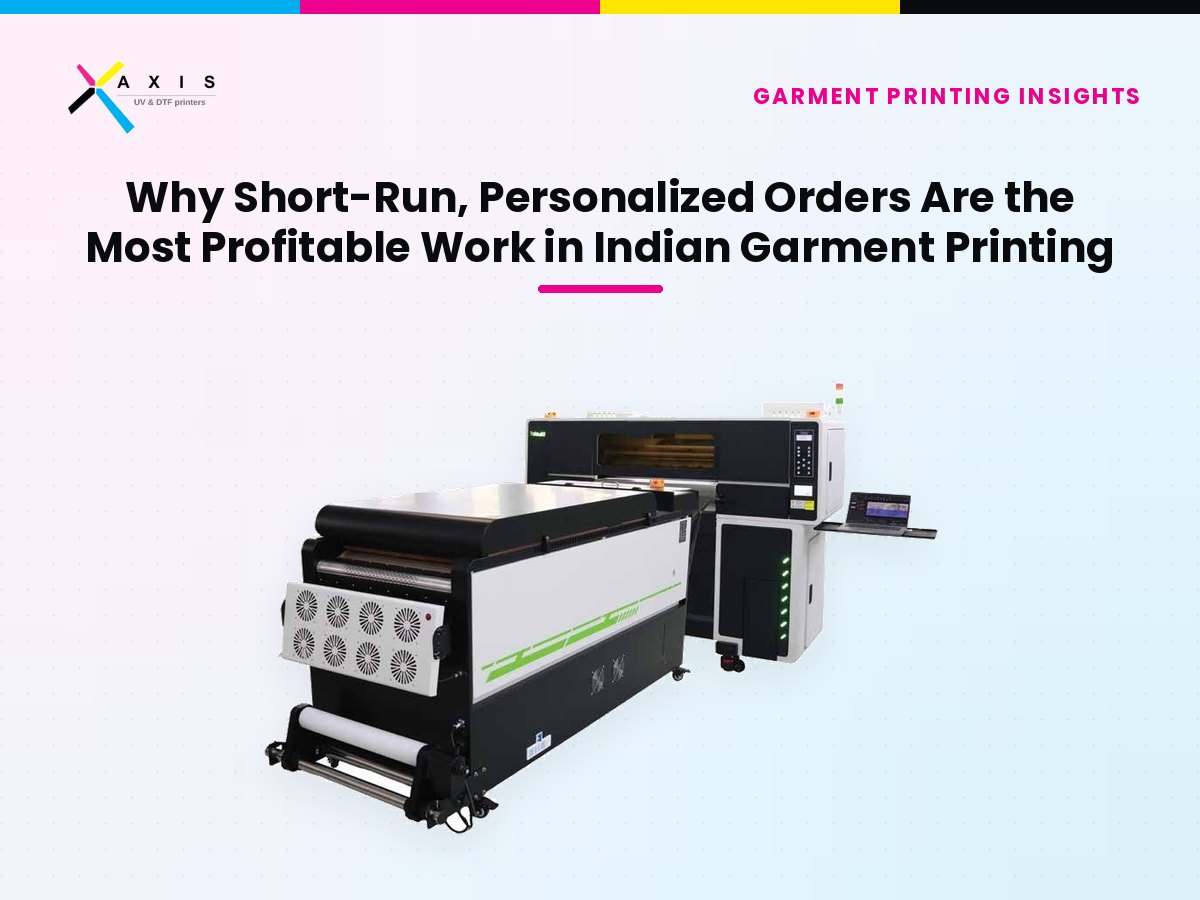
This is the practical face of personalization in physical products, and it sits at the centre of the print on demand model. The enabling technology is direct-to-film printing, which transfers a design onto almost any fabric without the screens or plates older methods required.
Because there is no setup to amortise, the cost of printing one unit is close to the cost of printing the hundredth. That single fact is what turns tiny orders from a nuisance into a business.
How much more will buyers actually pay for something personalized?
Enough to change the economics of a print shop. A Deloitte Consumer Review on the rise of mass personalisation found that 36 percent of consumers are interested in personalised products or services, one in five of those buyers are willing to pay a 20 percent premium, and 48 percent will even wait longer to receive them.
That willingness shows up strongly in gifting, a natural adjacent market for any garment printer. India's gifting market was valued at USD 75.16 billion in 2024 and is projected to reach USD 92.32 billion by 2030, according to IMARC Group data reported by Franchise India (2025), with personalization named as a leading driver.
"Customers increasingly want gifts that reflect individuality, be it engraved keepsakes, customised hampers, or curated experiences." Pawan Gadia, CEO, Ferns N Petals, speaking to Franchise India.
Why do the biggest orders often make the least money?
Because bulk logo printing is a price war, and personalization is not. When fifty shops can print the same 500 plain-logo t-shirts, the only lever left is rate, and margins collapse toward zero.
The category is large but crowded. India's custom t-shirt printing market reached USD 176.6 million in 2025 and is set to grow to USD 407.9 million by 2034 at a 9.75 percent compound annual rate, according to IMARC Group (2026). Most of that volume is standardised work where buyers compare quotes on price alone.
Older commodity methods such as screen printing reward scale, not variety. A shop that only chases big identical runs is competing in the most contested, lowest-margin corner of the market, while the higher-margin personalized jobs go to whoever can print one piece profitably.
What is changing that finally makes single pieces profitable?
The economics of small runs have flipped, mainly because film-transfer technology removed the fixed setup cost per design. The equipment behind it is now widely available and improving, not experimental.
The global direct-to-film printing market stood at USD 2,930.0 million in 2025 and is projected to grow at 6.0 percent a year through 2030, according to Grand View Research (2026). That steady investment reflects how many printers are shifting toward on-demand, variable work rather than fixed bulk runs.
The difference between the two kinds of work is stark once you lay them side by side.
| :-: | :-: | :-: |
|---|---|---|
| Factor | Bulk logo printing | Short-run personalized printing |
| Typical order size | Hundreds of identical pieces | 1 to 50 pieces, often each unique |
| Price competition | High, many vendors compete on rate | Low, few shops print true one-offs |
| Minimum order | Usually required to be viable | None needed with film-transfer methods |
| Margin per piece | Thin, squeezed by rate cards | Higher, buyers pay for individuality |
| Repeat demand | Occasional and project based | Frequent from schools, teams, gifting, events |
How should a printer decide which work is worth taking?
Judge every job by margin per hour of machine time, not by the size of the order. A single personalized jersey priced at Rs. 400 to Rs. 600 can beat a bulk logo shirt on profit once you account for the rate war on the bulk job.
A smart buyer of equipment and a smart taker of orders should weigh the same criteria:
- Margin per hour, not per piece. Work that carries individuality resists price comparison and holds its margin.
- Repeatability. Favour customer types that reorder, such as schools, sports teams and corporate gifting, so each sale seeds the next.
- Low setup and no minimum order. The ability to print one piece at a healthy margin is what unlocks the personalization market.
- Fabric and product flexibility. One process that prints cotton, polyester, blends, bags and caps opens more paying niches than a single-fabric method.
- Uptime and predictable running cost. Downtime and unclear cost per print quietly erase the premium you just earned.
What should you look for in the machine and supplier behind a personalization business?
Look past the headline price and headline speed, and judge the whole package that keeps you printing profitably every day. The right supplier is the one who protects your uptime, your costing and your learning curve, not just the one with the lowest quote.
- Look for dependable machinery proven under Indian power, dust and humidity conditions, not just a demo-room number.
- Look for practical operator training so your team can run, clean and troubleshoot the machine without depending on one person.
- Look for transparent job costing, so you know the true cost per print including ink, film, powder, labour and GST before you quote.
- Look for responsive local after-sales service and readily available spare parts, because a stranded machine stops earning immediately.
- Look for a supplier who lets you see the machine print your own designs on your own fabrics before you commit.
- Look for support that also covers the heat press curing step, since adhesion and durability decide whether a personalized order comes back as a reorder or a complaint.
Putting it together: building a personalization-led print business
Everything above points to one setup: dependable film-transfer machinery, real training, honest costing and local support, so you can profitably print the small, personalized orders your competitors ignore. That is exactly what Axis Enterprises is built to provide. We supply DTF printing machines and heat presses configured for Indian conditions, along with installation, operator training, consumables and after-sales support.
If you want to see whether short-run personalized printing fits your business, the lowest-risk next step is to watch a machine print your own artwork on your own fabric. You can book a free live DTF machine demonstration with our team, ask about running costs and payback for your order mix, and get honest guidance on machine selection and ongoing support before you invest a rupee.
Frequently asked questions
What is the minimum order for personalized DTF printing?
There is no practical minimum. Direct-to-film printing has no screen setup, so a single named jersey or one custom hoodie can be produced at a healthy margin, which is what makes personalization viable as a core business.
Is personalized printing really more profitable than bulk t-shirt printing?
Usually, yes, on a per-hour basis. Bulk logo work competes on rate and thin margins, while personalized work faces little price competition and buyers accept a premium, as Deloitte's mass personalisation research shows. The key is to price by margin per hour of machine time.
What products can I personalize besides t-shirts?
A film-transfer setup prints on cotton, polyester and blends, so you can decorate hoodies, jerseys, sportswear, tote bags, caps, aprons and corporate gifting items. This range is what lets one machine serve schools, teams, brands and events from the same workflow.
Do I need separate machines for names and numbers versus full-colour designs?
No. One DTF machine handles simple name-and-number personalization and full-colour photographic designs from the same process, so you can mix both on a single order without extra equipment.
Where do repeat personalization customers come from in India?
The most reliable repeat buyers are schools and colleges, sports teams and academies, corporate gifting and onboarding, event organisers and small brands. Each of these reorders on a predictable calendar, which turns one-off jobs into recurring revenue.
Sources
- Grand View Research, India Print On Demand Market Size and Outlook (2026)
- Deloitte Consumer Review, Made-to-order: The rise of mass personalisation
- IMARC Group, India Custom T-Shirt Printing Market (2026)
- Grand View Research, Direct To Film Printing Market Report (2026)
- Franchise India, India's Gifting Revolution: Personalised, Premium, and Powered by Tech (2025)
Founder, Axis Enterprises. Selling and servicing digital printing machines across India since 2011. Author of "Increase Your Profit by 270% with UV Printing Technology". More about the author