Should You Pay Cash, Use EMI, or Finance Your DTF Printing Machine in India?
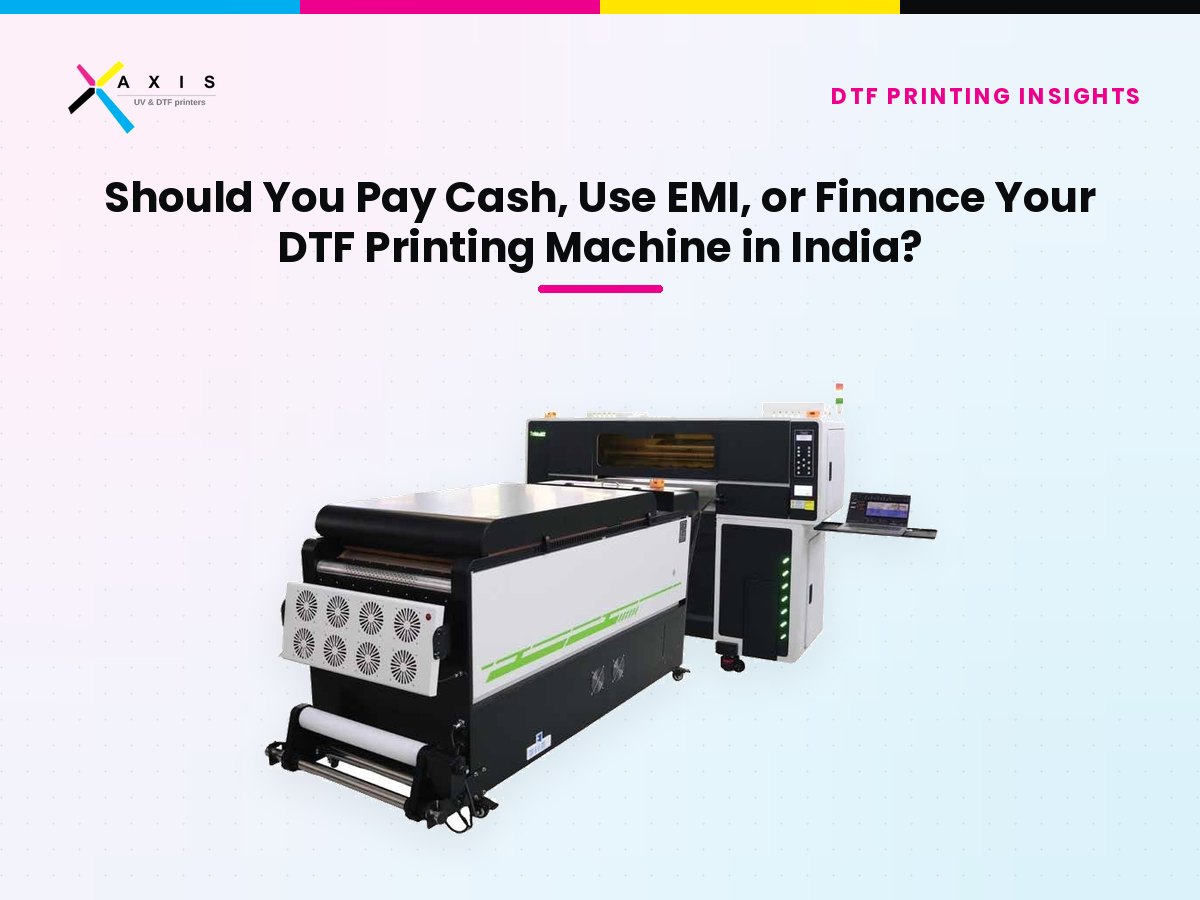
Equipment finance for a DTF printing machine is any arrangement, other than paying the full price in cash, that lets you take delivery of the machine now and spread its cost over time. In India this usually means a bank or NBFC machinery loan repaid as EMIs, or a lease where you pay to use the machine while the financier owns it.
What is the quick answer for a new DTF buyer?
There is no single right answer, only the right answer for your cash position and order book. Pay cash only if it still leaves you with three to six months of working capital after the purchase. If paying cash would drain your reserves, a machinery loan repaid through EMIs, or an equipment lease, is usually safer because it keeps cash free for film, ink, powder, garments, salaries and marketing. The deciding number is not the machine price. It is whether the monthly profit the machine earns comfortably covers the monthly repayment, with room to spare for slow months and repairs.
How big is the market you are actually buying into?
Demand for the printing this machine does is growing steadily, which is the real reason the financing decision is worth getting right. According to Grand View Research (2024), the global direct to film printing market was valued at USD 2,720.0 million in 2024 and is projected to reach USD 3,920.0 million by 2030, growing at a CAGR of 6.0 percent from 2025 to 2030.
The Indian slice is growing faster. According to IMARC Group (2025), India's custom T-shirt printing market reached USD 176.6 million in 2025 and is forecast to reach USD 407.9 million by 2034, a CAGR of 9.75 percent from 2026 to 2034.
In plain terms: the orders exist and keep rising. A financed machine that runs is an asset. A financed machine that sits idle is only a bill. Most of this article is about staying on the right side of that line. To understand the underlying business, it helps to know that print on demand lets you produce single pieces only after an order arrives, which is exactly what a DTF setup enables.
Why do most first-time DTF buyers get the payment decision wrong?
The most common mistake is treating the machine price as the whole cost and ignoring how you will fund the months before the business stabilises. The data on Indian small-business credit shows why this matters.
- According to Deloitte's State of Financial Services in India report (2025), India's MSME credit gap stood at around Rs 25 lakh crore as of March 2025, and only 14 percent of MSMEs have access to formal, institutional credit.
- Because formal credit is hard to reach, many owners fall back on costly borrowing. Machinery loan rates in India ran from roughly 7.50 percent to 30 percent per annum in 2025, according to lending marketplace moneyview (2025), with the higher end reserved for thin credit files and unsecured borrowing.
- The result is that a rushed cash purchase often empties the very reserve that would have kept the business alive through its first slow season.
Bad financing does not usually kill a DTF business on day one. It kills it in month four, when a clogged print head, a delayed order or a festival lull collides with a repayment that was set too high.
What is changing in how Indian small businesses fund equipment in 2026?
The good news is that formal, collateral-free options for machinery have widened, so more buyers can avoid expensive personal loans. In the Union Budget 2025, the government doubled the CGTMSE credit guarantee cover for micro and small enterprises from Rs 5 crore to Rs 10 crore, as summarised by ClearTax (2025), making it easier to raise a term loan for machinery without pledging property.
This shift matters because the alternative has long been the trap many owners fall into. As Dr Tamal Sarkar, Senior Advisor at the Foundation for MSME Cluster, told Outlook Business:
"Most of the time MSME entrepreneurs do get loans, but these are personal loans since they are not based in industrial areas. As personal loans are term loans, entrepreneurs end up paying a very high interest rate."
The practical lesson: a purpose-built machinery loan or a structured lease is almost always cheaper than dressing up a personal loan to buy equipment. A lease can also keep the asset off your balance sheet and preserve cash, while a GST-registered business can generally claim input tax credit on the GST paid on the machine, lowering the true cost either way.
How should a smart buyer decide between cash, EMI, and equipment finance?
Decide by matching the funding method to your cash reserve and the machine's expected monthly profit, not by chasing the lowest sticker price. Three criteria settle most decisions.
- Working-capital survival: after the purchase, can you still cover three to six months of consumables, rent, salaries and personal expenses? If not, do not pay cash.
- Repayment-to-margin cushion: your realistic monthly contribution margin should cover any EMI at least two to three times over, so a slow month never threatens the repayment.
- Total cost of borrowing: compare the full interest and fees over the tenure, not just the monthly figure. A longer tenure lowers the EMI but raises what you finally pay.
The table below compares the three routes for a typical first machine. An equated monthly installment (EMI) is simply a fixed monthly repayment covering principal and interest.
| :-: | :-: | :-: | :-: |
|---|---|---|---|
| Factor | Pay cash | Machinery loan / EMI | Lease |
| Upfront outflow | Full price at once | Down payment plus first EMI | Small deposit or advance rentals |
| Effect on working capital | Reduces reserves sharply | Preserves most cash | Preserves the most cash |
| Total cost over time | Lowest (no interest) | Price plus interest (roughly 7.5 to 30 percent p.a.) | Rentals, often higher than loan interest |
| Ownership | Yours immediately | Yours, financier holds security until repaid | Financier owns; you use it |
| Best for | Strong reserves, proven demand | Steady orders, limited cash | Preserving cash, uncertain long-term need |
What should you look for before you sign any DTF payment plan?
Look past the finance paperwork at the machine and the seller behind it, because the repayment is only affordable if the machine keeps earning. Use this checklist before committing to any cash, EMI or lease decision.
- Choose a supplier whose machine build and print-head quality are dependable, since every day of downtime still leaves the EMI due.
- Confirm that practical operator training is included, because an untrained operator wastes film and ink and pushes real cost per print far above your plan.
- Insist on transparent job costing help, so you know your true contribution margin before you fix an EMI you must pay every month.
- Verify that local after-sales service and genuine spare parts are available fast, as a week-long breakdown can wreck a financed machine's repayment schedule.
- Ask for a timed live demonstration on your own fabrics, so the output you are financing is real, not an advertised maximum speed.
- Match tenure to reality: pick a repayment period your slowest realistic month can still absorb.
Notice that most of these have nothing to do with the lender. Whether cash or EMI is the safer choice depends far more on machine uptime, operator skill and honest costing than on the interest rate alone. The same principles apply to your heat press and curing setup, where reliability protects the margins that fund every repayment.
Where does Axis Enterprises fit in this decision?
This is exactly the problem Axis Enterprises is built to solve. Axis Enterprises supplies dependable DTF printing machines, heat presses and consumables to Indian garment printers, and pairs every machine with installation, practical operator training and responsive local support, so the machine you finance actually earns the way your plan assumes.
Because the biggest risk to any financed machine is downtime and weak costing, our focus on reliable machinery, hands-on training and transparent job costing is designed to keep your repayment comfortably covered by real production. When you can trust the uptime and know your cost per print, the choice between cash and EMI becomes a calm calculation rather than a gamble.
If you are weighing how to pay for your first or next machine, the most useful next step is to see the machine run on your own fabrics before you decide anything about financing. You can book a free live DTF machine demonstration with our team, bring a sample garment, and watch the real output, real speed and real cost per print for yourself. Come with your questions about training, spare parts and after-sales support, and let the numbers, not the sales talk, guide your decision. Start by visiting axisdtf.com to arrange your demonstration.
Frequently asked questions
Is it better to buy a DTF machine on EMI or pay cash?
Pay cash only if it still leaves you three to six months of working capital afterward. If it would drain your reserves, an EMI or lease is usually safer because it keeps cash free for consumables, salaries and slow months. The test is whether monthly profit covers the repayment several times over.
What interest rate should I expect on a machinery loan in India?
Machinery loan rates in India ranged from roughly 7.50 percent to 30 percent per annum in 2025, according to moneyview. Secured borrowers with strong credit sit near the lower end, while thin credit files and unsecured personal loans sit near the top. Always compare the total cost over the full tenure, not just the monthly EMI.
Can I get a DTF machine loan without collateral?
Often yes. Under the CGTMSE scheme, whose cover for micro and small enterprises was doubled to Rs 10 crore in Union Budget 2025, eligible businesses can raise collateral-free term loans for machinery. Eligibility, guarantee fees and lender approval still apply, so confirm the specifics with your bank.
Does a longer EMI tenure save me money?
No. A longer tenure lowers the monthly EMI but raises the total interest you finally pay. Choose the shortest tenure your slowest realistic month can still absorb, so you clear the debt sooner without risking a missed payment during a lull.
Can I claim GST benefits when I finance a DTF machine?
A GST-registered business can generally claim input tax credit on the GST paid on the machine, which lowers the effective cost whether you pay cash or finance it. The credit applies to the machine, not to loan interest. Confirm your eligibility and documentation with a tax professional.
Sources
- Grand View Research: Direct To Film Printing Market Size Report (2024)
- IMARC Group: India Custom T-Shirt Printing Market (2025)
- Deloitte, State of Financial Services in India report, via Whalesbook (2025)
- moneyview: Machinery Loan Rates and Tenure in India (2025)
- ClearTax: MSME Credit Guarantee Scheme and Budget 2025 Update (2025)
- Outlook Business: SIDBI, the MSME credit gap and digital lending (interview with Dr Tamal Sarkar)
Founder, Axis Enterprises. Selling and servicing digital printing machines across India since 2011. Author of "Increase Your Profit by 270% with UV Printing Technology". More about the author