Ten Startup Mistakes That Delay DTF Printing Profitability in the First 12 Months
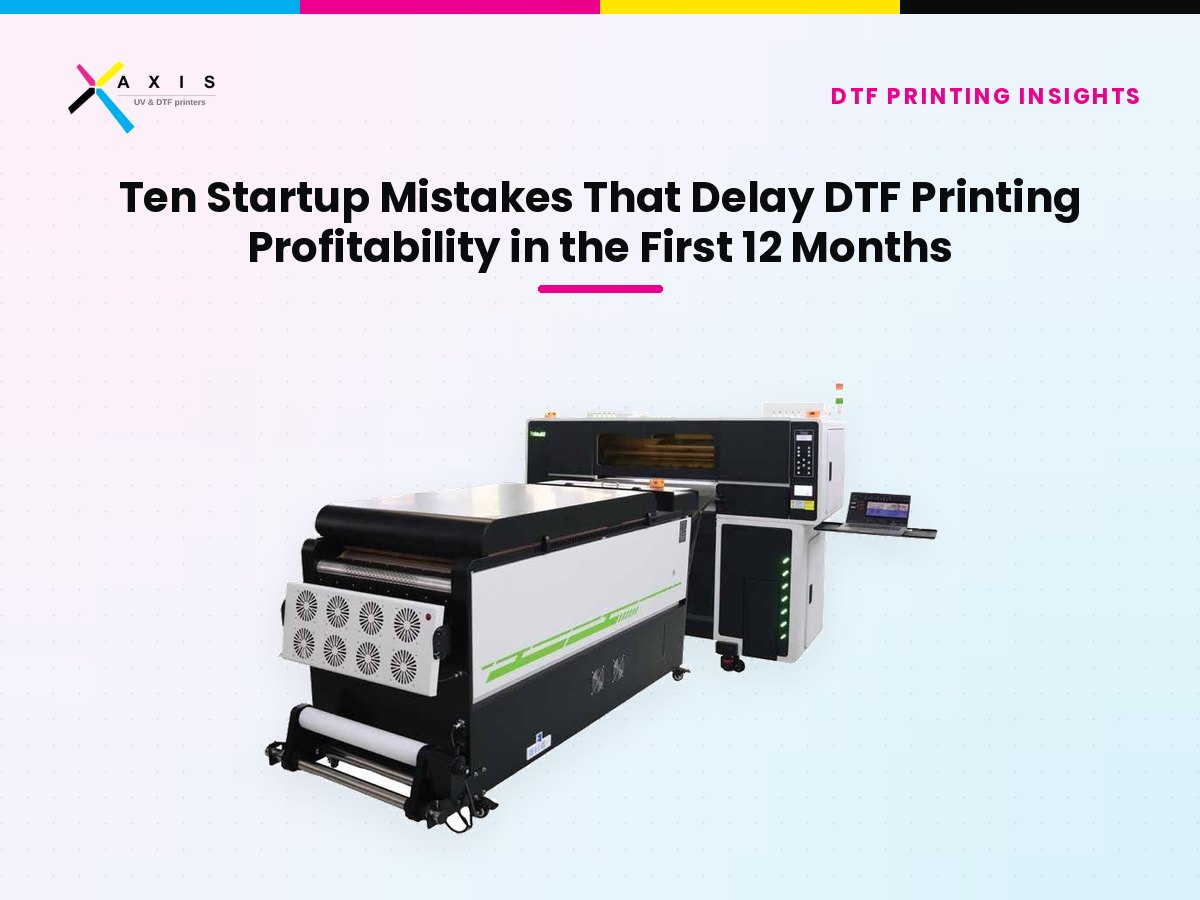
Here is a number most first-time printers never see coming: the India direct-to-film printing market is growing faster than the machines are being paid off. According to Grand View Research (2025), the India DTF market reached about US$243.9 million in 2025 and is projected to hit US$380.3 million by 2030 at a 9.3% annual growth rate, while the global DTF market sits near US$2.93 billion. Yet a large share of new DTF businesses still spend their first year barely breaking even.
Quick answer: Most new DTF printing businesses in India do not stay unprofitable because of weak demand. They stay unprofitable because of avoidable startup mistakes: buying the cheapest machine, launching with no anchor customers, underpricing jobs, skipping operator training, ignoring maintenance, and running out of working capital. Fix these before you print your first order and profitability usually arrives far sooner. This article walks through the ten most common mistakes, the data behind why they matter, and the criteria a smart buyer should use to avoid every one of them.
Why do so many new DTF printing businesses stay unprofitable in year one?
The main reason is money management, not market size. SCORE (2025) reports that roughly 82% of small businesses that fail do so because of cash-flow problems, not lack of sales.
The Indian small-business backdrop makes this sharper. Government data reported by Deccan Herald (March 2025) shows more than 75,000 MSMEs shut down over five years, with closures in 2024-25 nearly doubling the 19,828 recorded the year before.
A DTF setup is a real capital purchase. If it drains your cash before customers arrive, the machine sits idle and the loan does not. That is the trap the mistakes below quietly build.
What is DTF printing, and why is India suddenly full of new entrants?
Direct-to-film printing is a textile printing method where a design is printed onto a special film, coated with adhesive powder, cured, and then transferred onto fabric using a heat press. It works on cotton, polyester, blends, and dark garments without the setup cost of screens.
That low barrier is exactly why entrants are flooding in. Andy Gregory, Sales Director at Hybrid Services, noted in the State of the DTF Market Report 2025 published by Images magazine: "What's been notable is the breadth of businesses taking it on." More players means the easy, unplanned money is disappearing first.
The demand side keeps expanding too. IMARC Group (2025) values the India custom T-shirt printing market at US$176.6 million in 2025, rising to US$407.9 million by 2034 at a 9.75% growth rate. The opportunity is real, but so is the competition.
What is really changing in the DTF market right now?
The market is maturing, which means preparation now beats speed of entry. In the same State of the DTF Market Report 2025, Andy Hancock of Indie Ink observed: "Whilst the market is starting to mature, we still feel there are a few more years of growth to come."
Maturity changes the rules. Early on, almost any printer could win work simply by existing. Now customers compare quality, turnaround, and price, and the businesses that planned their costs and capacity are the ones keeping margins healthy.
This is why cash flow discipline and job costing matter more in 2026 than they did three years ago. The window for careless entry is closing.
Which ten mistakes most delay DTF printing profitability?
The ten mistakes below account for most of the lost first-year profit. Each one is avoidable before you buy.
- 1. Buying the cheapest machine to "test the waters." A low sticker price often hides high running costs: frequent print-head failures, downtime, and wasted film and ink. The lifetime cost, not the purchase price, decides profitability.
- 2. Launching with no anchor customers. Buying first and finding buyers later leaves an expensive machine idle. Secure two or three recurring customer categories, such as uniform dealers, local brands, or event agencies, before purchase.
- 3. Underpricing every job. Printers quote on garment cost alone and forget ink, film, powder, labour, electricity, wastage, maintenance reserve, and GST. Price on true cost per print, not gut feel.
- 4. Skipping structured operator training. When only one person knows the machine, a single sick day stops production. Trained operators protect both output and print quality.
- 5. Ignoring a maintenance routine. White ink settles and clogs quickly. Without daily circulation and nozzle checks, blockages and print-head damage turn into your biggest surprise repair bill.
- 6. Underestimating working capital. Spending nearly all your funds on the machine leaves nothing for consumables, samples, and the slow first months. Reserve several months of running cash.
- 7. Buying from a supplier with no local service. If spare parts and technicians are far away, every fault becomes days of lost revenue. After-sales access is part of the machine's real value.
- 8. Chasing too many products at once. Spreading across T-shirts, bags, caps, and signage before mastering one repeatable offer scatters focus and slows quality gains.
- 9. Running with no costing or bookkeeping system. Without job-level records, you cannot see which orders make money. Guesswork pricing quietly erodes margins.
- 10. Scaling before standardizing. Adding a second machine before documenting procedures multiplies weak maintenance and inconsistent colour instead of multiplying profit.
How should a smart DTF buyer think about avoiding these mistakes?
Reframe the decision: you are not buying a printer, you are buying dependable output and a business partner. That single shift prevents most of the ten mistakes.
Judged that way, a smart buyer looks for four things:
- Dependable machinery with proven uptime, so the loan is serviced by production, not by fresh capital.
- Practical operator training that removes dependence on a single technician.
- Transparent job costing guidance so every quote protects a real margin.
- Responsive local after-sales service and spare parts so a fault costs hours, not weeks.
What should you look for in a DTF machine supplier before you buy?
Look for a supplier who behaves like a long-term partner, not a one-time seller. The checklist below separates the two.
- Look for a supplier who runs a live, timed demonstration on your own artwork, not a canned sample.
- Look for one who provides structured operator training, not a rushed handover on delivery day.
- Look for transparent cost-per-print and pricing guidance you can build quotes on.
- Look for a committed local service response with genuinely stocked spare parts.
- Look for installation and setup support suited to Indian power, dust, and humidity conditions.
- Look for a partner who helps you plan capacity and working capital, not just close a sale.
| :-: | :-: | :-: |
|---|---|---|
| Startup decision | Common shortcut (delays profit) | Profit-protecting choice |
| Machine selection | Cheapest available unit | Dependable machine with lowest lifetime cost |
| Customers | Find buyers after buying | Line up anchor customers first |
| Pricing | Quote on garment cost only | Quote on true cost per print plus GST |
| People | One person knows the machine | Multiple trained operators |
| Support | No local service or spares | Committed local service and stocked parts |
Where does a dependable DTF partner fit in?
Everything above points to one need: a supplier that treats your profitability as the goal. That is exactly the role Axis Enterprises plays for garment printers across India, pairing DTF printing machines and heat presses with installation, operator training, consumables, and responsive after-sales support. It is the difference between owning a machine and running a profitable printing business.
Because the machine is only as good as the support behind it, Axis Enterprises focuses on dependable equipment backed by local service and genuine spare parts, so a fault never turns into weeks of lost orders.
What is the simplest next step to avoid these mistakes?
The lowest-risk way to test everything in this article is to see a machine run on your own artwork before you commit a rupee. You can book a free live DTF machine demonstration and watch real print quality, speed, and finishing in person. Bring a design you actually sell, ask about training and spare-part availability, and use the visit to pressure-test the buying criteria above. It is the most useful hour you can spend before starting a print on demand or custom apparel business.
Frequently asked questions
How long does a DTF printing business usually take to become profitable?
It depends on how many of the ten mistakes you avoid. Printers who line up anchor customers, cost their jobs correctly, and keep the machine running with proper maintenance typically reach steady profit far quicker than those who buy first and plan later. The main delay is almost always cash flow, not demand.
What is the single biggest reason new DTF printers lose money?
Cash flow. SCORE reports that about 82% of failing small businesses fail on cash-flow problems, and DTF is no exception. Spending nearly all your capital on the machine, then underpricing jobs, is the fastest route to a stalled business.
Do I really need operator training if the machine is easy to use?
Yes. Ease of use and profitable, consistent production are different things. Structured training reduces wastage, protects the print head, and removes the risk of production stopping when one person is unavailable.
How important is local after-sales service and spare parts?
Very important. A DTF machine that is down is losing money every day. A supplier with committed local service and stocked spare parts turns a serious fault into a few hours of downtime instead of weeks.
Is DTF still worth entering in 2026 with so much competition?
The data says yes, but preparation matters more now. Grand View Research projects the India DTF market rising to US$380.3 million by 2030, and IMARC Group projects the custom T-shirt market growing to US$407.9 million by 2034. The growth is real; the careless entry window is closing.
Sources
- Grand View Research, India Direct-to-Film Printing Market Size and Outlook (2025)
- IMARC Group, India Custom T-Shirt Printing Market (2025)
- Deccan Herald, More Than 75,000 MSMEs Shut Shop in Past Five Years (March 2025)
- SCORE, The Number One Reason Small Businesses Fail (2025)
- Images magazine, State of the DTF Market Report 2025
Founder, Axis Enterprises. Selling and servicing digital printing machines across India since 2011. Author of "Increase Your Profit by 270% with UV Printing Technology". More about the author