Two-Head or Four-Head DTF Machine: How to Choose the Right Setup Without Overpaying in 2026
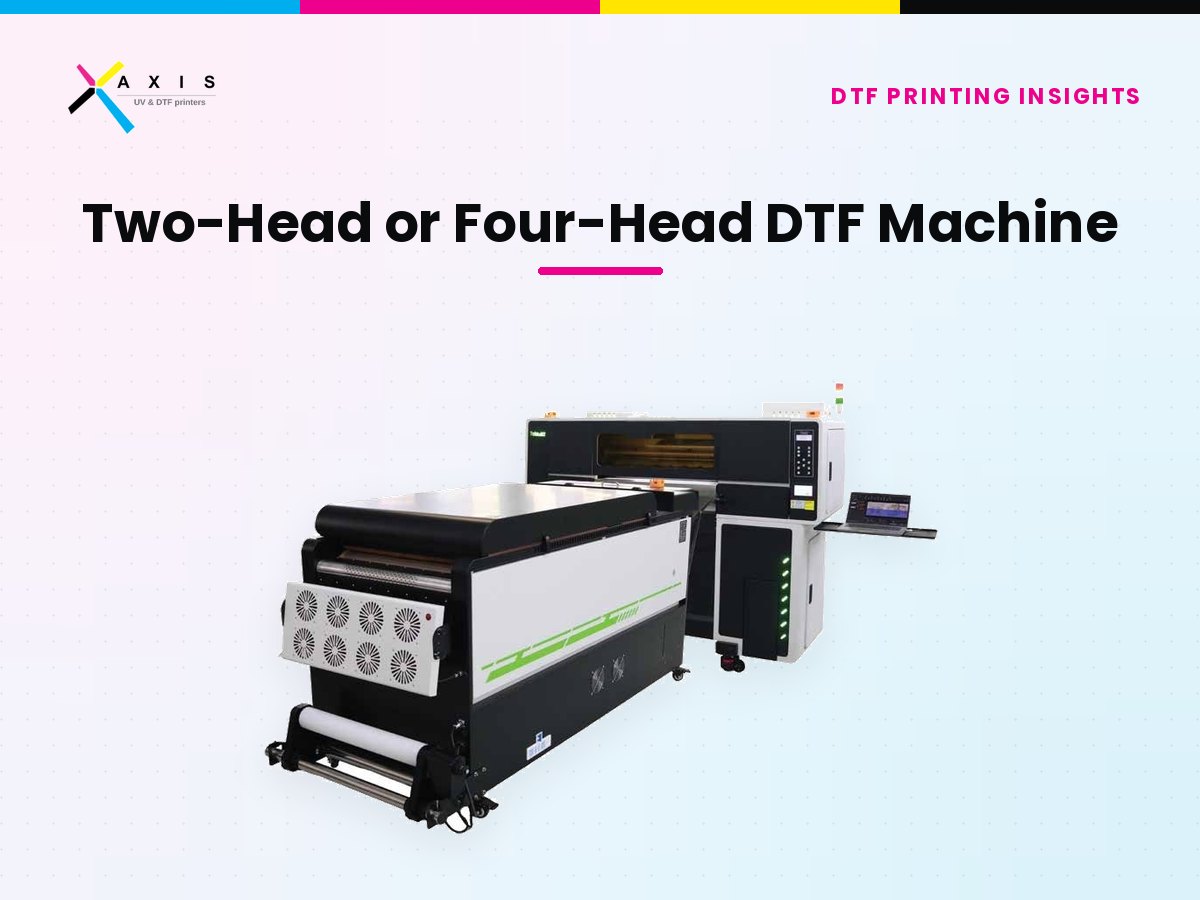
Quick answer: A two-head DTF machine suits shops printing up to roughly 150 to 300 finished A3 transfers a day, where budget and simplicity matter most. A four-head machine suits shops that consistently run high daily volume and need faster throughput and denser white and colour layers, at a higher purchase and running cost. The right choice is decided by your normal daily order volume at 60 to 70 percent utilisation, not by a seller's maximum-speed claim. Match head count to sustained demand, verify real sellable output in a live demonstration, and confirm local service and spare parts before you pay.
Direct-to-film (DTF) printing is a method that prints a design onto a coated film, coats it with adhesive powder, cures it, and heat-presses it onto fabric. A print head is the component that fires ink through microscopic nozzles onto the film, so the number of heads largely sets how fast and how densely a machine can print.
Why is DTF suddenly everywhere in India's printing market in 2026?
DTF has moved from a niche transfer trick to a mainstream apparel decoration technology in under five years, and the market data explains the rush. According to Grand View Research (2025), the global direct-to-film printing market was valued at USD 2,720.0 million in 2024 and is projected to reach USD 3,920.0 million by 2030, growing at a 6.0 percent CAGR.
The demand pulling DTF forward is even larger. Grand View Research (2026) values the global print on demand market at USD 10.8 billion in 2025, forecast to hit USD 57.5 billion by 2033 at a 23.6 percent CAGR, with Asia Pacific growing fastest at 24.8 percent.
India sits inside that fast-growing region. The Indian textile and apparel industry reached nearly USD 190 billion in 2025-26 and is projected to reach USD 350 billion by 2030, according to IBEF (2026). That order flow is what makes the head-count decision matter.
What does choosing the wrong DTF head configuration actually cost you?
Picking the wrong head count is one of the most expensive mistakes a new printer can make, because it is fixed on the day you buy. An undersized machine bottlenecks the moment orders spike, while an oversized machine ties up capital and burns more ink and maintenance than your volume can justify.
The pressure is rising because demand is shifting to small, fast, digital jobs. The global custom t-shirt printing market grew from USD 6.84 billion in 2025 toward a forecast USD 13.19 billion by 2031, and digital printing is expanding at a 12.28 percent CAGR, outpacing screen printing, according to Mordor Intelligence (2026).
The same research reports that direct-to-consumer and on-demand channels held a 61.40 percent revenue share in 2025. In practice, that means more short runs, more variety, and more pressure on the machine you buy today to still fit your workload in two years.
Why do two-head and four-head DTF machines exist in the first place?
They exist to serve different production volumes, not to make one universally better than the other. More print heads mean more nozzles firing at once, so a four-head unit can lay down colour and white ink faster and denser, while a two-head unit keeps ink channels, cost and maintenance surface smaller.
This mirrors an old tradeoff in the wider decoration market. As Mike Dolph of the ROQ US Service Team observed at the PRINTING United Expo 2025, covered by ASI Central (2025):
"For high quantities and high volume, screen is always going to be king."
DTF competes below that ceiling, where variety and short runs win. In the same ASI Central report, Cassie Green, Content Director at Apparelist, called DTF a defining technology for the current market:
"It's such a defining tech in today's apparel decoration market."
The practical point is that head count buys throughput, and throughput only pays if you have the sustained order volume to feed it. A heat press, powder curing and finishing all sit downstream, so raw print speed rarely equals finished output.
How should a smart buyer compare a two-head and four-head DTF setup?
Compare them on sustained sellable output and total running cost, not on the maximum print speed printed in a brochure. A machine that prints fast but clogs, wastes film or sits idle is more expensive per finished transfer than a slower machine you keep running.
Five criteria separate a smart purchase from a costly one:
- Sustained daily output at 60 to 70 percent utilisation, measured from your real order pattern, not a peak-speed demo.
- Total cost per sellable print, including ink, film, powder, cleaning, wastage and downtime.
- White-ink stability, because more heads add capacity but also more channels to keep circulating and clog-free.
- Upgrade path, so growth does not force you to replace the whole setup early.
- Local service and spare-part availability, since a stalled machine earns nothing while you wait for parts.
The table below maps how the two configurations typically compare on the factors that decide profit.
| :-: | :-: | :-: |
|---|---|---|
| Factor | Two-Head DTF Machine | Four-Head DTF Machine |
| Best-fit daily volume | Roughly 150 to 300 A3 transfers | Sustained high volume above that band |
| Upfront investment | Lower | Higher |
| Print speed and ink density | Good for most short runs | Faster, denser colour and white |
| Ink and maintenance load | Fewer channels, simpler upkeep | More channels, more daily maintenance |
| White-ink clog risk if idle | Lower surface to manage | Higher, needs disciplined routine |
| Ideal buyer | Startups and steady small shops | Scaling shops with proven demand |
What should you look for in a DTF machine supplier before you decide on head count?
Look for a supplier who helps you size the machine to your real demand rather than upselling head count you cannot feed. The right partner treats the purchase as a production decision, not a spec-sheet contest.
- Look for a supplier who runs a timed live demonstration from artwork to finished transfer, so you see actual sellable output on both configurations.
- Look for a supplier who explains total cost per print in plain numbers, including ink, film, powder and GST, before you commit.
- Look for a supplier who offers hands-on operator training, so white-ink and curing routines are followed from day one.
- Look for a supplier who stocks genuine spare parts and consumables locally and commits to a service response time.
- Look for a supplier who offers a practical upgrade path, so a two-head start does not become a dead end.
Where does Axis Enterprises fit into this decision?
Axis Enterprises exists to answer exactly the questions above. As a specialist in DTF printing machines and heat presses for Indian garment businesses, the company helps you match head count to your real order volume, then backs the machine with installation, operator training, genuine consumables and responsive local after-sales support. You can compare a two-head and four-head DTF setup side by side and see finished output before you decide.
If you are weighing this choice in 2026, the lowest-risk next step is to watch both configurations run your kind of job. Book a free live DTF machine demonstration and bring a sample design, so the sizing decision is made on your real output and costing rather than a brochure. You can also ask about training and after-sales spare-part support during the same visit.
Frequently asked questions
Is a four-head DTF machine always faster than a two-head?
In raw print speed, usually yes, but finished output depends on powdering, curing and finishing too. A two-head machine kept running steadily can beat a four-head machine that stalls or sits idle. Match head count to your sustained daily volume.
How many print heads do I need for a small T-shirt business?
Most small and startup shops printing up to roughly 150 to 300 A3 transfers a day are well served by a two-head machine. It keeps upfront cost and maintenance lower while you build steady demand. Move to four heads once your order volume consistently exceeds that band.
Do four-head DTF machines cost more to maintain?
Yes, because more heads mean more ink channels and nozzles to keep clean and circulating. That raises daily maintenance time and white-ink management discipline. The extra cost is worth it only when high volume keeps the heads busy.
Can I start with a two-head machine and upgrade later?
Often yes, if you buy from a supplier who offers a clear upgrade path. Confirm before purchase whether extra heads, higher production modes or shaker capacity can be added. Growth should not force a full replacement.
Which setup gives better white-ink coverage?
A four-head machine can lay down denser white and colour in a single pass, which helps on dark and heavy fabrics at volume. A two-head machine still produces excellent white coverage for most jobs. The gap matters most at high daily output.
Sources
- Grand View Research, Direct To Film Printing Market Report (2025)
- Grand View Research, Print On Demand Market Report (2026)
- India Brand Equity Foundation (IBEF), Textiles Industry in India (2026)
- Mordor Intelligence, Custom T-Shirt Printing Market (2026)
- ASI Central, PRINTING United Expo 2025: Decoration Trends and Equipment Upgrades (2025)
Founder, Axis Enterprises. Selling and servicing digital printing machines across India since 2011. Author of "Increase Your Profit by 270% with UV Printing Technology". More about the author