Where Your Next 100 Orders Come From: How DTF Printing Businesses in India Win Steady Customers in 2026
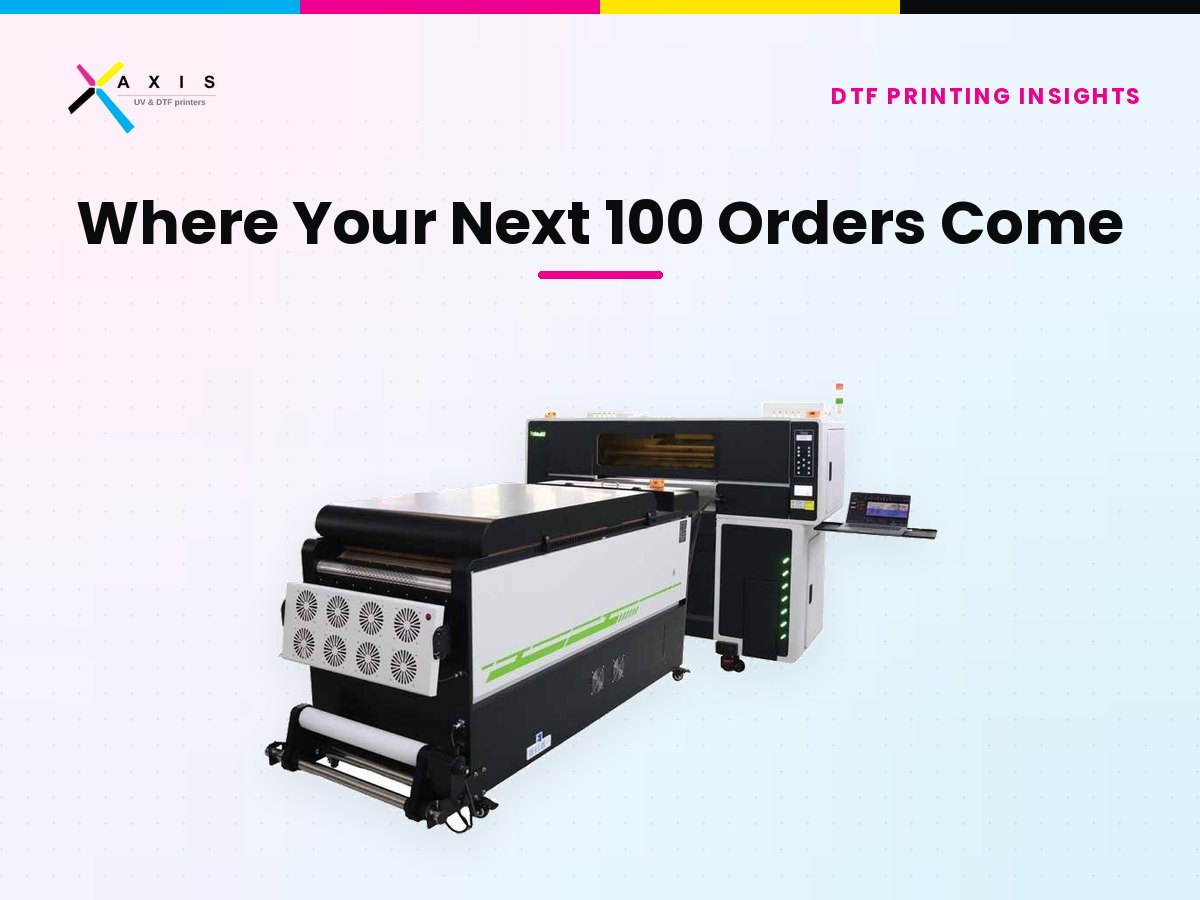
How does a DTF printing business in India build a steady stream of orders?
A DTF printing business in India builds a steady stream of orders by combining four channels instead of relying on one: local walk-in and shop-front demand, online and social selling, reseller and wholesale tie-ups, and repeat corporate or bulk contracts. The fastest results come from being easy to find in local search, showing real print samples, quoting each job transparently with GST built in, and delivering consistent quality so first orders turn into repeat orders. Because winning a new buyer costs far more than keeping one, the printers who grow treat every job as the start of a relationship, not a one-off sale. Match your capacity to demand and orders compound month on month.
Why is demand for custom printing rising faster than most printers realise?
Demand is rising because personalised apparel and made-to-order printing are moving from a niche into everyday buying, and the numbers are steep. According to Grand View Research (2026), India's print on demand market was valued at about USD 857.9 million in 2025 and is forecast to reach roughly USD 5,419.0 million by 2033, a compound annual growth rate of 26.2 percent.
The apparel slice is growing fast too. IMARC Group (2026) values India's custom T-shirt printing market at USD 176.6 million in 2025, projected to reach USD 407.9 million by 2034 at a 9.75 percent CAGR.
Print on demand means goods are produced only after an order arrives, so a single machine can serve schools, weddings, corporate gifting and online resellers at once. The opportunity is real. The question is whether your order book reflects it.
Why do so many DTF machines sit idle after purchase?
Many machines sit idle because owners plan the purchase carefully but never plan the pipeline of customers to feed it. Buying the printer is a one-day decision; filling it with orders is a daily discipline, and that gap is where margins quietly disappear.
The economics punish a thin order book. Research compiled by Invesp (2024), citing Harvard Business Review, finds that acquiring a new customer can cost five to twenty-five times more than keeping an existing one, so a shop that chases only fresh buyers and never earns repeats runs on the most expensive fuel there is.
Meanwhile the market itself is competitive. Grand View Research (2026) puts the global direct-to-film printing market at USD 2,720.0 million in 2024, rising to USD 3,920.0 million by 2030, which means more printers, more price pressure, and less room for a machine that only runs a few hours a day.
What is actually changing in how customers buy custom apparel?
What is changing is where buyers look first and what they expect when they find you: they search locally, they compare instantly, and they assume the work will be tailored to them. Printers who understand this shift capture orders that used to walk past the shop.
Customer acquisition is the process of finding buyers, converting them into paying customers, and keeping them long enough to order again. Today most of that process starts on a phone. Backlinko's 2024 local SEO research reports that 76 percent of people who run a "near me" search visit a business within a day, that 46 percent of all Google searches carry local intent, and that 75 percent of consumers regularly read online reviews before choosing a local business.
Expectations have also shifted toward personalisation. The McKinsey Next in Personalization report (2021) found that 71 percent of consumers expect companies to deliver personalised interactions and 76 percent get frustrated when this does not happen. Custom DTF printing sits exactly where that demand lands.
Industry voices frame this as new territory rather than a saturated one. At the 2026 Print on Demand Conference, Rob Watson, CEO of Vantage Apparel, told ASI Central (2026):
"Print on demand is not replacing revenue, but it's net new revenue opportunities."
Lisa Hubbard, VP of Sales and Marketing at The Vernon Company, added at the same event: "If you do it right, then the opportunities are limitless." The demand exists; disciplined execution is what converts it into a steady order book.
How should a smart printer think about building an order pipeline?
A smart printer stops thinking about "finding one more order" and starts building a system that produces orders repeatedly and predictably. That reframe changes what you value in your equipment, your process, and your supplier.
Use these criteria to judge whether your setup can actually sustain a pipeline:
- Consistent output quality: repeat orders and referrals only happen when every print matches the last one, so dependable machinery is a sales asset, not just a production tool.
- Uptime you can promise on: a missed deadline loses a customer permanently, so machine reliability and fast service directly protect your order book.
- Trained operators: a business that depends on one person cannot scale orders; structured operator skills let you accept more work without quality slipping.
- Transparent job costing: knowing your true cost per print, including ink, film, powder, labour, electricity and GST, lets you quote fast and win price-sensitive buyers without eroding margin.
- Room to grow: your first machine should handle a rising order volume, not become the bottleneck the moment demand climbs.
What should you look for in the equipment and supplier behind your pipeline?
Look for a supplier who helps you sell, not just one who sells you a box. The right partner shortens your path to a full order book; the wrong one leaves you troubleshooting alone while deadlines slip.
- Look for a supplier who demonstrates real print quality on live jobs before you buy, so you can show prospects samples you trust.
- Look for a supplier who trains your operators properly, so staff can run, maintain and troubleshoot the machine without constant dependence on the owner.
- Look for a supplier who offers responsive after-sales service and readily available spare parts, so downtime never costs you a customer.
- Look for a supplier who explains true running costs openly, so you can price jobs with confidence and defend your margin.
- Look for a supplier who supports several applications, from T-shirts to bags, caps and corporate merchandise, so you can serve more customer segments from one machine.
The channels themselves reward different strengths. Use this comparison to decide where to focus first:
| :-: | :-: | :-: | :-: | :-: |
|---|---|---|---|---|
| Order channel | How it works | Setup effort | Best for | Time to first orders |
| Local walk-in and shop-front | Local search, signage, samples on display | Low | Small custom runs, urgent jobs, weddings | Days to weeks |
| Online and social selling | Instagram, WhatsApp catalogue, marketplace listings | Medium | Print on demand, single pieces, niche designs | Weeks |
| Reseller and wholesale | Supplying other shops and boutiques at trade rates | Medium | Steady volume, predictable repeat work | Weeks to months |
| Corporate and bulk contracts | Uniforms, events, school and company merchandise | High | Large recurring orders and higher ticket sizes | Months |
Notice that every channel depends on the same foundation: consistent quality, reliable uptime and honest pricing. Fix those, and the channels feed each other.
Where does Axis Enterprises fit into all of this?
Everything above points to one need: dependable machinery, practical training, transparent costing and responsive local support that together turn a printer into a business with a steady order book. That is exactly what Axis Enterprises is built to provide. We supply DTF printing machines, heat presses and genuine inks, film and powder, along with installation, operator training, maintenance and after-sales service for garment-printing businesses across India.
Rather than selling a machine and disappearing, we help you set up, run and grow, so your equipment stays productive and your customers keep coming back. You can explore the full range of DTF machines and consumables and see how the pieces fit your plans.
What is the easiest next step?
The lowest-risk way to judge any DTF setup is to see it print your own designs before you spend a rupee. Book a free live DTF machine demonstration and watch real output on real fabric, ask about true cost per print, and get straight answers on training and service. When you are ready, book a free live DTF machine demonstration with our team, or reach out to talk to a DTF printing specialist about the pipeline you want to build. It is a short conversation that can shape a far steadier order book.
Frequently asked questions
How long does it take a new DTF printing business to get steady orders?
Most new shops see their first local and online orders within a few weeks, while reseller and corporate contracts usually build over a few months. The pace depends on how visible you are in local search, how strong your samples are, and how reliably you deliver early jobs. Consistent quality on the first orders is what turns them into repeat business.
Which is the best channel to find DTF printing customers in India?
There is no single best channel; the steadiest businesses combine local walk-in demand, online and social selling, reseller tie-ups and corporate contracts. Local search and WhatsApp catalogues tend to bring the quickest first orders, while wholesale and corporate work provide predictable repeat volume. Starting with one channel and adding others as capacity grows is the practical route.
Do I need to spend heavily on advertising to get orders?
No. Being easy to find in local search, displaying real print samples and collecting genuine reviews often drives more orders than paid advertising for a small printer. Backlinko's 2024 research shows most "near me" searchers act within a day, so a well-managed local presence captures ready buyers at little cost. Paid ads can add reach later, once your quality and pricing are proven.
How do I keep DTF customers coming back?
Repeat business comes from consistent print quality, on-time delivery and fair, transparent pricing. Since keeping a customer costs far less than winning a new one, small steps like follow-ups, reorder reminders and dependable turnaround pay back quickly. Reliable machinery and trained operators make that consistency possible.
What role does the machine and supplier play in getting customers?
A dependable machine and a responsive supplier protect the two things customers judge you on: quality and deadlines. Downtime or inconsistent prints cost you buyers directly, while fast service and good training keep production steady. Choosing equipment with strong after-sales support is therefore part of your customer-acquisition strategy, not separate from it.
Can one DTF machine serve different customer segments?
Yes. A single DTF setup can print on T-shirts, hoodies, bags, caps and many other items, letting you serve retail customers, resellers and corporate buyers from the same equipment. This flexibility, unlike some fixed methods of textile printing, is what makes it easier to keep the machine busy across seasons. Pairing it with a good heat press widens the range of products further.
Sources
- Grand View Research: India Print On Demand Market Size and Outlook, 2026 to 2033
- IMARC Group: India Custom T-Shirt Printing Market, 2026 to 2034
- Grand View Research: Direct-to-Film Printing Market Report, 2025 to 2030
- McKinsey and Company: The value of getting personalization right or wrong is multiplying (Next in Personalization, 2021)
- Backlinko: Local SEO Statistics, 2024
- Invesp: Customer Acquisition vs Retention Costs (citing Harvard Business Review)
- ASI Central: Print on Demand Conference 2026, The Opportunities Are Limitless
Founder, Axis Enterprises. Selling and servicing digital printing machines across India since 2011. Author of "Increase Your Profit by 270% with UV Printing Technology". More about the author