The Wholesale DTF Transfer Opportunity Most Indian Printers Will Overlook in 2026
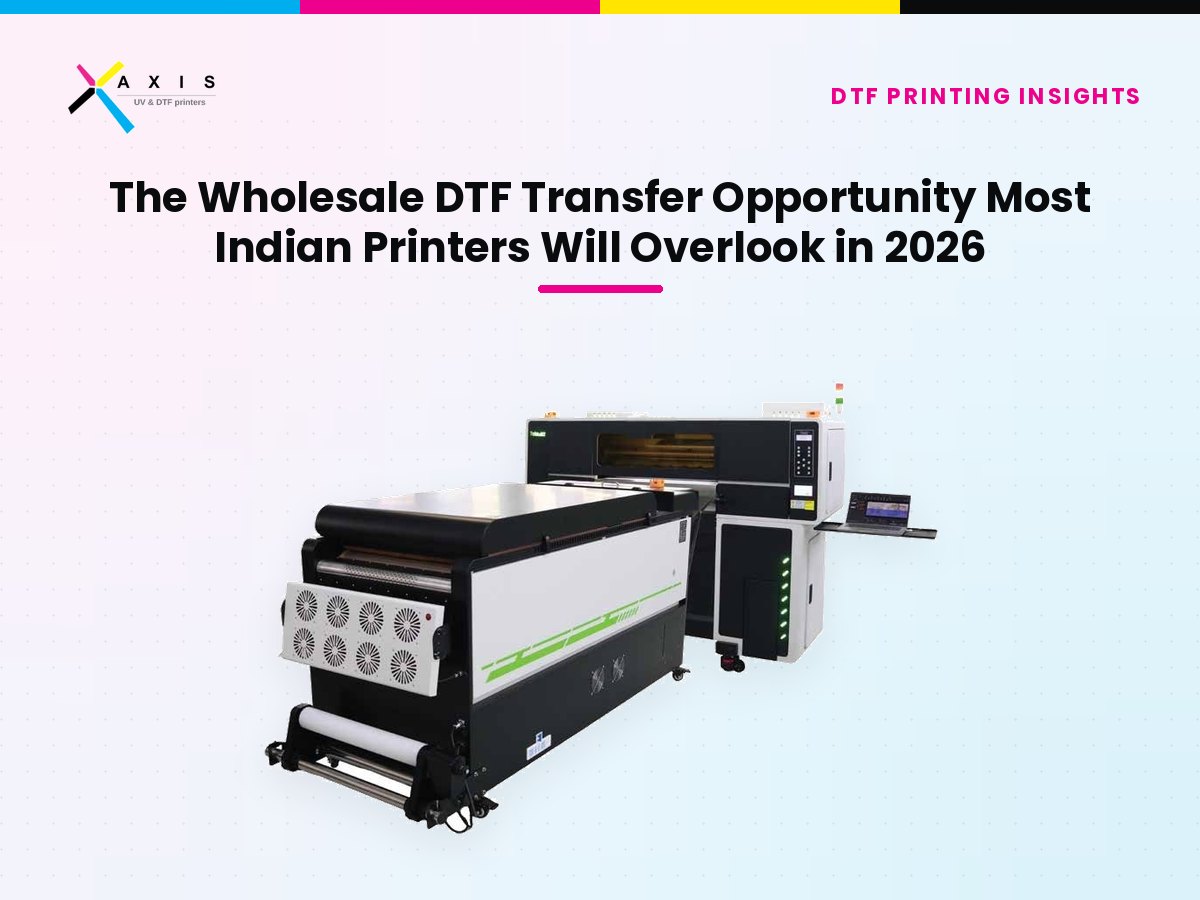
Here is a number that surprises most print-shop owners. The global print-on-demand market is projected to reach USD 57.49 billion by 2033, growing at 23.6% a year, and apparel already holds the largest single share of it at 39.5% in 2025, according to Grand View Research (2026). Almost none of that volume is printed in bulk. It is printed one, five or twenty pieces at a time.
That shift toward small, personalised runs has created a quiet business most printers walk straight past: supplying finished, ready-to-press transfers to other companies that have the demand but not the machine.
Quick answer: can Indian printers earn money selling DTF transfers wholesale?
Yes. Selling ready-to-press DTF transfers wholesale means printing finished, powder-coated, cured designs that another business simply heat-presses onto its own garments. It turns a printer's idle machine hours into a second income stream that does not depend on winning retail orders. Indian printers can supply resellers, boutiques, event organisers, embroidery shops and smaller stores that have demand but no equipment. Because transfers ship flat and carry no garment cost, margins stay healthy and orders repeat. The model works best when the machine runs reliably, white ink stays consistent and the true cost per print is known.
What is a ready-to-press DTF transfer?
A ready-to-press DTF transfer is a design printed onto a special film, coated with hot-melt adhesive powder and cured, so a buyer only needs to position it and apply heat to finish the garment. It is the "print" half of direct-to-film printing sold as a standalone product, without the garment attached.
The buyer supplies their own t-shirt, hoodie or bag and presses the transfer using a heat press. You never touch their inventory. You print the film, pack it flat and ship it, which is why the model is often sold as gang sheets that pack many designs onto one roll.
Why are garment businesses buying transfers instead of printing their own?
Because the machine, the training and the consumables are a real commitment, and many businesses would rather buy finished transfers than run production themselves. A boutique, a gifting agency or an embroidery shop can add printed apparel to its range without learning white-ink maintenance or colour management.
The demand is expanding underneath them. The global direct-to-film printing market was valued at USD 2,720 million in 2024 and is projected to reach USD 3,920 million by 2030 at a 6.0% CAGR, per Grand View Research (2024). Every one of those new machines represents a buyer who also needs overflow capacity when orders spike.
This is the same forces that reshaped screen printing a generation earlier, only faster: low minimum orders, quick turnaround and personalisation are now the norm, not the exception.
How large is the opportunity for Indian printers in 2026?
Large and growing faster than the global average. India's custom t-shirt printing market alone reached USD 176.6 million in 2025 and is forecast to grow at a 9.75% CAGR through 2034, according to IMARC Group (2025).
Zoom out and the base is enormous. India's textile and apparel sector was worth nearly USD 190 billion in 2025-26 and is targeted to reach USD 350 billion by 2030, with direct employment of over 5.3 crore people, as reported by IBEF, citing the Textiles Ministry (2026).
Most of that ecosystem is small shops. Each is a potential transfer customer for the printer who can deliver clean, wash-durable film on time.
What is changing that makes wholesale transfer supply work now?
Print quality and machine speed have caught up with the demand, which removes the old excuse for outsourcing badly. Faster, more consistent hardware means a single operator can produce sellable film in volume rather than one design at a time.
Industry leaders describe this as an early-stage market, not a saturated one. At the 2026 Print On Demand Conference, Carleen Gray, CEO of Stahls', told attendees that "print on demand is not a trend. It's a real business model," while Rob Watson, CEO of Vantage Apparel, added, "we're right at the beginning of the curve," as reported by ASI Central (2026).
"For us, speed is everything." Steven Farag, CEO and Cofounder of Campus Ink, speaking at the 2026 Print On Demand Conference.
Speed is exactly what a wholesale transfer supplier sells. The business that presses your film cannot wait a week, so the printer with a dependable machine and a steady white-ink routine wins the repeat order.
Wholesale transfers versus finished garments: which model fits your shop?
Wholesale transfers carry no garment cost and almost no inventory risk, which is why many printers run both models side by side. The comparison below shows why transfers can be the steadier earner between retail jobs.
| :-: | :-: | :-: |
|---|---|---|
| Factor | Selling finished printed garments | Selling wholesale ready-to-press transfers |
| Garment cost you carry | High: you buy and stock blanks | None: the buyer supplies the garment |
| Inventory and size risk | Wrong sizes and colours can go unsold | Very low: film is printed to order |
| Space needed | Storage for blanks and finished stock | Minimal: flat film and rolls |
| Turnaround pressure | Print plus press plus pack per unit | Print and ship film only |
| Repeat-order potential | Project based | High: business buyers reorder regularly |
| Best suited to | Local retail and event demand | Filling idle machine hours with B2B volume |
For example, a printer might sell an A3 gang sheet of mixed designs for Rs. 250 to Rs. 400 depending on ink coverage, then repeat that order weekly for a single reseller. Remember to account for GST on both your consumables and your invoices when you set those prices.
How should you judge a DTF setup meant for wholesale transfer production?
Judge it on continuous output, not peak brochure speed, because wholesale supply means running the machine hard, day after day. A setup that looks fast in a two-minute demonstration can still stall a real production week if white ink settles or nozzles clog.
Smart buyers weigh five criteria before spending a rupee:
- Sustained reliability: stable output across a full shift, not a short burst.
- White-ink consistency: disciplined circulation so whites stay strong and adhesion holds.
- Known cost per print: a clear figure for ink, film, powder, electricity and wastage, so every transfer is priced for profit.
- Operator confidence: staff trained to run and maintain the machine, not one irreplaceable technician.
- Local service and spare parts: fast on-ground support, because downtime on a wholesale line means broken promises to other businesses.
What should you look for in a DTF machine supplier before you commit?
Look for a supplier who behaves like a long-term production partner, not a one-time seller, because a wholesale transfer business lives or dies on uptime. The checklist below separates a dependable partner from a box mover.
- Look for a supplier who runs a timed live demonstration from file to finished, cured transfer, so you see real hourly output.
- Look for a supplier who provides structured operator training, not just a handover on delivery day.
- Look for a supplier who shows you a transparent cost-per-print breakdown before purchase.
- Look for a supplier who stocks genuine ink, film, powder and critical spare parts locally.
- Look for a supplier who commits to responsive after-sales service with defined response times.
- Look for a supplier who understands Indian operating conditions, from voltage fluctuation to humidity.
Where does Axis Enterprises fit into this?
Everything above describes how Axis Enterprises is built to work. We supply DTF printing machines, heat presses and consumables to Indian garment businesses, and we back them with installation, operator training, transparent job costing and responsive local after-sales support and spare parts.
If your goal is to fill idle machine hours with steady wholesale transfer orders, the deciding factor is not the sticker speed. It is dependable machinery and service you can build a promise on, which is exactly what our DTF printing machines and after-sales support are designed to deliver.
The lowest-risk way to judge any of this is to watch a machine run your kind of work in person. You can book a free live DTF machine demonstration and see real, cured transfers produced from start to finish, then ask us for the cost-per-print figures for your own volume. Bring a design you would actually sell and let the output make the decision for you, before you commit a single rupee.
Frequently asked questions
Can I sell ready-to-press DTF transfers to other printing businesses?
Yes. Many printers earn steady income supplying finished transfers to shops, resellers and agencies that press onto their own garments. You print and ship flat film, so you carry no garment cost and very little inventory risk. It is one of the simplest ways to keep a machine earning between your own retail orders.
Which DTF products offer the best repeat orders in India?
Wholesale gang sheets, school and uniform name-and-number transfers, corporate onboarding kits and event or festival merchandise all reorder regularly. Business buyers who come back every week or every season are far more valuable than one-off retail sales. Focus first on the segments near you that reorder on a predictable calendar.
How much space and equipment do I need to supply transfers wholesale?
Less than a full garment operation, because you skip blank storage and per-unit pressing. You need a reliable DTF printer, a stable power and workspace setup and disciplined consumable handling. Flat film and rolls take little room, which makes the model workable even for a compact shop.
Is white ink management harder when I produce transfers at volume?
It matters more, because volume exposes any weakness in white-ink circulation quickly. Consistent whites and clean nozzles are what keep adhesion and colour reliable across a long run. A daily and weekly maintenance routine, plus operator training, keeps a wholesale line running without costly interruptions.
How do I price wholesale transfers so I still make a profit?
Start from your true cost per print, which includes ink, film, powder, electricity, labour and wastage, then add a margin and account for GST. Price by ink coverage and sheet size rather than a flat rate, since heavy designs cost more to produce. Reviewing your real cost monthly keeps margins from slipping as consumable prices move.
Sources
- Grand View Research, Print On Demand Market (2026)
- Grand View Research, Direct To Film Printing Market Report (2024)
- IMARC Group, India Custom T-Shirt Printing Market (2025)
- IBEF, India's Textile Industry Target by 2030 (2026)
- ASI Central, Print On Demand Conference 2026
Founder, Axis Enterprises. Selling and servicing digital printing machines across India since 2011. Author of "Increase Your Profit by 270% with UV Printing Technology". More about the author